

(UroToday.com) The 2025 South Central AUA annual meeting included a session on prostate cancer, featuring a presentation from Dr. Renata Duarte Valdes discussing whether artificial intelligence can match multidisciplinary expertise in managing high- and very high-risk prostate cancer with positive surgical margins. Prostate cancer remains a leading cause of morbidity and mortality among men, requiring multidisciplinary approaches for effective treatment.
With the rapid development of artificial intelligence, its role in enhancing diagnostic accuracy and treatment decisions has gained attention. This study retrospectively compared treatment recommendations from multidisciplinary teams for high and very-high-risk prostate cancer patients with positive surgical margins against those generated by artificial intelligence. Additionally, the investigators assessed the potential of artificial intelligence to complement or challenge human expertise in decision-making for prostate cancer.
This was a retrospective cohort study conducted at a tertiary care center, analyzing cases from 2010 to 2024. The study included patients with high and very high risk locally advanced prostate cancer who underwent multidisciplinary team evaluations prior to radical prostatectomy, followed by multidisciplinary team reviews after the identification of positive surgical margins. Clinical, laboratory, and imaging data were input into a zero-shot learning NLP Tool (ChatGPT 4.0), which was equipped with guidelines from the NCCN, AUA, and EAU on prostate cancer. Artificial intelligence recommendations were then compared with those of the multidisciplinary teams in terms of diagnostic accuracy, success rates, and consistency.
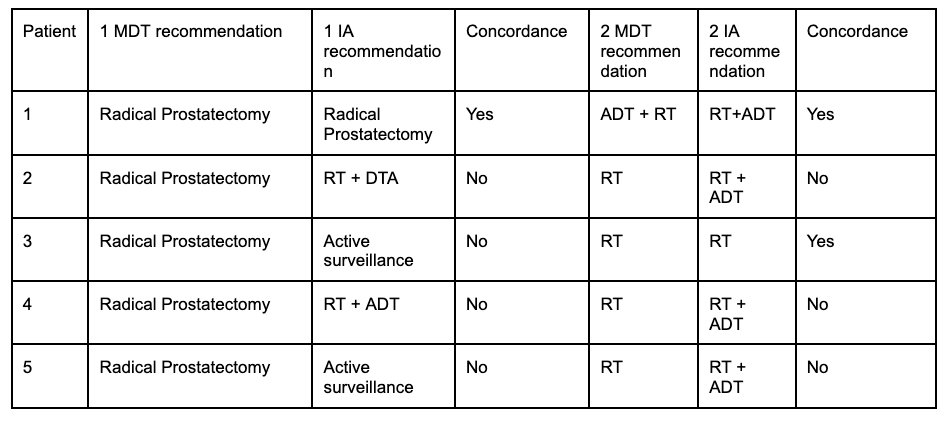
Five patients were identified who underwent multidisciplinary sessions both before and after surgery. Artificial intelligence’s performance was evaluated in comparison with multidisciplinary team recommendations, highlighting both areas of agreement and divergence in clinical decisions. The agreement in decision-making between the multidisciplinary teams and artificial intelligence was analyzed using Cohen's Kappa coefficient, showing minimal agreement for the first decision (0.0) and slight agreement for the second decision (0.12):
Dr. Valdes concluded this presentation discussing whether artificial intelligence can match multidisciplinary expertise in managing high and very high risk prostate cancer with positive surgical margins, with the following take-home points:
- This study highlights the potential of artificial intelligence in prostate cancer management by offering a unique comparison between machine-driven and human decision-making in high and very high-risk localized prostate cancer cases with positive margins after radical prostatectomy
- While artificial intelligence shows promise, specific aspects may require targeted pre-training to enhance its performance
- In complex clinical scenarios, artificial intelligence is prone to errors and cannot currently replace the decision-making expertise of a multidisciplinary team. However, it can streamline administrative tasks and provide clinicians and patients with a clearer perspective on the disease
- As artificial intelligence technology advances, understanding its strengths, limitations, and ethical implications is essential
- In the context of prostate cancer management, artificial intelligence holds substantial promise as a complementary tool, but careful evaluation is needed to ensure it supports, rather than substitutes, expert clinical judgment
Written by: Zachary Klaassen, MD, MSc – Urologic Oncologist, Associate Professor of Urology, Georgia Cancer Center, Wellstar MCG Health, @zklaassen_md on Twitter during the 2025 South Central American Urological Association (AUA) Annual Meeting, Orlando, FL, Wed, Sept 10 – Sat, Sept 13, 2025.