

(UroToday.com) The 2025 South Central AUA annual meeting included a session on bladder cancer, featuring a presentation from Dr. David Hinojosa-Gonzalez discussing novel therapeutic regimens in previously untreated metastatic urothelial carcinoma. Metastatic urothelial carcinoma has historically had few effective therapeutic options.
Recently, immune checkpoint inhibitors were introduced as therapeutic options for cisplatin-ineligible patients; 1 however, direct head-to-head trials comparing these treatments are lacking. To address this gap, this study aimed to compare the performance of immune checkpoint inhibitors as first-line agents for metastatic urothelial carcinoma.
In March 2024, the investigators systematically searched databases PubMed, MEDLINE, Scopus, Web of Science, and Google Scholar for randomized clinical trials comparing the use of immune checkpoint inhibitors or the antibody-drug conjugate enfortumab vedotin in combination with pembrolizumab in patients with previously untreated metastatic urothelial carcinoma that reported overall survival and progression-free survival. Queries included: “bladder cancer,” “urothelial cancer,” “urothelial carcinoma,” “immune checkpoint inhibitors,” “avelumab,” “atezolizumab,” “durvalumab,” “nivolumab,” “pembrolizumab,” and “enfortumab.” Pairwise meta-analysis using Bayesian modeling was used to build a network, and data analysis used both fixed and random effects models.
Six studies with 5,449 patients were included, including 3,255 receiving immune checkpoint inhibitor monotherapy or combination, and 2,194 served as controls. Moreover, a total of 3,006 had PD-L1 positive tumors and 2,362 were PD-L1 negative. Median overall survival ranged from 12.1 to 31.5 months across the studies, with the combination of enfortumab vedotin and pembrolizumab demonstrating the most substantial reduction in the risk of death (HR 0.47, 95% CrI 0.38, 0.58), followed by avelumab monotherapy (HR 0.69, 95% CrI 0.56, 0.86):
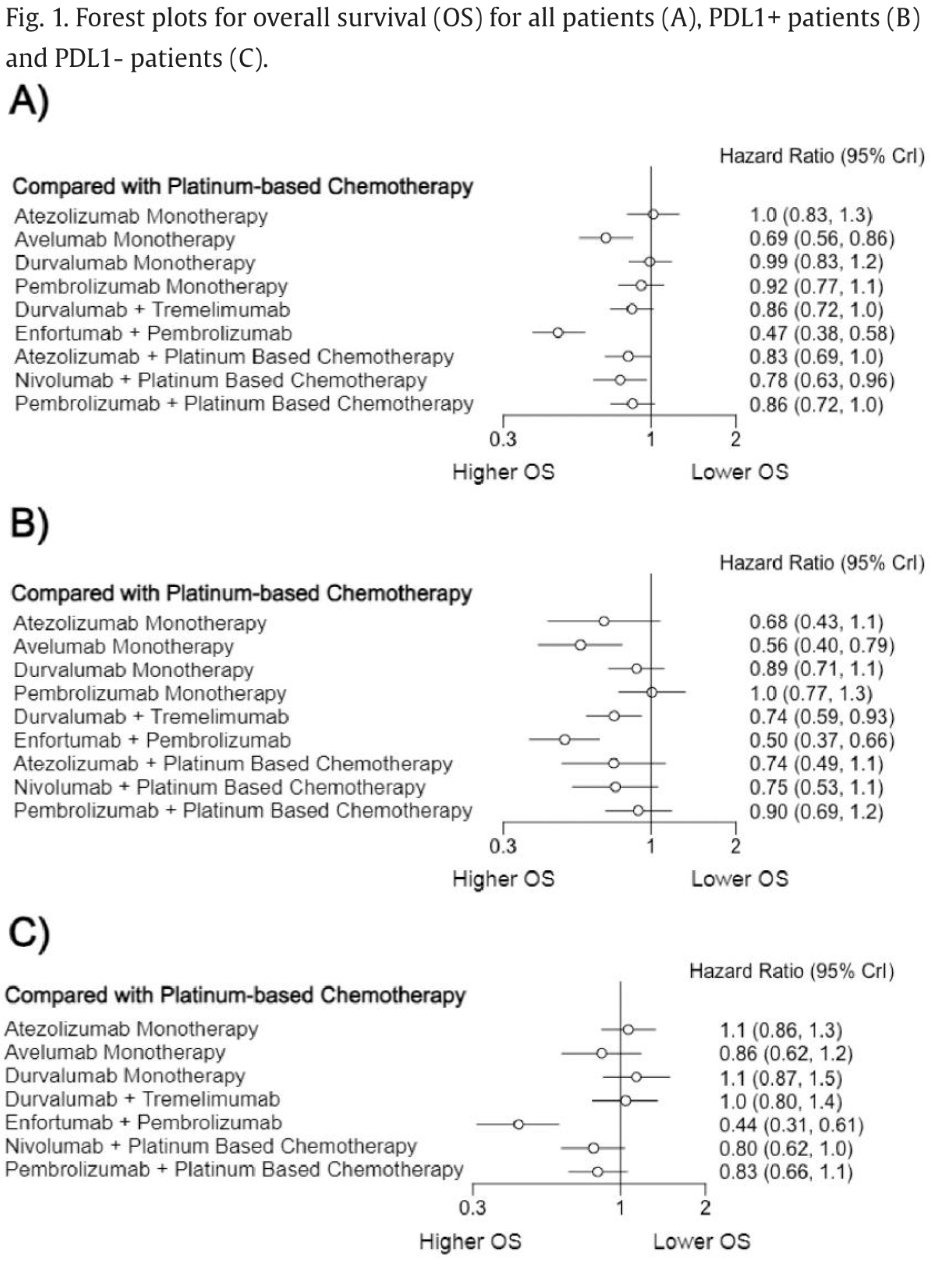
Median progression-free survival ranged from 2.0 to 12.5 months, with combination therapy of enfortumab vedotin and pembrolizumab exhibiting the most significant improvement in progression-free survival with an HR of 0.45 (95% CrI 0.38, 0.54), followed by avelumab monotherapy with an HR of 0.62 (95% CrI 0.52, 0.75).
Dr. Hinojosa-Gonzalez concluded his presentation discussing novel therapeutic regimens in previously untreated metastatic urothelial carcinoma with the following take-home messages:
- The enfortumab vedotin + pembrolizumab combination significantly improved survival, while avelumab showed notable single-agent activity
- These findings provide a valuable framework to guide clinical decision-making and future research of novel combination strategies to enhance anti-tumor immunity in this challenging malignancy
Presented by: David Hinojosa-Gonzalez, MD, Baylor College of Medicine, Houston, TX
Written by: Zachary Klaassen, MD, MSc – Urologic Oncologist, Associate Professor of Urology, Georgia Cancer Center, Wellstar MCG Health, @zklaassen_md on Twitter during the 2025 South Central American Urological Association (AUA) Annual Meeting, Orlando, FL, Wed, Sept 10 – Sat, Sept 13, 2025.
References: