

(UroToday.com) The 2025 South Central AUA annual meeting included a session on bladder cancer, featuring a presentation from Dr. Yair Lotan discussing an assessment of tissue penetration of gemcitabine phosphate metabolites following TAR-200 administration versus standard intravesical instillation in minipigs. Gemcitabine has been used for many years as an intravesical instillation to treat non muscle invasive bladder cancer; however, its short half life (<3 hours) limits tissue exposure. TAR-200 is a novel intravesical targeted releasing system designed to provide local continuous/sustained release of gemcitabine within the bladder, with potentially deep-tissue penetration. The preclinical Penelope study evaluated the penetration of gemcitabine (dFdC) and its active metabolites, diphosphate and triphosphate of dFdC (dFdCDP, dFdCTP), in bladder tissues up to 96 hours after TAR-200 administration or intravesical instillation.
Bladder tissue concentrations of gemcitabine and its active metabolites were measured in 5 minipigs following gemcitabine administration either by intravesical or TAR-200 instillation. Three animals received a 2 hour bolus intravesical instillation of 2 g free base-equivalent of gemcitabine hydrochloride dissolved in saline (40 mg/mL), after which tissue samples were collected from one animal at 2 hours, a second animal at 24 hours (day 1), and a third animal at 96 hours (day 4). The TAR-200 delivery system, containing 225 mg free base-equivalent, was placed into the bladder of two animals, where it remained until tissue collection at 48 hours (day 2) and 96 hours (day 4), respectively:
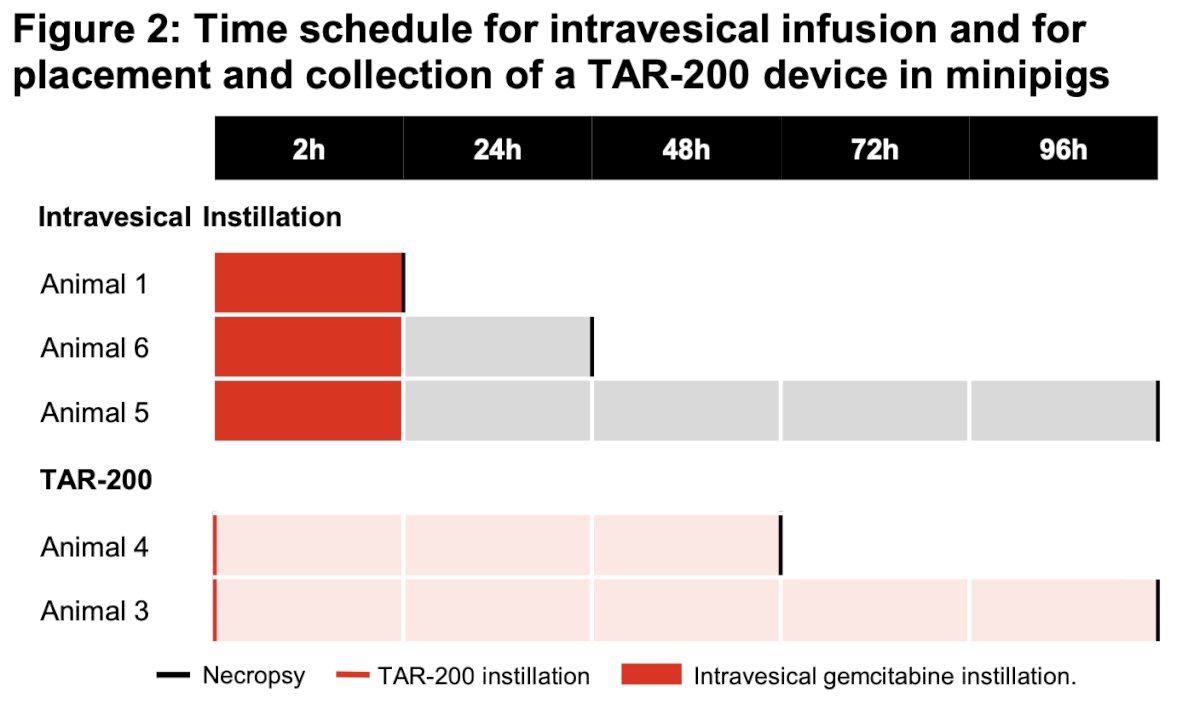
At necropsy, samples of dome, left and right lateral wall, and trigone were collected, and the urothelium with underlying lamina propria were separated from the muscle layer of the urinary bladder. Results are reported as the mean of the four tissue samples collected.
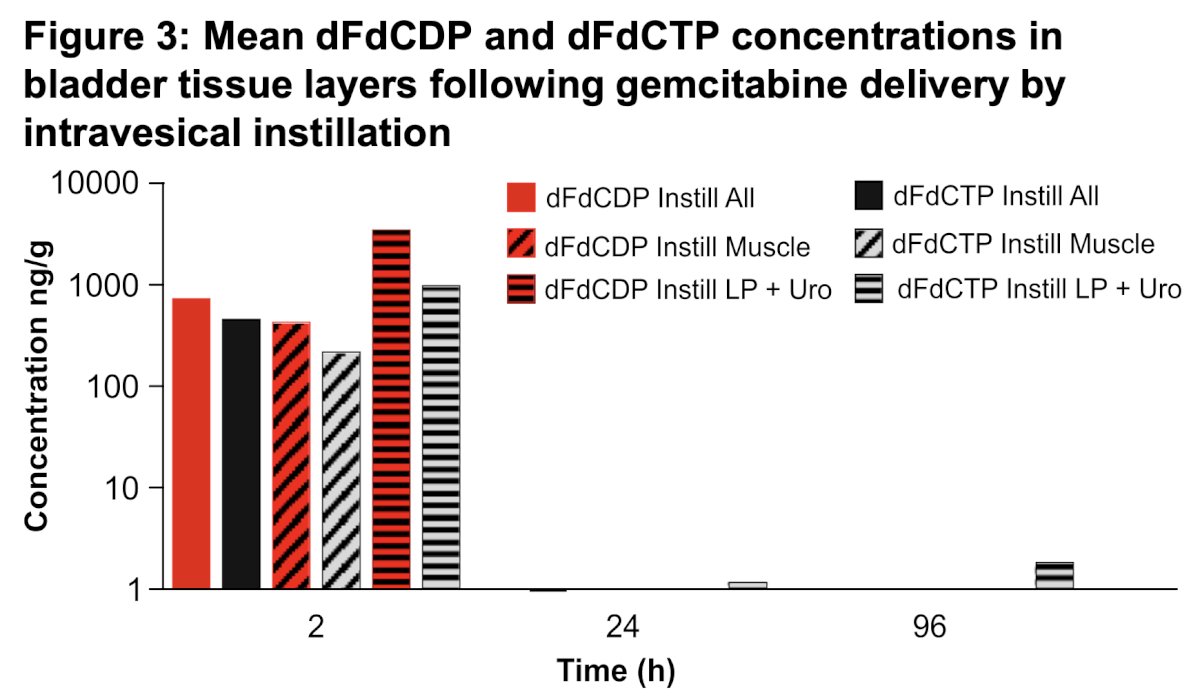
Following intravesical delivery of gemcitabine (2 hours), total bladder tissue concentrations of the active phosphorylated metabolites of gemcitabine were high and were detected in all bladder layers, but were virtually undetectable in tissue samples after 24 hours and 96 hours:
When delivered with the TAR-200 system, gemcitabine active metabolites could be detected in all bladder layers throughout the 48 hour and 96 hour indwelling period. Active metabolite concentrations were higher in the urothelium and lamina propria compared to the muscle, but were sustained in both tissue samples for up to 96 hours. Active metabolite concentrations were lower compared to levels detected following 2 hour gemcitabine instillation. However, concentrations of active metabolites were sustained across bladder tissues up to 96 hours:
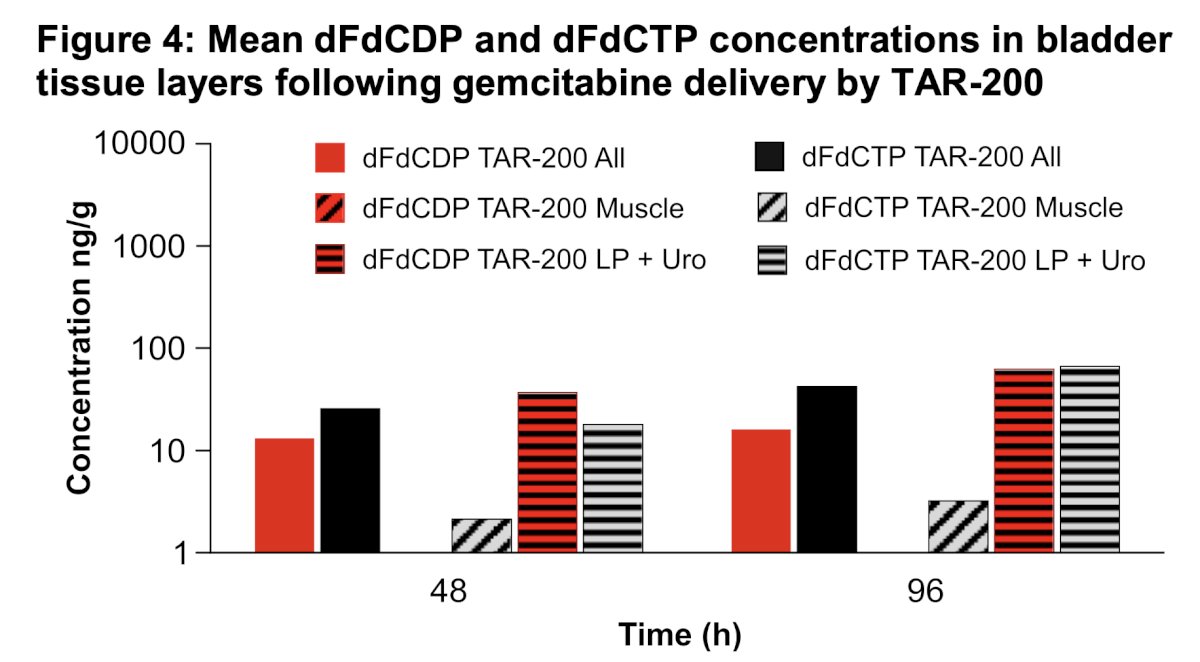
These results confirmed that TAR-200 maintained persistent tissue penetration of active gemcitabine metabolites, particularly in the urothelium and lamina propria, where concentrations were sustained for up to 96 hours post insertion.
Dr. Lotan concluded his presentation discussing an assessment of tissue penetration of gemcitabine phosphate metabolites following TAR-200 administration versus standard intravesical instillation in minipigs with the following take home messages:
- Following administration of gemcitabine using the TAR-200 delivery system, measurable levels of active phosphorylated metabolites were detected in all bladder tissue layers including the urothelium/lamina propria and the muscle at 48 hours and 96 hours
- Comparatively, tissue exposure to gemcitabine delivered through a bolus instillation over a 2 hour indwelling period is limited by its short half-life (<3 hours) with little evidence of gemcitabine active metabolites in bladder tissue by 24 hours
- Results of this study demonstrate that sustained local delivery of gemcitabine to the bladder through the TAR-200 system can deliver active metabolites to all layers of the bladder at least 4 days following TAR-200 placement
Presented by: Yair Lotan, MD, UT Southwestern Medical Center, Dallas, TX
Written by: Zachary Klaassen, MD, MSc – Urologic Oncologist, Associate Professor of Urology, Georgia Cancer Center, Wellstar MCG Health, @zklaassen_md on Twitter during the 2025 South Central American Urological Association (AUA) Annual Meeting, Orlando, FL, Wed, Sept 10 – Sat, Sept 13, 2025.