

(UroToday.com) The 2025 European Society of Medical Oncology (ESMO) Annual Congress held in Berlin, Germany between October 17th and 21st was host to the session Mini oral session: GU tumours, prostate, penile and testis. Dr. Alexandros Papachristofilou presented the abstract Single-dose carboplatin and involved-node radiotherapy for seminoma stage IIA/B: long-term follow-up from the international multicenter phase II trial SAKK 01/10.
Dr. Papachristofilou opened his presentation by outlining the SAKK 01/10 trial, conducted between 2012 and 2018 across 20 centers in Switzerland and Germany, through a collaboration between the Swiss Cancer Institute (formerly SAKK) and the German Testicular Cancer Study Group. This single-arm, phase II therapy optimization trial enrolled 116 patients, most of whom had stage IIB seminoma with larger nodal disease, distinct from the smaller stage II populations enrolled in recent primary RPLND trials.
Patients received one cycle of carboplatin (AUC 7) followed by involved-node radiotherapy (30–36 Gy), precisely targeting only the affected lymph nodes. The goal of this approach was to minimize treatment volume and avoid multiple cycles of systemic chemotherapy while maintaining efficacy and preserving future salvage options. Results for the trial’s primary endpoint, 3-year progression-free survival, were previously presented at ESMO 2021 and published in 2022.1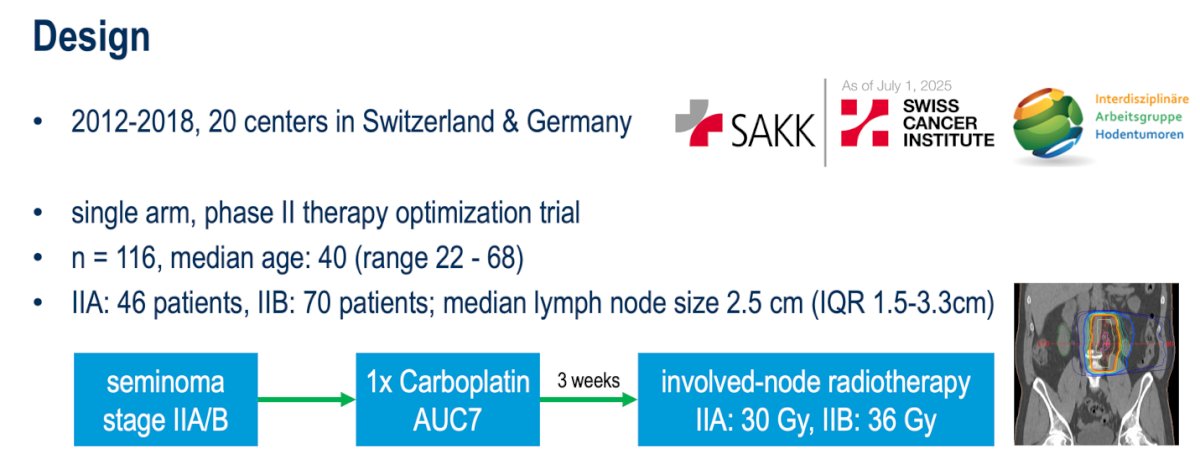
At a median follow-up of 4.5 years, the SAKK 01/10 trial reported a 3-year progression-free survival of 93.7%, including 95.2% for stage IIA and 92.6% for stage IIB disease. More than half of the patients experienced no acute adverse events, and high-grade toxicities were rare, with only mild nausea and fatigue being the most frequent side effects. These outcomes were attributed to the substantial reduction in radiation exposure (almost 75%) achieved through the involved-node radiotherapy technique, which allowed for excellent disease control with minimal treatment-related toxicity.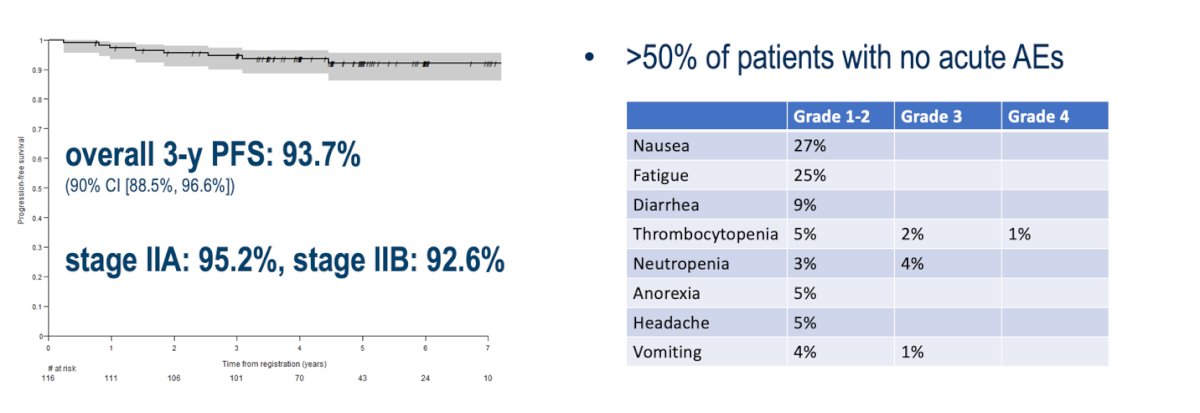
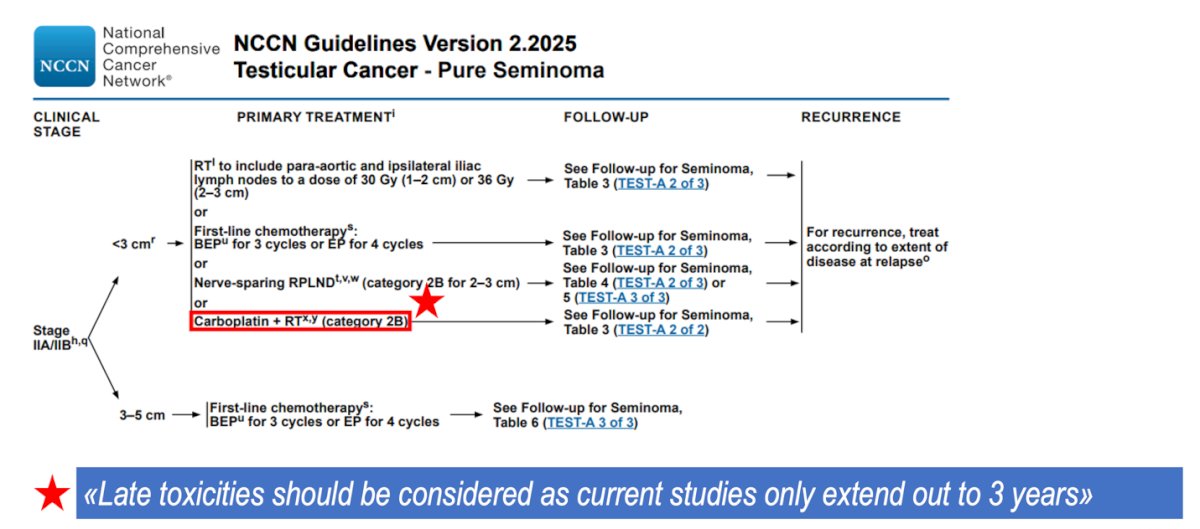
Dr. Papachristofilou highlighted that the findings from SAKK 01/10 have influenced current treatment guidelines. The NCCN recently incorporated this regimen as an alternative option for stage II seminoma in their latest update as illustrated below.2 However, it remains a category 2B recommendation, with the important note that long-term toxicities should be considered, as available data extend only to approximately three years of follow-up.
Dr. Papachristofilou presented the updated long-term outcomes from the SAKK 01/10 trial, now with a median follow-up of 8.1 years. The 10-year progression-free survival reached 92.8% (95% CI, 86.1–96.3%), with ongoing follow-up in 85 patients and no additional progression events observed since the primary analysis reported in 2021. Stage-specific outcomes remained consistent, with 95.2% for stage IIA and 91.3% for stage IIB disease, reinforcing the durability and sustained efficacy of this combined carboplatin and involved-node radiotherapy approach.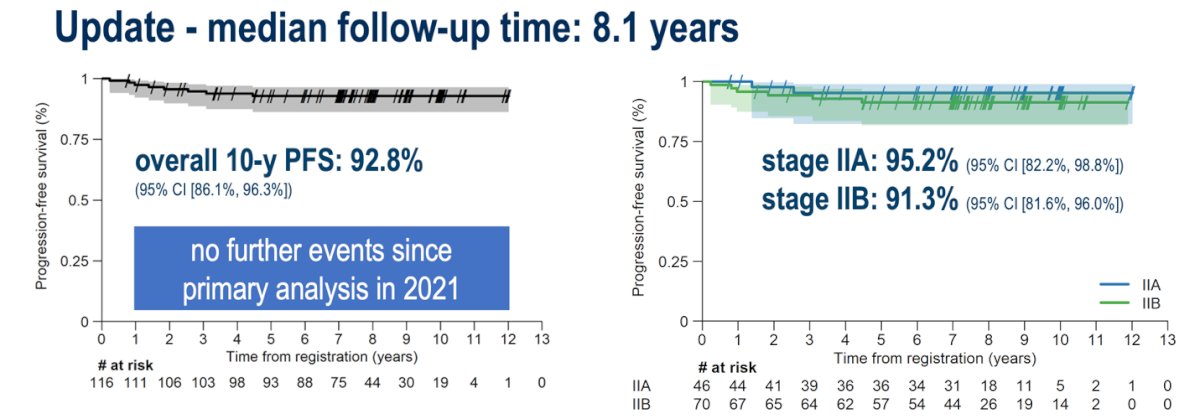
At 10 years, overall survival reached 99.1%, with only one death unrelated to seminoma, translating into a 100% seminoma-specific survival.
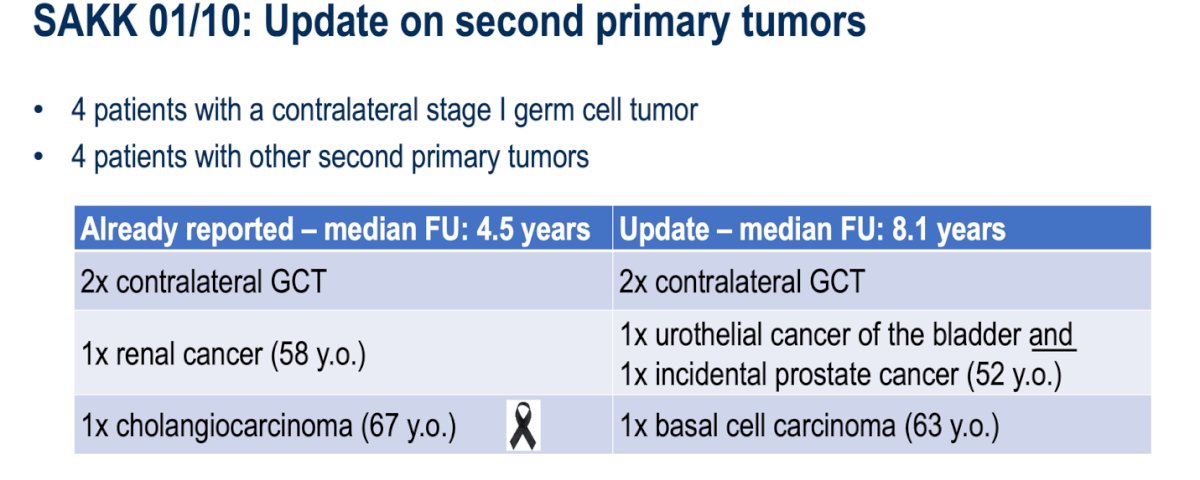
The investigators reported one late adverse event possibly related to treatment, a non-ST-elevation myocardial infarction occurring seven years after therapy in a 53-year-old patient. Four patients developed a contralateral stage I germ cell tumor, all successfully treated with surgery and remaining disease-free. Another four patients were diagnosed with second primary malignancies, including previously reported cases of renal cancer and cholangiocarcinoma who sadly died of this disease, and, in this long-term update, one case each of urothelial bladder cancer with incidental prostate cancer and basal cell carcinoma of the skin. All secondary tumors arose outside the radiotherapy fields, and none were considered treatment-related upon review of the plans, with plausible alternative etiologies such as underlying hepatitis in the patient with cholangiocarcinoma.
Dr. Papachristofilou wrapped up his presentation with the following conclusions:
- Extended follow-up from the SAKK 01/10 trial confirms the durable efficacy of single-dose carboplatin plus involved-node radiotherapy for stage IIA/B seminoma, with a 10-year PFS of 92.8% and no late recurrences.
- The regimen demonstrated minimal toxicity, including long-term safety.
- Findings counter previous concerns regarding an increased risk of secondary malignancies or late toxicities associated with combined treatment.
- Single-dose carboplatin with involved-node radiotherapy should be considered a new standard of care for stage IIA/B seminoma, balancing efficacy, low acute toxicity, and sustained tolerability.
Presented by: Alexandros Papachristofilou, MD, Department of Radiation Oncology, University Hospital of Basel, Basel, Switzerland
Written by: Julian Chavarriaga, MD – Urologic Oncologist at Cancer Treatment and Research Center (CTIC) via Society of Urologic Oncology (SUO) Fellow at The University of Toronto. @chavarriagaj on Twitter during the 2025 European Society of Medical Oncology (ESMO) Annual Congress held in Berlin, Germany, between October 17th and 21st.
Reference:
- Papachristofilou A, Bedke J, Hayoz S, Schratzenstaller U, Pless M, Hentrich M, Krege S, Lorch A, Aebersold DM, Putora PM, Berthold DR, Zihler D, Zengerling F, Dieing A, Mueller AC, Schaer C, Biaggi C, Gillessen S, Cathomas R. Single-dose carboplatin followed by involved-node radiotherapy for stage IIA and stage IIB seminoma (SAKK 01/10): a single-arm, multicentre, phase 2 trial. Lancet Oncol. 2022 Nov;23(11):1441-1450. doi: 10.1016/S1470-2045(22)00564-2. Epub 2022 Oct 10. PMID: 36228644.
- Gilligan T, Vaughn DJ, Hanna N, Albany C, Albers P, Barlow L, et al. NCCN Guidelines® Insights: Testicular Cancer, Version 2.2025. J Natl Compr Canc Netw. 2025;23(4):e250018. doi:10.6004/jnccn.2025.0018.