

(UroToday.com) The 2025 ESMO annual meeting featured a prostate cancer session and a presentation by Martin Boegemann, MD, discussing estimation of median overall survival to inform the ESMO-MCBS scores in non-metastatic castration-resistant prostate cancer (nmCRPC) using the ARAMIS study.1 Assessing the clinical benefit of anticancer treatments is essential for guiding therapeutic decisions. As such, the ESMO-MCBS evaluates clinical benefit by assigning scores based on predefined criteria, with overall survival as a key factor. Overall survival is a relevant measure for patients and healthcare professionals that can be used to guide treatment decisions. In clinical trials where overall survival is not achieved, validated extrapolation can be used to calculate an estimated median overall survival.
In the ARAMIS trial, which evaluated darolutamide with ADT for nmCRPC, the absence of median overall survival data resulted in a score one point lower than that of other androgen receptor inhibitors trials, such as SPARTAN2 and PROSPER,3 in MCBS Version 1.1. While median overall survival was observed in the SPARTAN and PROSPER trials, it was not observed in the ARAMIS trial due to its comparatively shorter follow-up duration. This analysis presented at ESMO 2025 aimed to estimate the median overall survival for both arms of the ARAMIS trial and compare it with SPARTAN and PROSPER.
To estimate median overall survival, the investigators used a parametric survival model based on two criteria: model goodness of fit and a review of the ARAMIS evaluation by the National Institute for Health and Care Excellence (NICE). Following NICE recommendations, they applied a generalized gamma distribution for the darolutamide + ADT arm and a Weibull distribution for the ADT arm. The study designs of ARAMIS, SPARTAN, and PROSPER are highlighted in the following table:
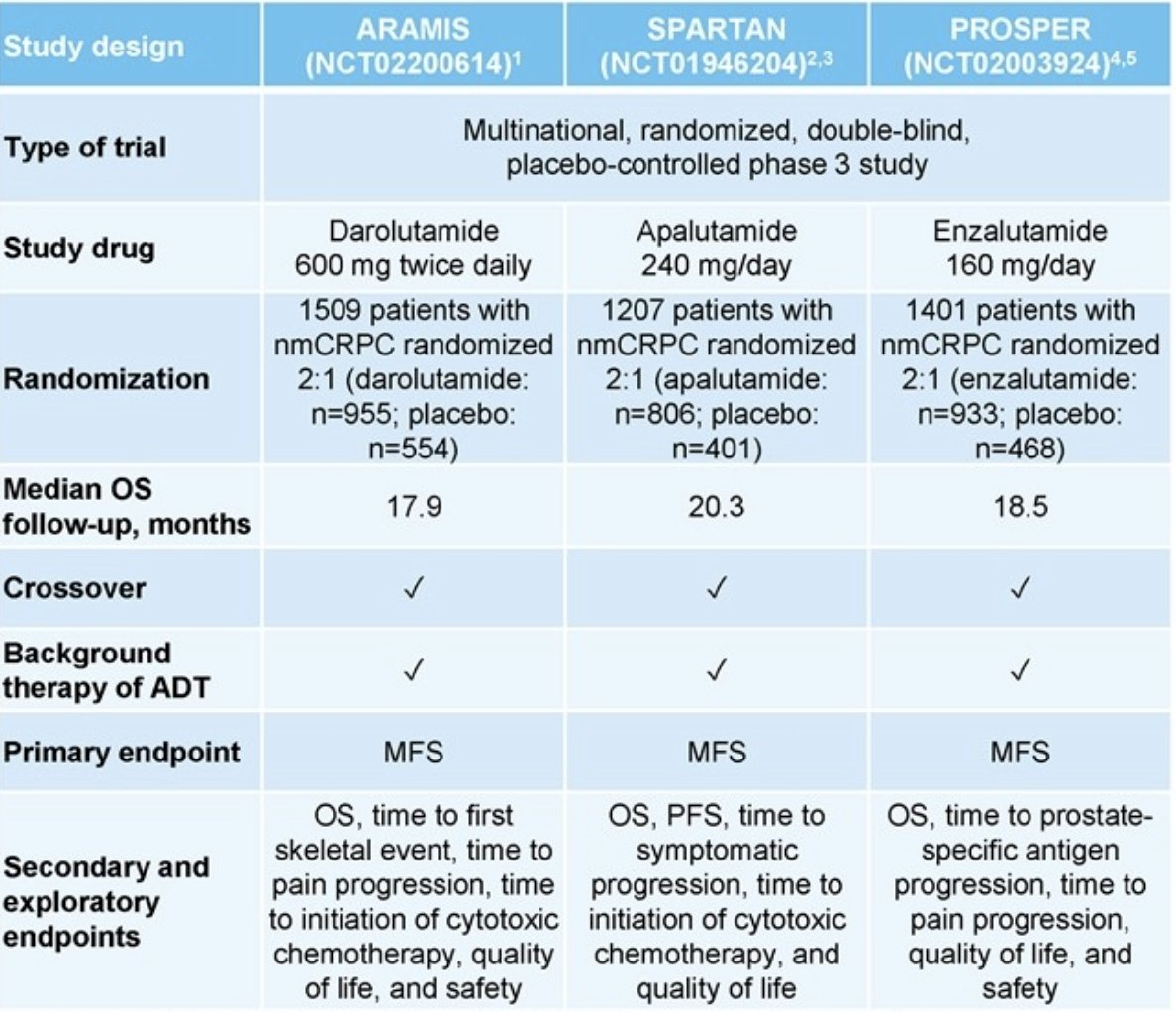
In general, ARAMIS, SPARTIN, and PROSPER had similar inclusion criteria, however both SPARTAN and PROSPER excluded patients with a seizure history, while ARAMIS did not. Baseline characteristics are shown in the table below:
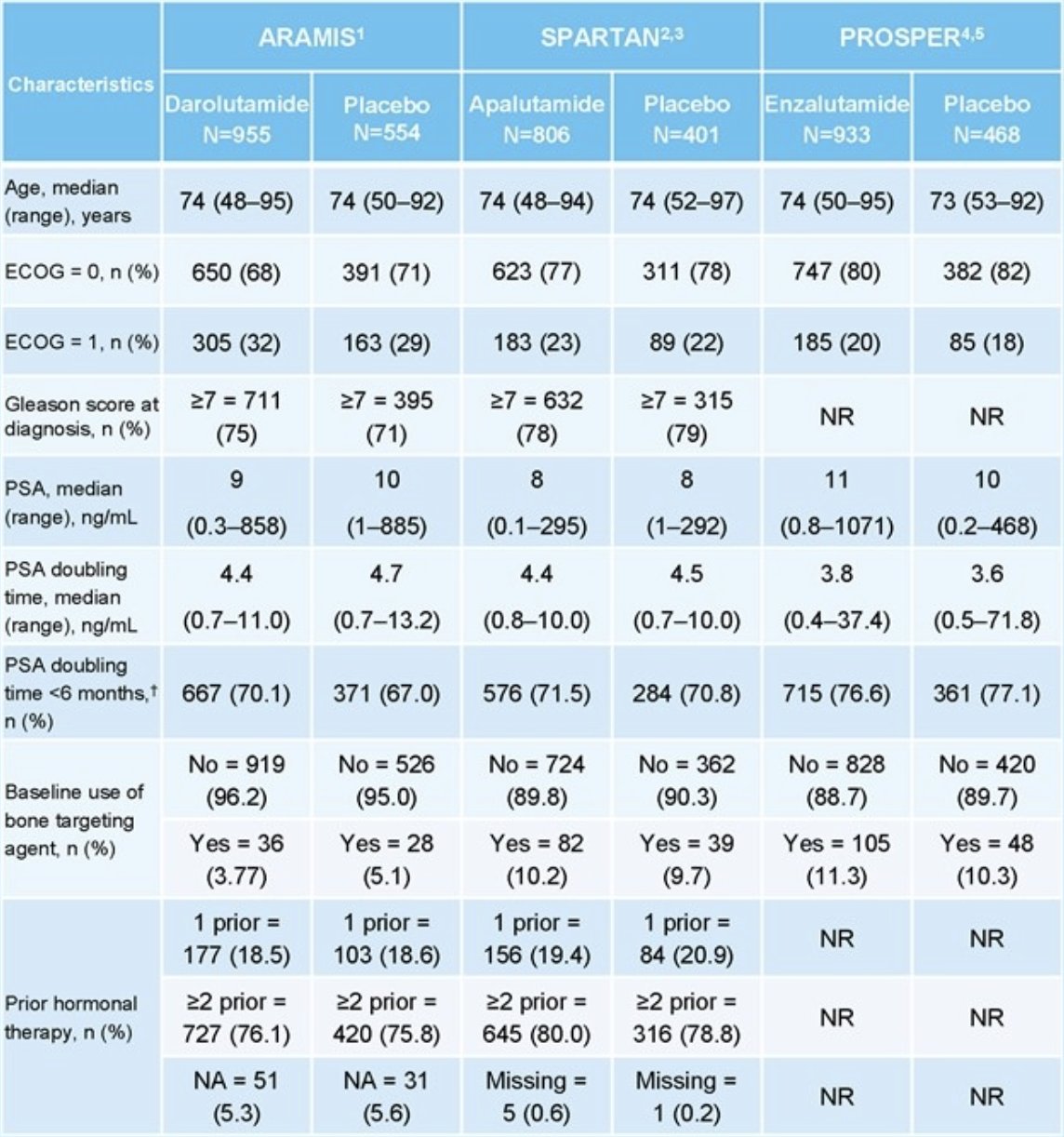
Several baseline characteristics differed between ARAMIS and SPARTAN, including race, region, classification of nodal disease, serum testosterone level, and tumor stage at diagnosis. Several baseline characteristics also differed between ARAMIS and PROSPER, including region, PSA doubling time, ECOG performance status, use of bone targeting agent, and disease status.
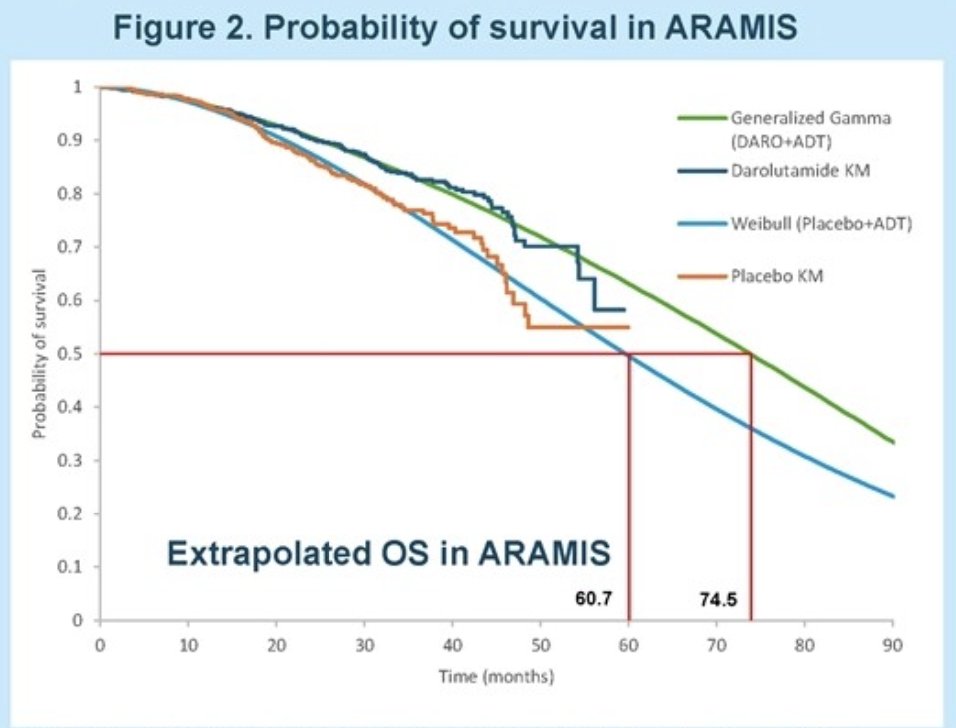
At a data cut-off (November 15, 2019), there had been 106 overall survival events in the placebo arm and 148 overall survival events in the darolutamide arm of ARAMIS; median survival had not been reached at that time. Median overall survival follow-up was 17.9 months in ARAMIS, 20.3 months in SPARTAN, and 18.5 months in PROSPER. The Kaplan-Meier curves for darolutamide and placebo were similar between 0 and ~18 months, whereas after 18 months, the placebo arm showed a greater rate of deaths. The difference between the curves continued until ~55 months. However, at 55 months there were very few patients still at risk in the placebo arm. The estimated median overall survival for patients receiving darolutamide + ADT in the ARAMIS trial was 74.5 months:
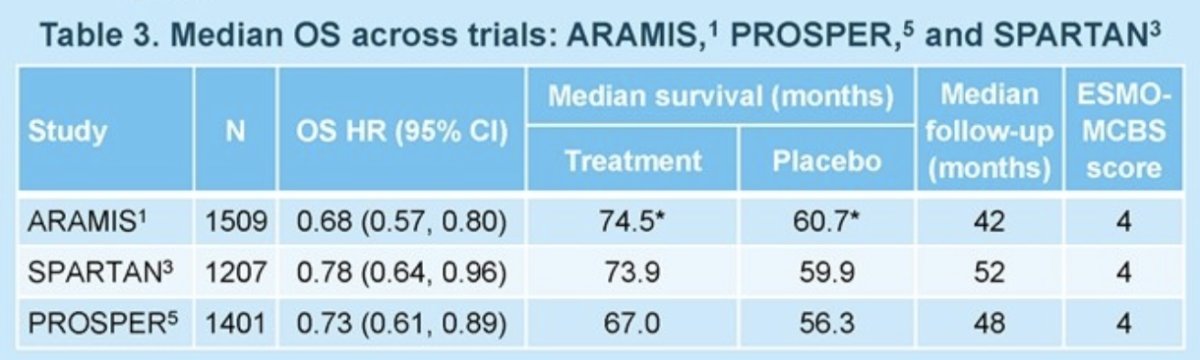
This compares favorably with the observed median overall survival of 73.9 months from the apalutamide + ADT arm of the SPARTAN trial and 67.0 months from the enzalutamide + ADT arm of the PROSPER trial. The Weibull distribution estimated the median overall survival for the ADT arm of the ARAMIS study to be 60.7 months, compared to 59.9 months in SPARTAN, and 56.3 months in PROSPER.
Dr. Boegemann concluded his presentation discussing estimation of median overall survival to inform the ESMO-MCBS scores in nmCRPC using the ARAMIS study with the following take home points:
- Relative to placebo, darolutamide combined with ADT extended the predicted median overall survival by 14 months
- The predicted median overall survival for darolutamide + ADT was longer than apalutamide + ADT, as well as enzalutamide + ADT
- Based on predicted parametric survival estimates from new data gathered over an additional 18 months, ARAMIS would be graded 4 on the ESMO-MCBS (substantial benefit)
- This finding reinforces the potential of darolutamide to positively impact overall survival outcomes in patients with nmCRPC
Presented by: Martin Boegemann, MD, University of Muenster Medical Center, Muenster, Germany
Written by: Zachary Klaassen, MD, MSc – Urologic Oncologist, Associate Professor of Urology, Georgia Cancer Center, Wellstar MCG Health, @zklaassen_md on Twitter during the 2025 European Society for Medical Oncology (ESMO) Annual Congress, Berlin, Germany, October 17–21, 2025
References:
- Fizazi K, Shore N, Tammela TL, et al. Darolutamide in nonmetastatic castration-resistant prostate cancer. N Engl J Med. 2019;380(13):1235-1246.
- Smith MR, Saad F, Chowdhury S, et al. Apalutamide treatment and metastasis-free survival in prostate cancer. N Engl J Med 2018;378(15):1408-1418.
- Hussain M, Fizazi K, Saad F, et al. Enzalutamide in men with nonmetastatic, castration-resistant prostate cancer. N Engl J Med. 2018 Jun 28;378(26):2465-2474.