

(UroToday.com) The 2025 European Society of Medical Oncology (ESMO) Annual Congress held in Berlin, Germany, was host to the Poster presentation session. Dr. Kim J. Van der Velden presented the poster De-escalation of therapy with androgen receptor pathway inhibitors or docetaxel by using PSMA PET/CT in metastatic castration-resistant prostate cancer patients: study results from a Dutch cohort.
Dr. Vander Velden noted that the aim of this study was to explore the potential impact of integrating [¹⁸F]PSMA-1007 PET/CT at predefined time points on treatment decision-making and to compare these findings with standard-of-care (SoC) imaging in patients with mCRPC.
This single-center, observational study included mCRPC patients receiving first- or second-line docetaxel, abiraterone, or enzalutamide at Leiden University Medical Centre. Patients underwent [¹⁸F]PSMA-1007 PET/CT for response assessment, 3 weeks after completing chemotherapy or 3 months after starting ARPI therapy.
Responses (progressive vs. non-progressive) were evaluated per established consensus statements for [¹⁸F]PSMA-1007 PET/CT criteria. The SoC comparison group was derived from the CAPRI-3 prostate cancer registry, where imaging followed physician discretion using conventional modalities. Key outcomes included time to therapy discontinuation, overall survival, and reasons for treatment discontinuation.
A descriptive swimmer plot analysis (figure below) was conducted for the single-hospital cohort (n=60) to evaluate time to therapy discontinuation, including ongoing (censored) patients at cutoff. Therapy discontinuation was most frequently driven by [¹⁸F]PSMA-1007 PET/CT findings (n=29), reflecting its influence on treatment decisions. Additional reasons included therapy-related toxicity (n=7) and completion of planned treatment cycles (n=17), while 7 patients remained on therapy at data cutoff.
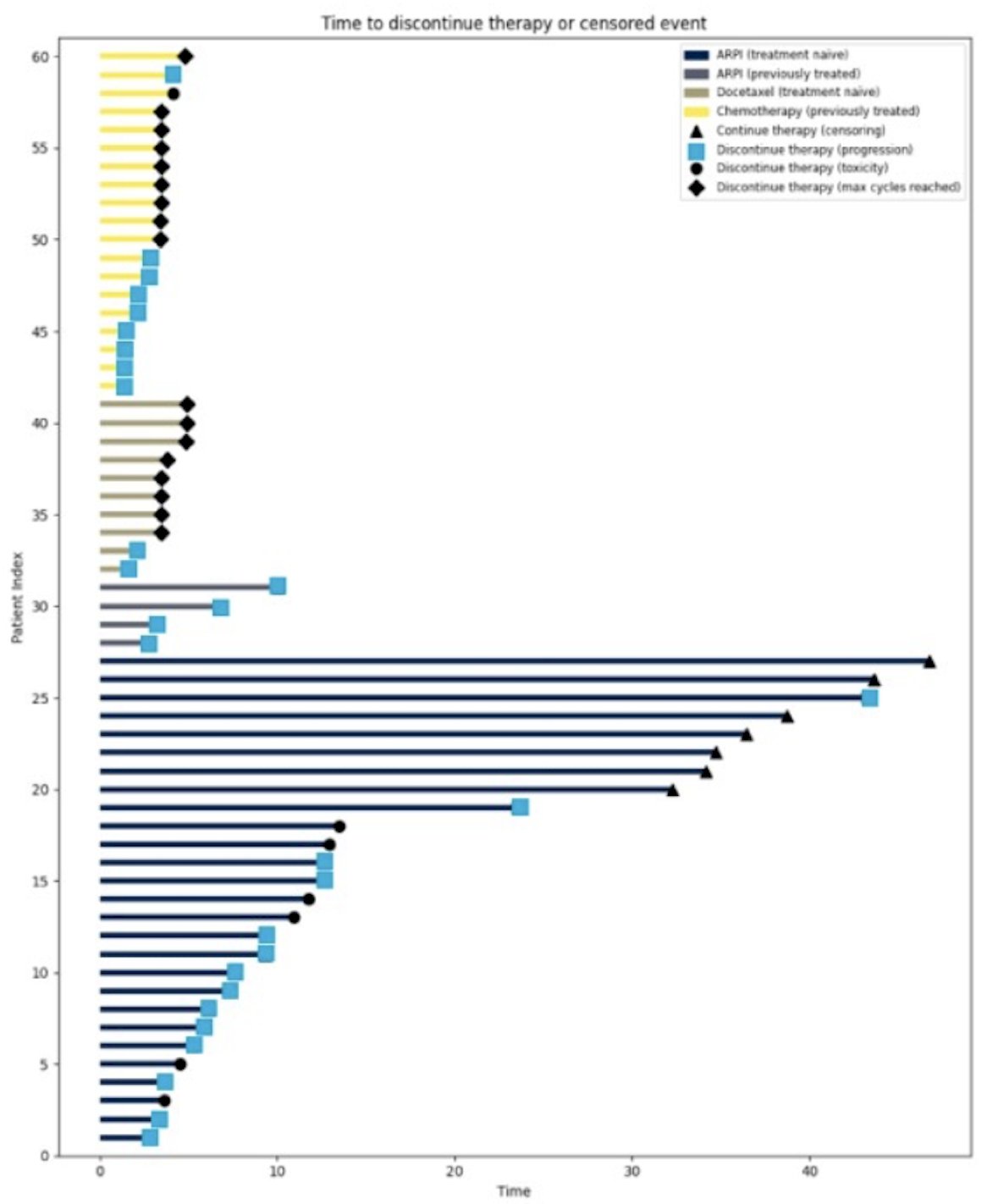
These results suggest that [¹⁸F]PSMA-1007 PET/CT may help minimize unnecessary toxicity and enable earlier transitions to more effective therapies. Ongoing integration of registry data will strengthen the comparative assessment of [¹⁸F]PSMA-1007 PET/CT versus standard-of-care imaging.
Limitations of the study included a limited follow-up period and the presence of censored events, which affect the robustness of time-to-event analyses and complicate interpretation of results. Additionally, factors related to follow-up imaging such as the timing of scans, reasons for imaging, response criteria, and modality were not standardized by protocol. The small sample size (n=60), heterogeneity in treatment regimens, and single-center observational design further limit the generalizability of the findings and should be considered when applying the results to broader clinical practice.
The therapeutic landscape of mCRPC is becoming increasingly complex with the introduction of targeted agents such as radium-223 and ¹⁷⁷Lu-PSMA-617, as well as evolving sequencing and combination strategies. Evaluating the clinical impact of [¹⁸F]PSMA-1007 PET/CT in guiding these treatment decisions remains challenging, as comparative imaging studies are rarely integrated into phase 3 trial designs. While randomized trials provide standardized and unbiased data, they are limited by long timelines, strict inclusion criteria, and high resource demands—factors that restrict their ability to fully represent real-world patient populations.
Lastly, Dr Van der Velden emphasized that clinical registries, such as CAPRI-3, offer a valuable complement by capturing real-world evidence across broader and more diverse populations over extended timeframes. However, current registries often lack structured imaging data, standardized response criteria, and detailed records on therapy adjustments. Enhancing these datasets with dedicated fields for imaging modality, tracer type, scan timing, and therapy monitoring would improve understanding of imaging-guided clinical decisions. As mCRPC treatment strategies continue to evolve toward multimodal and biomarker-driven approaches, adaptable and comprehensive registries will be key to bridging the gap between controlled trial evidence and real-world practice, enabling more informed and dynamic patient management.
Presented by: Kim J. Van der Velden, BSc, PhDc, PhD Candidate Urology and Master Student, Nijmegen, Netherlands
Written by: Julian Chavarriaga, MD – Urologic Oncologist at Cancer Treatment and Research Center (CTIC) via Society of Urologic Oncology (SUO) Fellow at The University of Toronto. @chavarriagaj on Twitter during the 2025 European Society for Medical Oncology (ESMO) Annual Congress, Berlin, Germany, October 17–21, 2025