

(UroToday.com) The 2025 European Society of Medical Oncology (ESMO) Annual Congress held in Berlin, Germany, was host to the Poster presentation session. Dr. Aaron Holmes presented the poster Long-term adverse events (AEs) in PSMA targeted radionuclide therapy (TRT) for castration-resistant prostate cancer (CRPC).
Dr. Holmes began by noting that targeted radionuclide therapy (TRT) has become an established standard of care in CRPC. While short-term toxicities associated with PSMA-TRT such as myelosuppression, xerostomia, fatigue, nausea, and pain are well recognized, data on long-term adverse events remain limited. The objective of this study was to systematically analyze adverse events of special interest (AESIs) related to PSMA-TRT across multiple prospective clinical trials.
The study included patients with CRPC either metastatic or non-metastatic who had received any form of PSMA-targeted radionuclide therapy as part of a prospective clinical trial between 2001 and 2023, with a minimum follow-up of 18 months post-enrollment. AESIs were defined as elevations in creatinine, AST/ALT, or bilirubin, as well as occurrences of neutropenia, thrombocytopenia, anemia, or new primary malignancies. All AESIs were assessed according to CTCAE v5 at the last follow-up.
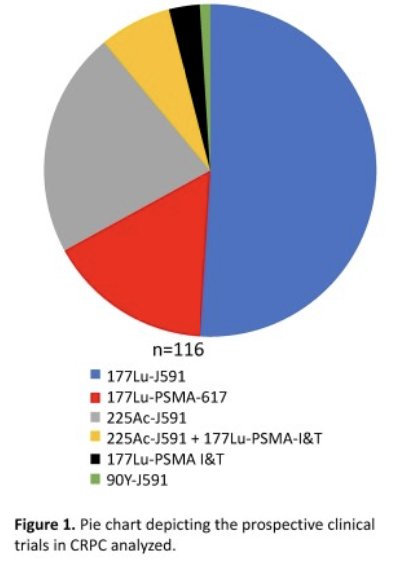
Dr. Holmes presented data from 116 patients enrolled across 11 prospective clinical trials conducted between 2001 and 2023, with a median follow-up of 35 months (range 18–189). The majority received 177Lu-J591, followed by 177Lu-PSMA-617 and 225Ac-based therapies. Most patients had undergone prior systemic treatments, including chemotherapy (53%), AR pathway inhibitors (44%), and external beam radiation (27%). After PSMA-targeted therapy, 52% received subsequent chemotherapy, 12% additional PSMA-TRT, and 12% immunotherapy.
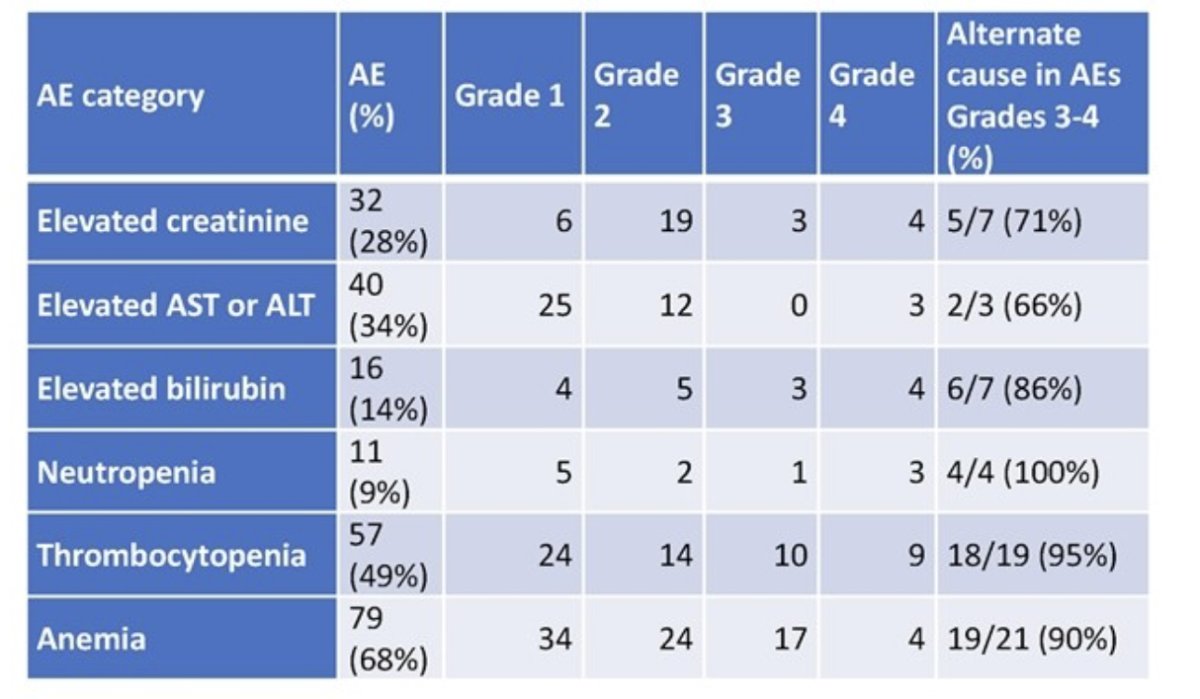
Notably, as outlined in the table, hematologic and biochemical adverse events were common but largely low grade. Anemia (68%) and thrombocytopenia (49%) were the most frequent, while elevated AST/ALT (34%) and creatinine (28%) were also observed. However, most grade 3–4 events were attributed to alternate causes rather than PSMA-targeted therapy itself, suggesting that long-term toxicities may not be directly treatment-related.
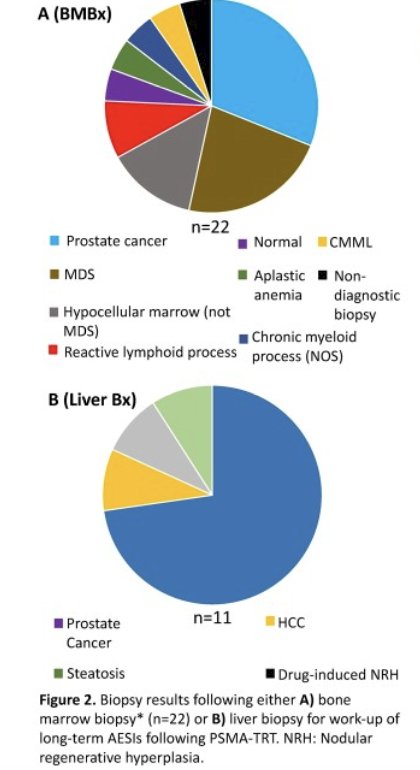
Furthermore, biopsy results provided additional insight into the etiology of long-term adverse events. Among 22 bone marrow biopsies performed, findings included myelodysplastic syndrome (MDS) in several cases, along with instances of aplastic anemia, chronic myeloid processes, and hypocellular marrow. Similarly, in 11 liver biopsies, most abnormalities were attributed to either drug-induced nodular regenerative hyperplasia (NRH) or hepatic steatosis rather than direct PSMA-TRT toxicity, supporting the notion that long-term adverse effects may often reflect multifactorial causes
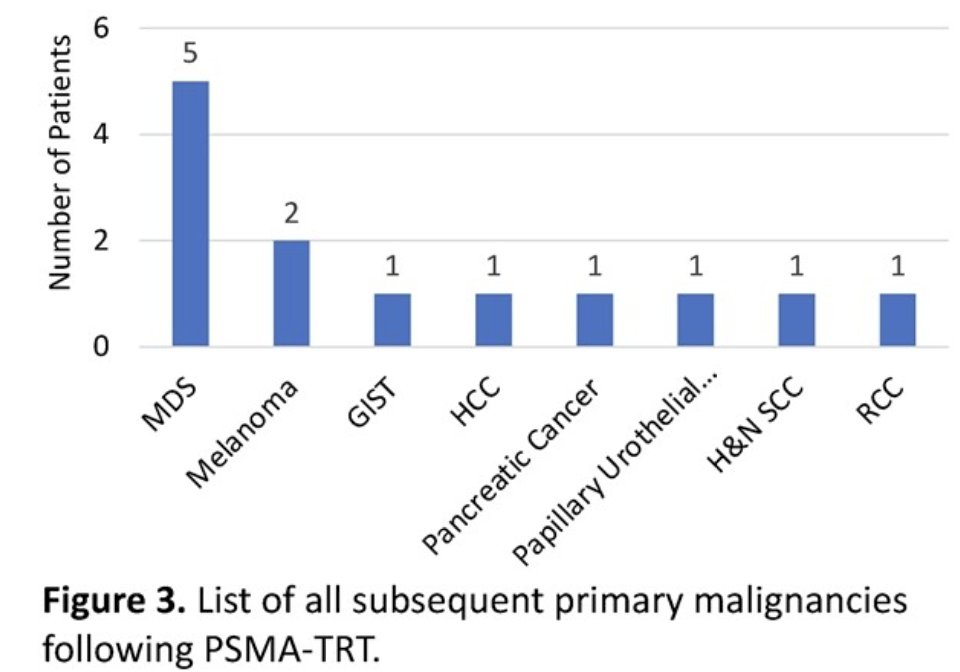
Lastly, Dr. Holmes presented data on subsequent primary malignancies observed after PSMA-targeted radionuclide therapy. Among treated patients, myelodysplastic syndrome (MDS) was the most frequently reported (n=5), followed by melanoma (n=2), and isolated cases of GIST, hepatocellular carcinoma, pancreatic cancer, papillary urothelial carcinoma, head and neck squamous cell carcinoma, and renal cell carcinoma. While causality remains uncertain, these findings highlight the importance of continued long-term monitoring in patients receiving PSMA-TRT.
Dr. Holmes concluded the presentation with the following key findings.
- Only 6% of patients experienced grade 3–4 adverse events considered attributable to PSMA-targeted radionuclide therapy.
- While subsequent primary malignancies such as MDS and renal, liver, or marrow toxicities may occur, they remain uncommon.
- Overall, long-term safety data support PSMA-TRT as a well-tolerated treatment option, though continued vigilance and long-term follow-up are warranted.
Presented by: Aaron Holmes, MD, Instructor at Weill Cornell Medicine in the Department of Medicine and a Research Fellow in the Department of Hematology/Oncology in the Division of Genitourinary Oncology. New York, United States of America.
Written by: Julian Chavarriaga, MD – Urologic Oncologist at Cancer Treatment and Research Center (CTIC) via Society of Urologic Oncology (SUO) Fellow at The University of Toronto. @chavarriagaj on Twitter during the 2025 European Society for Medical Oncology (ESMO) Annual Congress, Berlin, Germany, October 17–21, 2025