

(UroToday.com) The 2025 European Society for Medical Oncology (ESMO) Annual Congress held in Berlin, Germany, was host to a prostate cancer poster session. Dr. Philipp Mandel presented results from the ARON-3 study evaluating doublet versus triplet therapy in high volume metastatic hormone-sensitive prostate cancer (mHSPC) patients with bone metastases.
While the addition of an androgen receptor pathway inhibitor (ARPI; darolutamide or abiraterone acetate) to a doublet regimen of ADT + docetaxel has proven overall survival benefits in mHSPC patients,1,2 it remains unknown whether the addition of docetaxel to a doublet regimen of ADT + an ARPI is associated with a significant survival benefit.
In this study, Dr. Mandel and colleagues utilized the multicentric, international ARON-3 database to identify high-volume mHSPC patients with bone metastases undergoing doublet (ADT + ARPI) or triplet therapy (ADT + ARPI + docetaxel). Patients were stratified by the number of bone metastases (≤10 vs. >10). The study endpoints were:
- Time-to-treatment failure (TTF)
- PSA response
- Overall survival (OS)
The treatment groups were balanced using propensity score matching.
Overall, 841 patients were included, with 75% and 25% treated with doublet and triplet therapy, respectively. At 12 weeks following treatment initiation, patients undergoing triplet therapy had a higher reduction in opioid use and improvement in ECOG performance status.
The median OS was 63 months for ADT + abiraterone, but was not reached for ADT + apalutamide, ADT + enzalutamide, and ADT + docetaxel + darolutamide.
After adjustment for differences in tumor characteristics on multivariable analyses, both TTF (HR: 0.44, p=0.002) and OS (HR: 0.50, p=0.048) were significantly longer with triplet therapy, compared to doublet therapy, in patients with >10 bone metastases. A similar pattern was observed in patients with visceral metastases.
However, for patients with ≤10 bone metastases, there were no significant differences in TTF or OS with doublet or triplet therapy regimens.

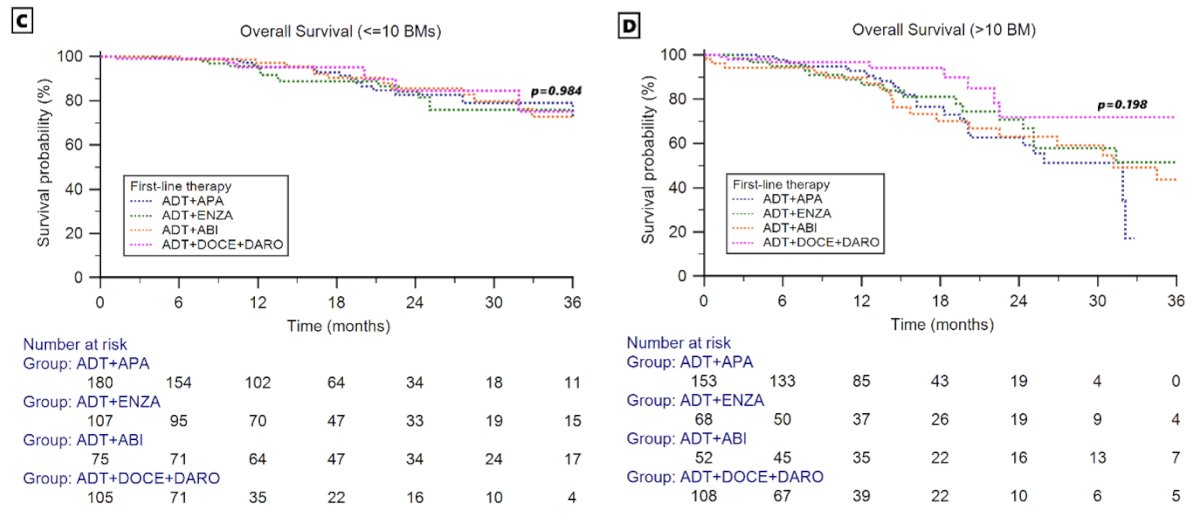
Dr. Mandel concluded that triplet therapy, compared to doublet regimens, is associated with superior oncologic outcomes in mHSPC patients with >10 bone metastases and/or visceral metastases.
Presented by: Philipp Mandel, MD, Goethe University Frankfurt, University Hospital, Department of Urology, Frankfurt am Main, Germany
Written by: Rashid K. Sayyid, MD, MSc, Assistant Professor, Urologic Oncologist, Department of Urology at The University of Arizona and Banner University Medical Center – Tucson, AZ, @rksayyid on X during the 2025 European Society for Medical Oncology (ESMO) Annual Congress, Berlin, Germany, October 17–21, 2025
References:
- Smith MR, Hussain M, Saad F, et al. Darolutamide and Survival in Metastatic, Hormone-Sensitive Prostate Cancer. N Engl J Med. 2022; 386(12):1132-1142.
- Fizazi K, Foulon S, Carles J, Roubaud G, et al. Abiraterone plus prednisone added to androgen deprivation therapy and docetaxel in de novo metastatic castration-sensitive prostate cancer (PEACE-1): A multicentre, open-label, randomized, phase 3 study with a 2 x 2 factorial design. Lancet. 2022; 399(10336):1695-1707.