

(UroToday.com) The 2025 European Society of Medical Oncology (ESMO) Annual Congress held in Berlin, Germany between October 17th and 21st was host to the session Mini oral session: GU tumours, prostate, penile and testis. Dr. Arun Azad presented the First interim efficacy analysis of the Phase 1/2 PETRANHA trial of saruparib + androgen receptor pathway inhibitors (ARPI) in patients (pts) with metastatic prostate cancer.
Dr. Azad opened by explaining that phase 3 trials combining PARP inhibitors such as olaparib, talazoparib, or niraparib with androgen receptor pathway inhibitors (abiraterone acetate or enzalutamide) have shown meaningful improvements in radiographic progression-free survival in men with metastatic castration-resistant prostate cancer, regardless of HRR mutation status, and in mCSPC with HRRm.1-3 Saruparib (AZD5305) is a next-generation, PARP1-selective inhibitor with preclinical data indicating greater target engagement, efficacy, and safety compared with earlier nonselective agents.4
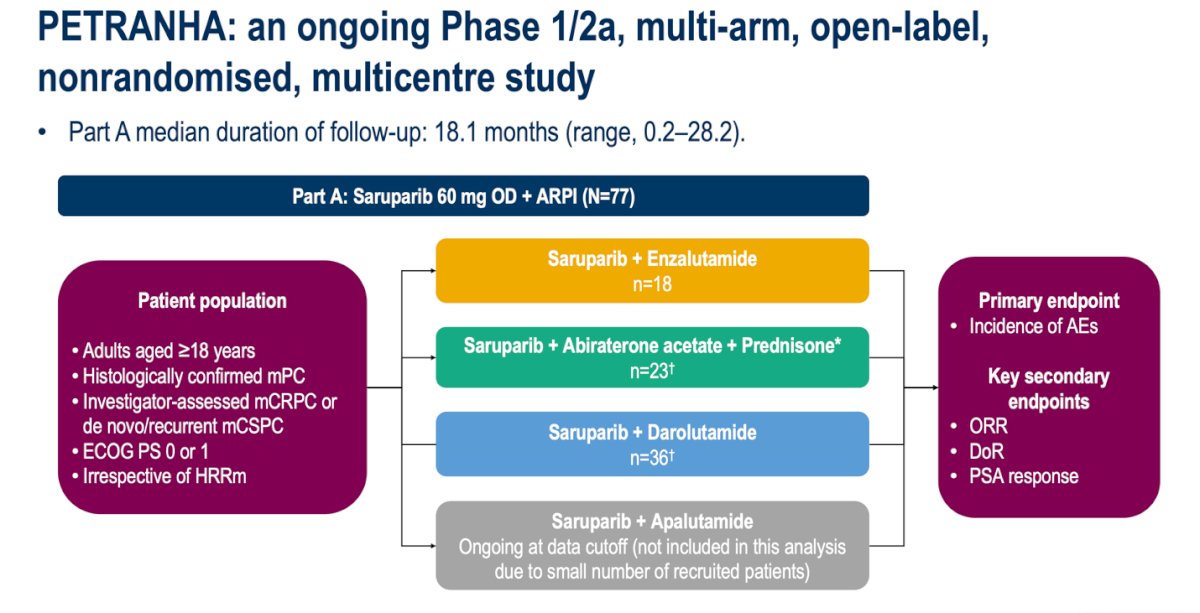
Dr Azad presented updated safety and interim efficacy results from Part A of the phase 1/2a PETRANHA study (NCT05367440). A multi-arm, open-label, nonrandomized, multicenter study evaluating saruparib in combination with different ARPIs. Part A included 77 patients receiving saruparib 60 mg once daily alongside enzalutamide (n=18), abiraterone acetate plus prednisone (n=23), or darolutamide (n=36). The apalutamide arm remains ongoing and was not included in the current analysis due to limited enrollment. Eligible patients were adults with histologically confirmed metastatic prostate cancer either mCRPC or de novo/recurrent mCSPC with ECOG PS 0–1 and irrespective of HRR mutation status. At a median follow-up of 18.1 months (range, 0.2–28.2), the study’s primary endpoint was the incidence of adverse events, while key secondary endpoints included objective response rate, duration of response, and PSA response.
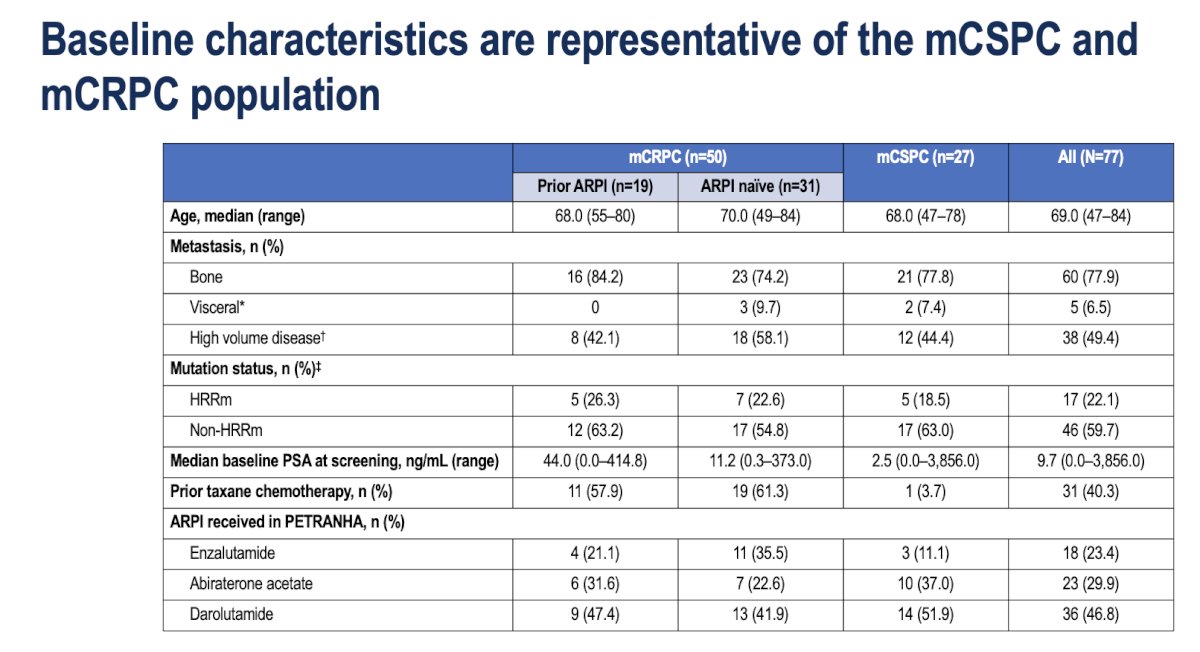
Among the 77 enrolled participants, the median age was 69 years, with 78% presenting with bone metastases and 6.5% with visceral involvement. High-volume disease was observed in 49% of patients. HRR mutations were present in 22%, while 60% were classified as non-HRRm. The median baseline PSA at screening was 9.7 ng/mL. Forty percent of patients had received prior taxane-based chemotherapy. Regarding ARPI treatment within PETRANHA, 23% received enzalutamide, 30% abiraterone acetate, and 47% darolutamide as shown in the table below.
The combination of saruparib with an ARPI was well tolerated overall. Grade ≥3 adverse events were reported in 46.8% of patients, with relatively low rates of anemia (19.5%) and gastrointestinal events (2.6%). Treatment discontinuations due to adverse events occurred in 10.4% of patients receiving saruparib and 3.9% receiving the ARPI. Importantly, no cases of myelodysplastic syndrome were observed.

Dr. Azad noted that objective responses to saruparib combined with an ARPI were observed across patients with metastatic prostate cancer, irrespective of HRR mutation status. Tumor reductions were reported in both HRRm and non-HRRm subgroups, including patients previously treated with an ARPI as well as ARPI-naïve individuals as illustrated below.

Lastly, Dr. Azad highlighted that saruparib combined with an ARPI demonstrated encouraging efficacy, particularly in ARPI-naïve patients. The objective response rate (ORR) reached 73.3% in ARPI-naïve mCRPC and 100% in mCSPC, compared with 25% in patients previously treated with an ARPI. Similarly, confirmed PSA90 and undetectable PSA responses were achieved in 55.2% and 30% of ARPI-naïve mCRPC patients, and in 100% and 83.3% of those with mCSPC, respectively.

Dr Azad concluded his presentation with the following remarks:
- Saruparib in combination with different ARPIs showed manageable toxicity, with a comparable or lower incidence of Grade ≥3 adverse events than reported with nonselective PARP inhibitor combinations.
- Interim efficacy findings were encouraging, with high response rates observed regardless of HRR mutation status. Notable efficacy data included:
– The objective response rate reached 73.3% in ARPI-naïve mCRPC.
– Undetectable PSA levels were achieved in 83.3% of patients with mCSPC. - Collectively, this provides strong support for the Phase 3 EvoPAR-Prostate01 trial (NCT06120491), which is currently underway to further evaluate saruparib in combination with ARPIs in mCSPC.
Presented by: Arun Azad, MBBS, PhD, FRACP, Medical Oncologist, Associate Professor, Peter MacCallum Cancer Centre, Victoria, Australia
Written by: Julian Chavarriaga, MD – Urologic Oncologist at Cancer Treatment and Research Center (CTIC) via Society of Urologic Oncology (SUO) Fellow at The University of Toronto. @chavarriagaj on Twitter during the 2025 European Society of Medical Oncology (ESMO) Annual Congress held in Berlin, Germany, between October 17th and 21st.
Reference:
- Clarke NW, Armstrong AJ, Thiery-Vuillemin A, Oya M, Shore ND, Loredo E, et al. Olaparib combined with abiraterone in metastatic castration-resistant prostate cancer. N Engl J Med Evid. 2022;1(1):1–16.
- Agarwal N, Loriot Y, McKay RR, De Wit R, Sternberg CN, Hussain M, et al. Talazoparib plus enzalutamide in metastatic castration-resistant prostate cancer. Lancet. 2023;402(10396):291–303.
- Attard G, Morris MJ, Sternberg CN, de Bono J, Chi KN, Saad F, et al. Niraparib plus abiraterone acetate and prednisone in metastatic castration-sensitive prostate cancer (mCSPC): phase III MAGNITUDE study results. J Clin Oncol. 2025;43(Suppl 17):LBA5006.
- Illuzzi G, Colclough N, Hughes AM, Manley PW, Howard M, Orme JP, et al. AZD5305, a next-generation PARP1 selective inhibitor and trapper, demonstrates enhanced efficacy and safety in preclinical models of cancer. Clin Cancer Res. 2022;28(21):4724–36