

(UroToday.com) The 2025 ESMO annual meeting featured a kidney cancer session and a presentation by Dr. Camillo Guglielmo Porta discussing the final analysis of lenvatinib + pembrolizumab versus sunitinib in patients with advanced renal cell carcinoma (RCC) with or without bone metastases in the CLEAR trial.1 Bone metastases occur in approximately a third of patients with advanced RCC and are associated with a worse prognosis. RCC may induce immune cells to release factors that stimulate osteoclast formation, such as fibroblast growth factor (FGF) and platelet-derived growth factor (PDGF), which can lead to enhanced resorption. Specifically, alterations of the FGF/FGF receptor (FGFR) axis is associated with the development of bone metastases in several cancer types, including renal cancer.
Lenvatinib is a tyrosine kinase inhibitor that targets vascular endothelial growth factor receptors (VEGFRs) 1–3, FGFR1–4, PDGF receptor alpha (PDGFRα), KIT, and RET. Lenvatinib in combination with the anti-programmed death-1 therapy pembrolizumab showed statistically significant/clinically meaningful improvements versus sunitinib in progression free survival, overall survival, and objective response rate in the first-line treatment of patients with advanced RCC. Improved efficacy with lenvatinib + pembrolizumab continued to be observed after ~4 years of follow-up (data cutoff: 31 July 2022):
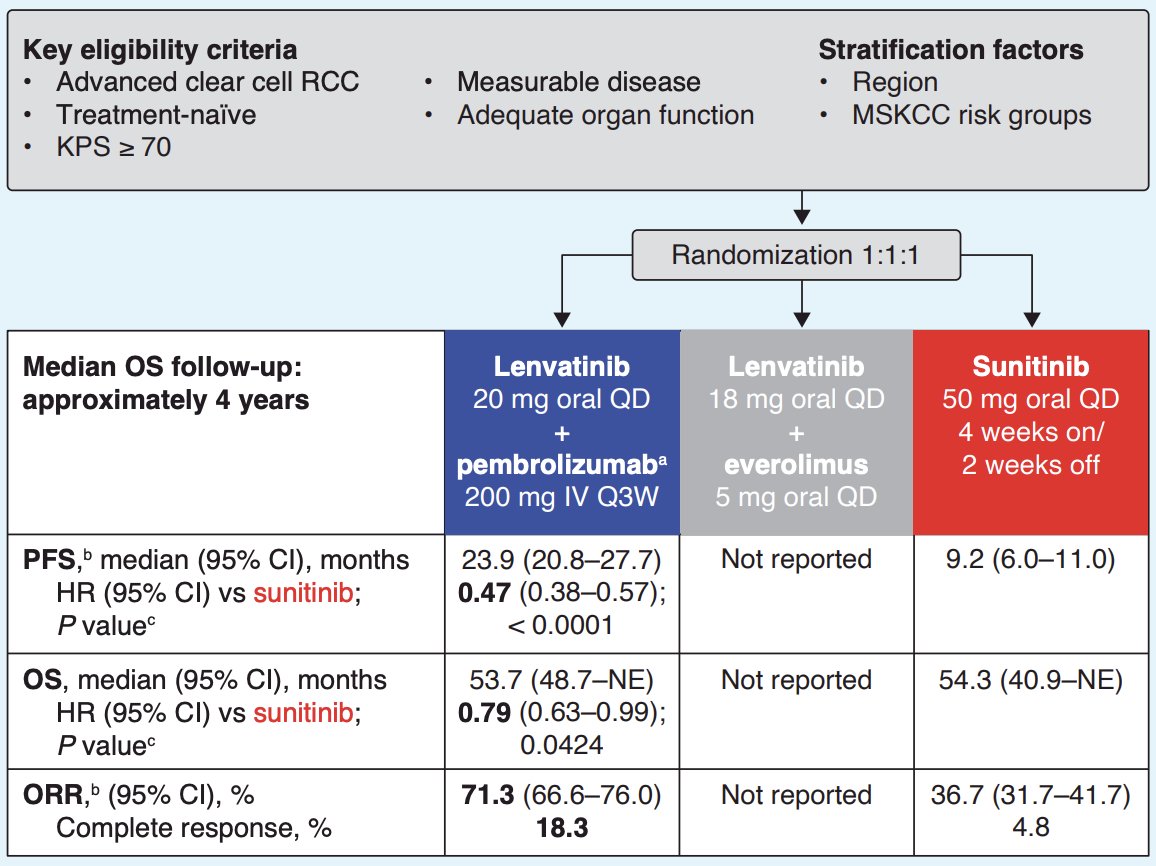
As such, at ESMO 2025, the investigators analyzed patients with or without baseline bone metastases treated with lenvatinib + pembrolizumab versus sunitinib in the CLEAR study with ∼4 years follow-up (cutoff: July 31, 2022).
The final overall survival analysis for CLEAR have been described in 2024 [2]. Tumor response was determined by independent imaging review per RECIST v1.1. IMDC score changes 6 months after treatment initiation were analyzed.
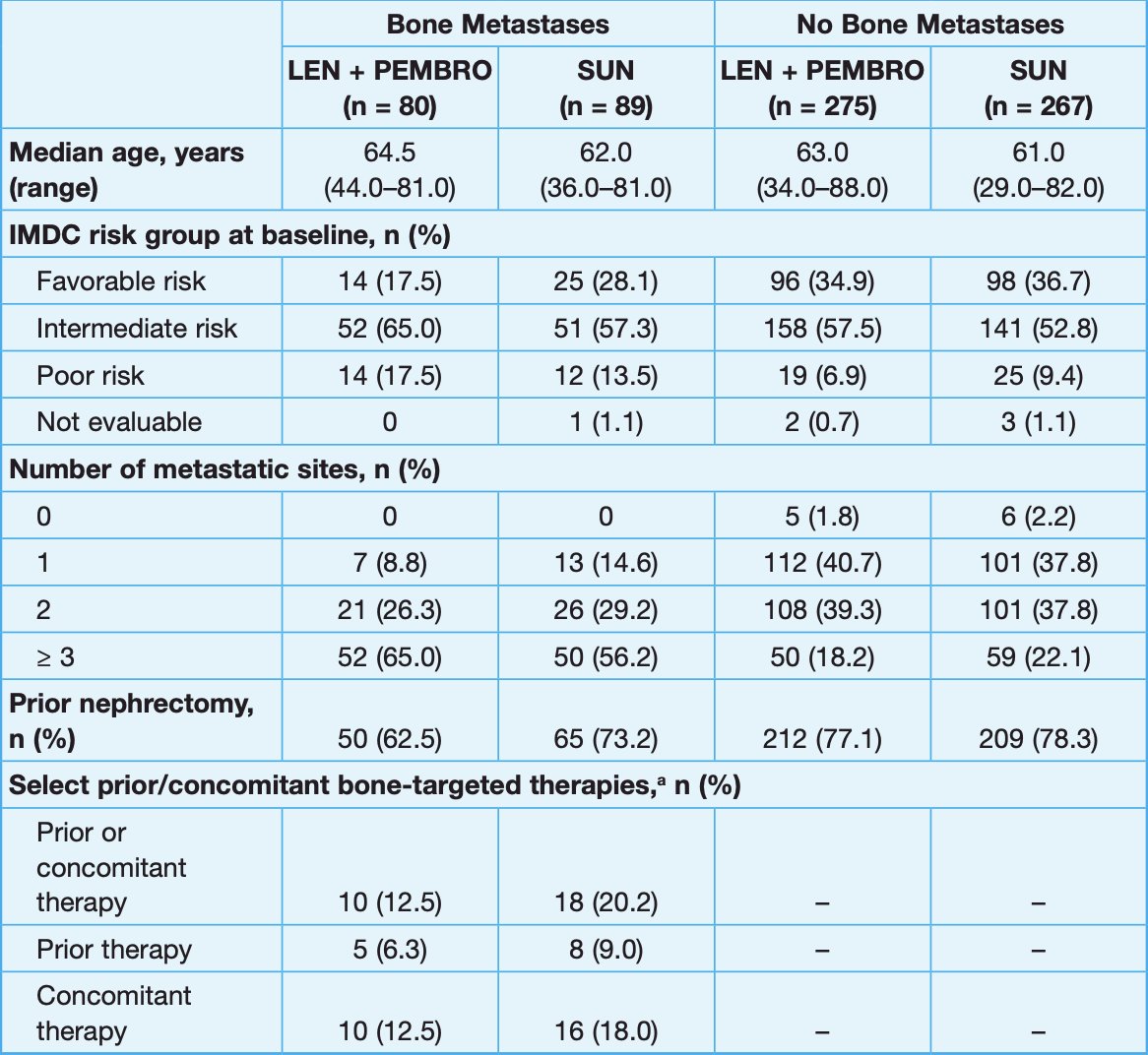
Baseline characteristics of patients with (lenvatinib + pembrolizumab, n = 80; sunitinib, n = 89) and without (lenvatinib + pembrolizumab, n = 275; sunitinib, n = 267) bone metastases were generally balanced across arms. There were some exceptions among patients with bone metastases: fewer patients in the lenvatinib + pembrolizumab versus sunitinib arms had IMDC favorable risk (17.5% versus 28%) and prior nephrectomy (62.5% versus 73%), and more patients in lenvatinib + pembrolizumab versus sunitinib had ≥3 metastatic sites (65% versus 56%). In patients with bone metastases, <10% of patients received prior denosumab/bisphosphonates across arms:
Median progression free survival favored lenvatinib + pembrolizumab versus sunitinib in patients with bone metastases (17.2 versus 5.6 months; HR 0.50, 95% CI 0.33-0.77) and without bone metastases (27.6 versus 9.9 months; HR 0.45, 95% CI 0.36-0.57) at baseline [3]:

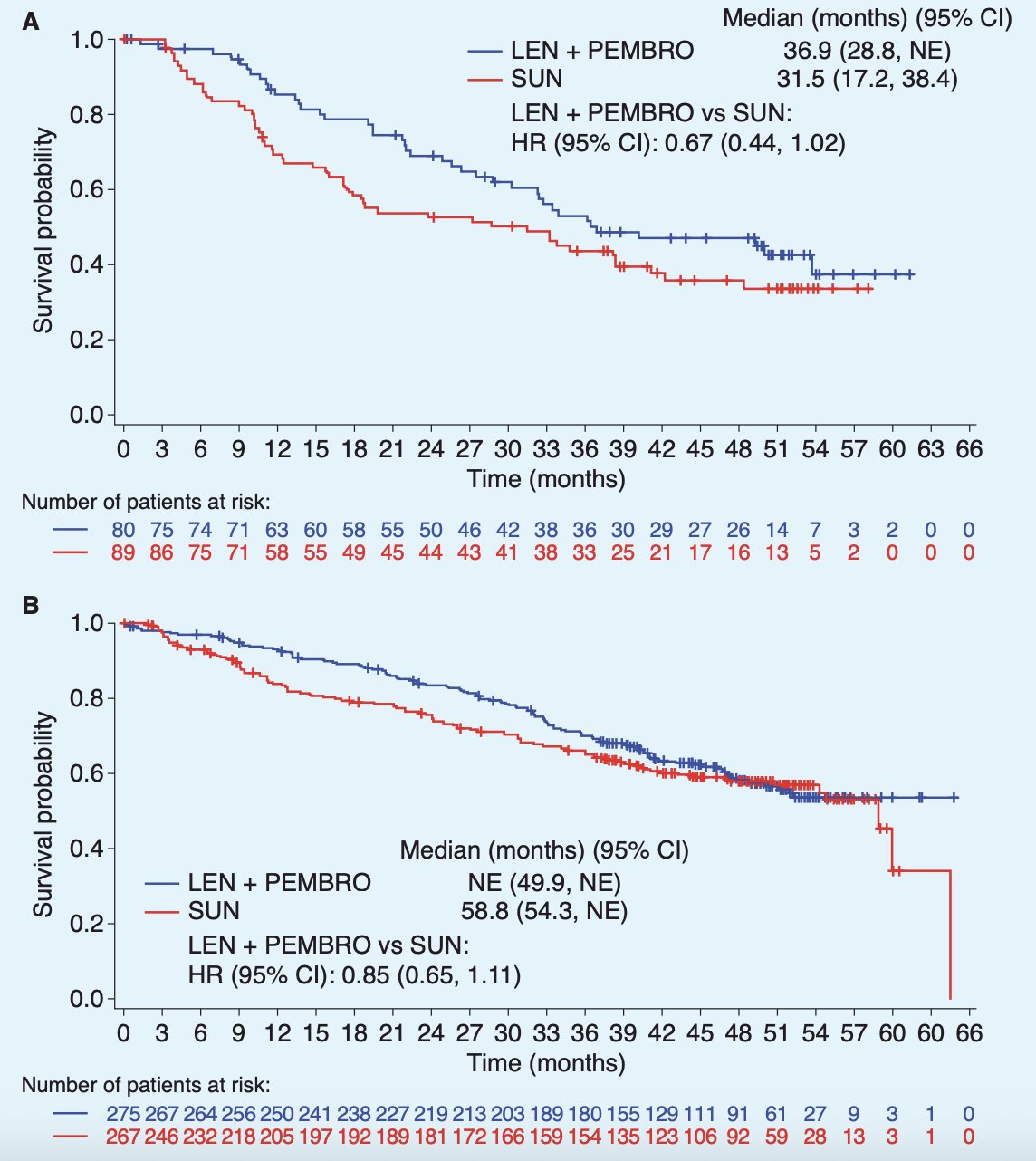
Median overall survival favored lenvatinib + pembrolizumab versus sunitinib in patients with bone metastases (36.9 versus 31.5 months; HR 0.67, 95% CI 0.44-1.02) and without bone metastases (not reached versus 58.8 months; HR 0.85, 95% CI 0.65-1.11) at baseline [3]:
Objective response rate was determined independently of site of metastases and favored lenvatinib + pembrolizumab versus sunitinib in patients with bone metastases (60% versus 27%) and without bone metastases (74.5% versus 40.1%) [3]:
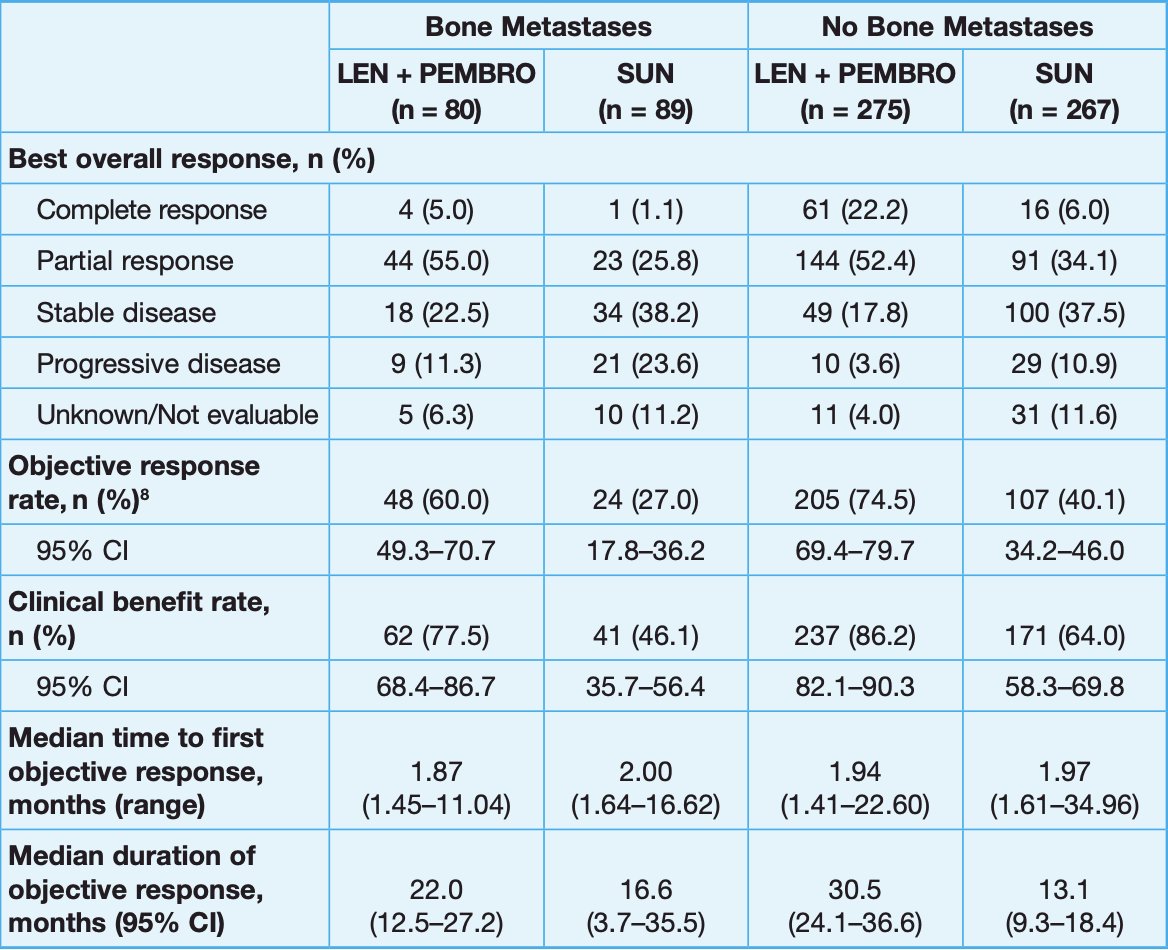
More patients with bone metastases had complete response and partial responses with lenvatinib + pembrolizumab versus sunitinib:
- Complete response: 5% versus 1%
- Partial response: 55% versus 26%
- Stable disease: 22.5% versus 38%
- Progressive disease: 11% versus 24%
The median duration of objective response was longer with lenvatinib + pembrolizumab than with sunitinib in patients with baseline bone metastases (22.0 versus 16.6 months) and those without (30.5 versus 13.1 months). IMDC scores in patients with bone metastases treated with lenvatinib + pembrolizumab generally improved/remained constant over 6 months (33.8% had ≥1 point decrease; 42.5% remained unchanged; 6.3% had ≥1 point increase):

Similar trends were seen in patients with no bone metastases, and in patients with/without baseline bone metastases in the sunitinib arm.
Dr. Porta concluded his presentation discussing the final analysis of lenvatinib + pembrolizumab versus sunitinib in patients with advanced RCC with or without bone metastases in the CLEAR trial with the following take home points:
- Although not included in MSKCC or IMDC prognostic risk scores, the presence of bone metastases is associated with worse prognosis in advanced RCC
- Despite worse baseline prognostic factors, lenvatinib + pembrolizumab improved overall survival, progression free survival, and objective response rate versus sunitinib in patients with bone metastases
- In patients treated with lenvatinib + pembrolizumab, IMDC scores generally improved or remained constant over 6 months, both in patients with and without bone metastases
- These results continue to support lenvatinib + pembrolizumab as a standard of care treatment for patients with advanced RCC, regardless of the presence or absence of bone metastases at baseline
Presented by: Camillo Guglielmo Porta, MD, University of Bari, Bari, Italy
Written by: Zachary Klaassen, MD, MSc – Urologic Oncologist, Associate Professor of Urology, Georgia Cancer Center, Wellstar MCG Health, @zklaassen_md on Twitter during the 2025 European Society for Medical Oncology (ESMO) Annual Congress, Berlin, Germany, October 17–21, 2025
References:
- Motzer R, Alekseev B, Rha SY, et al. Lenvatinib plus Pembrolizumab or Everolimus for Advanced Renal Cell Carcinoma. N Engl J Med. 2021 Apr 8;384(14):1289-1300.
- Motzer RJ, Porta C, Eto M, et al. Lenvatinib plus pembrolizumab versus sunitinib in first-line treatment of advanced renal cell carcinoma: Final prespecified overall survival analysis of CLEAR, a phase III study. J Clin Oncol. 2024 Apr 10;42(11):1222-1228.
- Grünwald V, McKay RR, Buchler T, et al. Clinical outcomes by baseline metastases in patients with renal carcinoma treated with lenvatinib plus pembrolizumab versus sunitinib: Post hoc analysis of the CLEAR trial. Int J Cancer. 2025 Apr 1;156(7):1326-1335.