

(UroToday.com) The 2025 European Society of Medical Oncology (ESMO) Annual Congress held in Berlin, Germany, was host to the Poster presentation session. Dr. Emmanuel Seront presented the poster Efficacy of [177Lu]Lu-PSMA-617 in Patients with Metastatic Clear Cell Renal Cell Carcinoma: a Multicentre Single-Arm Phase II Trial (RENALUT).
Dr. Seront highlighted that clear cell renal cell carcinoma (ccRCC) is characterized by excessive angiogenesis driven by inactivation of the Von Hippel-Lindau (VHL) gene. Current standard-of-care therapies include immune checkpoint inhibitors (ICI) and VEGFR tyrosine kinase inhibitors (TKIs), administered either in combination or sequentially. However, their efficacy significantly decreases in the second- and third-line settings.
He further emphasized that prostate-specific membrane antigen (PSMA) is overexpressed in the tumor vasculature of ccRCC and has shown a high detection rate of metastases using PSMA-directed imaging. Based on this, the beta-emitting radioligand [177Lu]-PSMA-617—already proven effective and well-tolerated in metastatic prostate cancer presents a promising therapeutic avenue for ccRCC.
The RENALuT trial aims to evaluate the efficacy and safety of [177Lu]Lu-PSMA-617 in patients with metastatic clear cell renal cell carcinoma (ccRCC).
Eligible patients must have histologically confirmed metastatic ccRCC that has progressed on or after VEGFR-TKI and ICI therapy, and at least one PSMA-positive metastatic lesion on PSMA PET/CT defined as tracer uptake higher than physiological liver uptake on visual analysis. Patients with predominantly PSMA-positive disease may be included even if they have PSMA-negative lesions, provided these are small (<15 mm for lymph nodes or <10 mm for solid-organ metastases).
Treatment consists of [177Lu]Lu-PSMA-617 administered at 7.4 GBq every six weeks for four cycles. In cases of partial response or stable disease, treatment may be extended to six cycles. A post-therapy SPECT/CT is performed on at least one treatment day, while conventional imaging is done every three months for the first year. Additionally, PSMA PET/CT scans are repeated after the second and fourth [177Lu]Lu-PSMA-617 administrations to assess treatment response. The study schema is shown below.
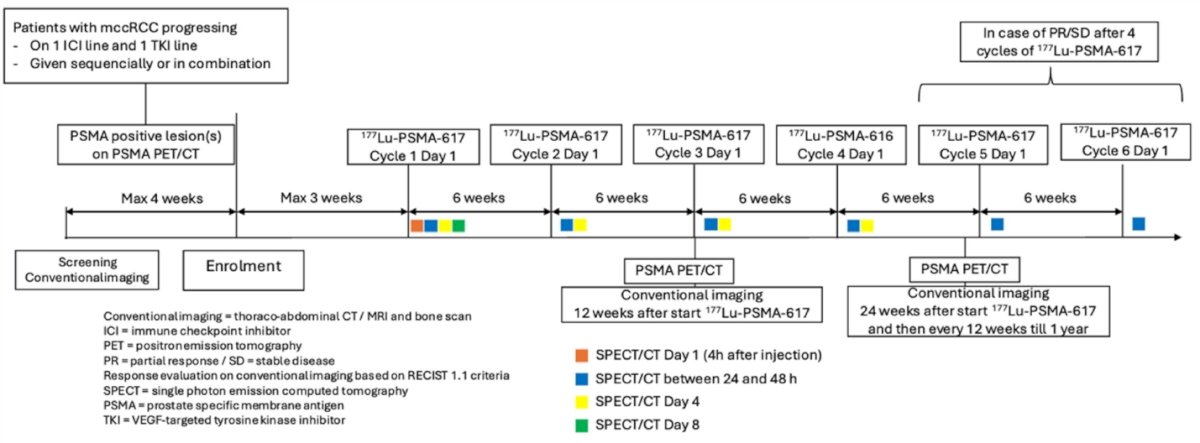
The primary endpoint of the RENALuT trial is the objective response rate (ORR) as assessed by RECIST 1.1 on conventional imaging.
Secondary endpoints include safety, progression-free survival (PFS), and overall survival (OS).
Exploratory objectives aim to further characterize treatment response by evaluating:
- The correlation between the efficacy of [177Lu]Lu-PSMA-617 and the number of administered cycles
- The predictive value of PSMA-PET uptake metrics (SUVmax, SUVmean, and total tumor volume [TTV]) for treatment efficacy in terms of ORR, disease control rate (DCR), PFS, and OS
- The cumulative absorbed tumor dose in index lesions after two and four cycles of [177Lu]Lu-PSMA-617
Dr Seront concluded with the following key points:
- RENALuT is a phase 2, single-arm trial evaluating the efficacy of [177Lu]Lu-PSMA-617 in patients with second- or third-line metastatic clear cell renal cell carcinoma (ccRCC).
- The study explores a novel therapeutic strategy by leveraging PSMA-targeted radioligand therapy, previously validated in metastatic prostate cancer.
- PSMA is overexpressed in ccRCC tumor vasculature, making it a promising target for radioligand-based treatment.
- RENALuT represents an important step toward expanding the treatment landscape for aggressive ccRCC and offers potential benefit for patients with limited therapeutic options.
Presented by: Emmanuel Seront, MD, PhD, Medical Oncologist at Cliniques Universitaires Saint-Luc, Brussels, Belgium
Written by: Julian Chavarriaga, MD – Urologic Oncologist at Cancer Treatment and Research Center (CTIC) via Society of Urologic Oncology (SUO) Fellow at The University of Toronto. @chavarriagaj on Twitter during the 2025 European Society for Medical Oncology (ESMO) Annual Congress, Berlin, Germany, October 17–21, 2025