

Dr. Albiges presented a comprehensive analysis from the French national health insurance claims database (SNDS), evaluating real-world first-line (1L) treatment trends for advanced renal cell carcinoma (aRCC) between 2020 and 2021. The study focused on immune-oncology (IO) and tyrosine kinase inhibitor (TKI) combinations (IO–IO or IO–TKI) recommended by ESMO guidelines, describing patient characteristics, prescription patterns, and outcomes across 4,665 aRCC patients.
From January 2020 to December 2021, a total of 4,665 patients with advanced renal cell carcinoma (aRCC) were included in this nationwide analysis, with a median age of 69 years and 73.8% being men. Over this two-year period, IO-based combinations rapidly expanded from 39.5% of all first-line treatments in 2020 (IO–TKI: 16.4%; IO–IO: 23.1%) to 67.0% in 2021 (IO–TKI: 37.6%; IO–IO: 29.4%), while TKI monotherapy use fell from 49.2% to 22.8%. IO monotherapy was prescribed in 8.2% of cases.
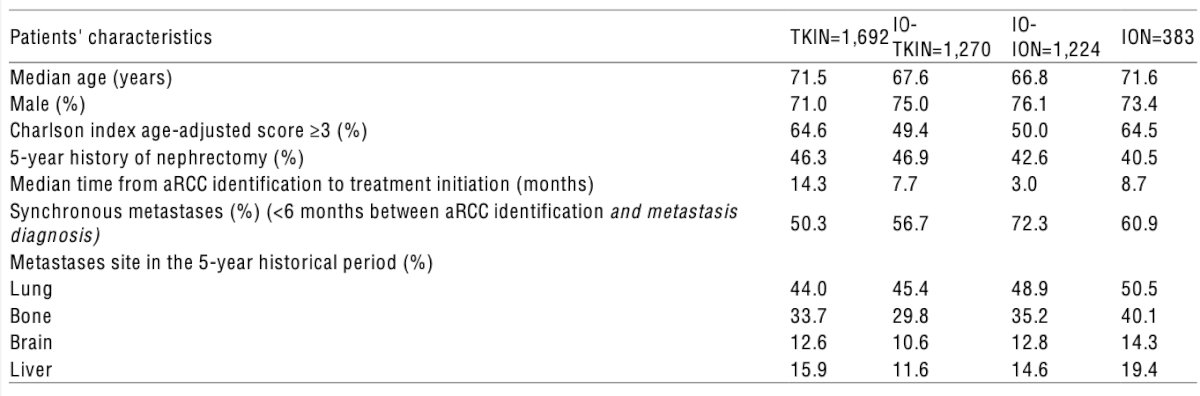
At a median follow-up of 36.1 months, 49.3% of patients went on to receive second-line therapy, and 28.6% had died. Median time-to-next-treatment-or-death (TNT-D) was longest for IO–TKI (18.3 months), compared to IO–IO (8.9 months), IO monotherapy (7.8 months), and TKI (7.8 months). IO–IO and IO–TKI recipients tended to have more adverse baseline features, including higher comorbidity indices, synchronous metastases, and increased metastatic burden (notably lung and bone sites).
Dr. Albiges concluded her presentation with the following key points:
- IO-based combinations have largely replaced TKI monotherapy as first-line treatment for aRCC in France, aligning with ESMO recommendations.
- Single-agent IO or TKI therapy remains primarily reserved for patients with significant comorbidities or poor performance status.
- IO–IO combinations are more frequently used in patients with adverse clinical features and aggressive disease biology.
- Despite shorter time-to-next-treatment-or-death (TNT-D), IO–IO combinations reflect appropriate, guideline-consistent treatment allocation across IMDC risk categories.
Presented by: Laurence Albiges, MD, PhD, Medical oncologist and is the Head of the Genitourinary Unit at Gustave Roussy Institute, Villejuif, France.
Written by: Julian Chavarriaga, MD – Urologic Oncologist at Cancer Treatment and Research Center (CTIC) via Society of Urologic Oncology (SUO) Fellow at The University of Toronto. @chavarriagaj on Twitter during the 2025 European Society for Medical Oncology (ESMO) Annual Congress, Berlin, Germany, October 17–21, 2025