

(UroToday.com) The 2025 European Society of Medical Oncology (ESMO) Annual Congress held in Berlin, Germany between October 17th and 21st was host to the session Mini Oral session 2: GU tumours, renal & urothelial Dr. Berkay Simsek presented 2613MO - Identifying Biomarkers of Response to First-Line Nivolumab plus Ipilimumab Therapy in Patients with Metastatic Clear Cell Renal Cell Carcinoma (mccRCC) enrolled in the COSMIC 313 trial.
Dr. Simsek began by emphasizing that their group had previously shown that CD8+ T cells expressing PD-1 but lacking TIM-3 or LAG-3 are associated with improved clinical outcomes to anti–PD-1 monotherapy in metastatic clear cell RCC. (1) These findings were initially observed in patients from the CheckMate 010 and 025 trials and later confirmed in the HCRN GU16-260 (2,3) study results that were not only reproducible but also biologically coherent, reinforcing the mechanistic relevance of this immune phenotype in treatment response.
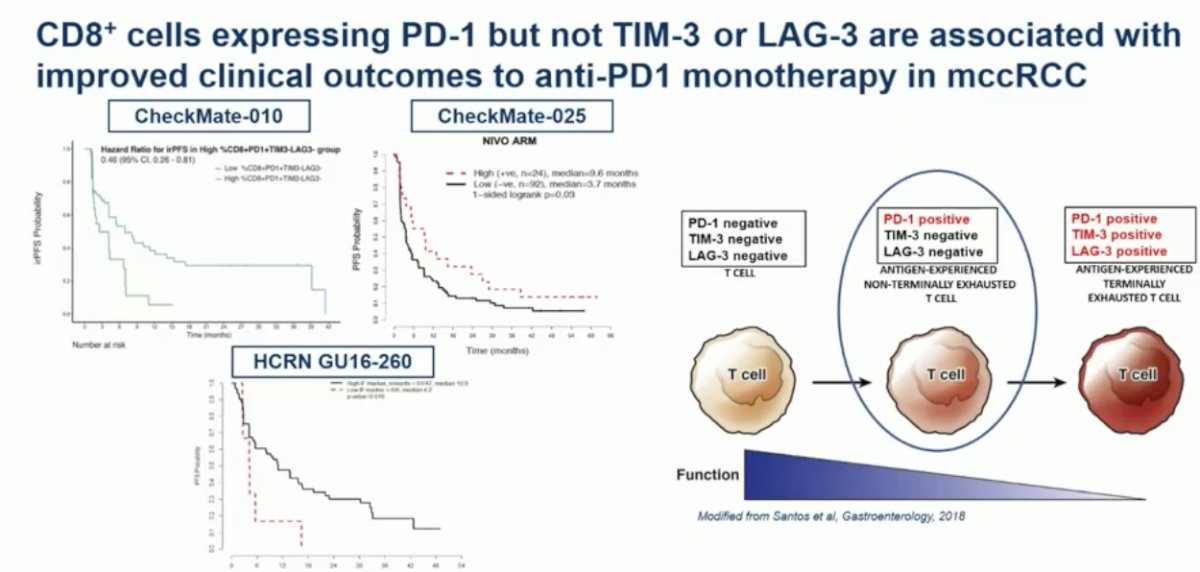
The aim of the study was to evaluate the association between CD8⁺PD1⁺TIM3⁻LAG3⁻ tumor-infiltrating lymphocytes (TILs) and clinical outcomes in patients with metastatic clear cell RCC treated with first-line nivolumab plus ipilimumab in the COSMIC-313 trial.
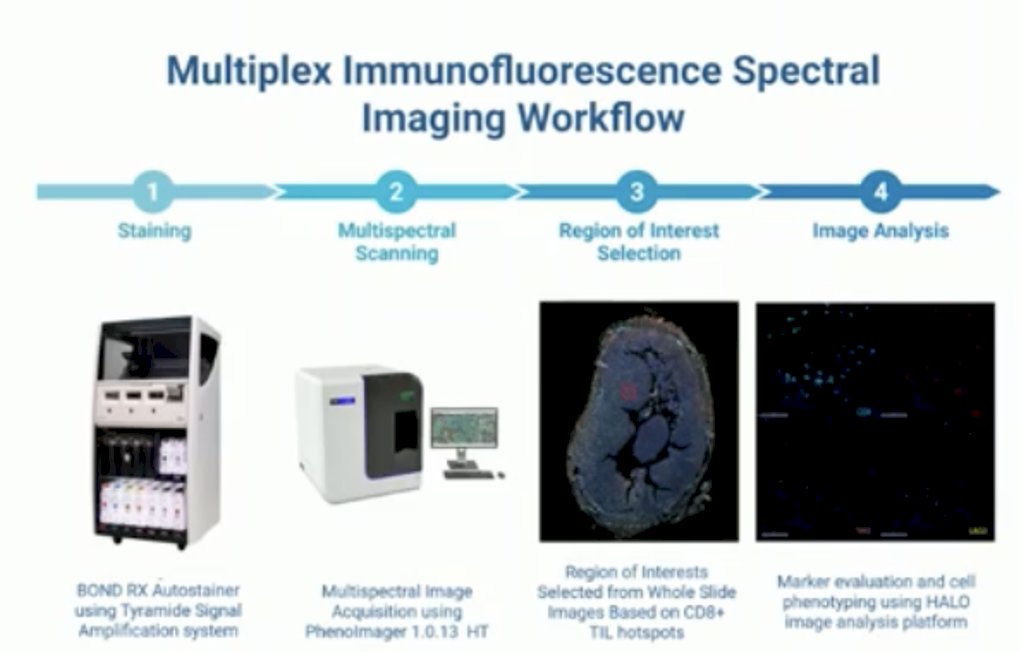
To achieve this, the team analyzed pre-treatment tumor samples from 198 patients in the nivolumab + ipilimumab arm using a multiplex immunofluorescence spectral imaging workflow previously developed in their laboratory. The density of CD8⁺PD1⁺TIM3⁻LAG3⁻ TILs was quantified, and its association with progression-free survival (PFS) and objective response rate (ORR) was assessed using univariable Cox and logistic regression models, respectively.
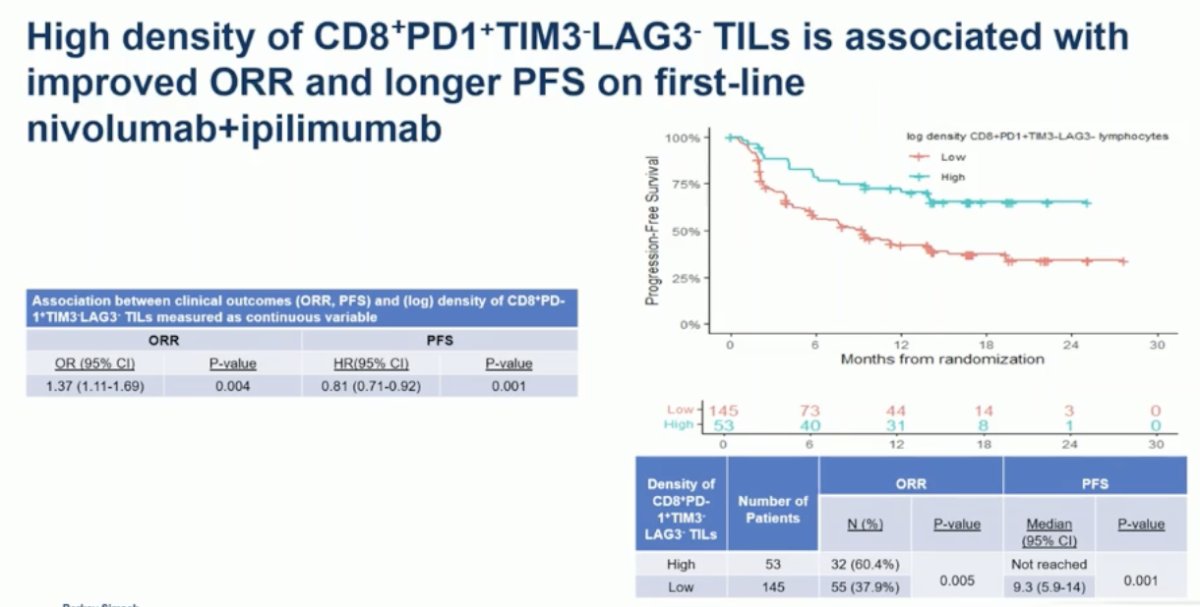
A higher density of CD8⁺PD1⁺TIM3⁻LAG3⁻ tumor-infiltrating lymphocytes (TILs) was significantly associated with improved objective response rate (ORR) and prolonged progression-free survival (PFS) in patients receiving first-line nivolumab plus ipilimumab. When analyzed as a continuous variable, higher CD8⁺PD1⁺TIM3⁻LAG3⁻ TIL density correlated with superior ORR (OR 1.37, 95% CI 1.11–1.69; p=0.004) and longer PFS (HR 0.81, 95% CI 0.71–0.92; p=0.001).
Patients with high biomarker density had an ORR of 60.4% compared to 37.9% in those with low density, with median PFS not reached versus 9.3 months (95% CI 5.9–14; p=0.001), suggesting that this phenotype may serve as a predictive biomarker of response to dual immune checkpoint blockade.
Dr. Simsek concluded his presentation with the following key remarks:
- Consistent with prior observations in the nivolumab monotherapy setting, higher levels of CD8⁺PD1⁺TIM3⁻LAG3⁻ tumor-infiltrating lymphocytes (TILs) were associated with improved outcomes to nivolumab plus ipilimumab in patients with metastatic clear cell RCC.
- These findings reinforce the potential role of this immune phenotype as a predictive biomarker of response to immune checkpoint blockade.
- Ongoing work aims to further explore this biomarker in combination with other tissue-based biomarkers to enhance patient stratification and response prediction.
Presented by: Berkay Simsek, MD, Research Fellow in Pathology at the Brigham and Women's Hospital, Boston, MA, United States of America
Written by: Julian Chavarriaga, MD – Urologic Oncologist at Cancer Treatment and Research Center (CTIC) via Society of Urologic Oncology (SUO) Fellow at The University of Toronto. @chavarriagaj on Twitter during the 2025 European Society of Medical Oncology (ESMO) Annual Congress held in Berlin, Germany, between October 17th and 21st.
Related content: COSMIC-313 Correlative Analysis Links Specific T-Cell Subset to Improved PFS with Immunotherapy - Berkay Simsek
References:
- Zelba H, Bedke J, Hennenlotter J, Mostböck S, Zettl M, Zichner T, Chandran A, Stenzl A, Rammensee HG, Gouttefangeas C. PD-1 and LAG-3 Dominate Checkpoint Receptor-Mediated T-cell Inhibition in Renal Cell Carcinoma. Cancer Immunol Res. 2019 Nov;7(11):1891-1899. doi: 10.1158/2326-6066.CIR-19-0146. Epub 2019 Sep 4. PMID: 31484656.
- Escudier B, Sharma P, McDermott DF, George S, Hammers HJ, Srinivas S, Tykodi SS, Sosman JA, Procopio G, Plimack ER, Castellano D, Gurney H, Donskov F, Peltola K, Wagstaff J, Gauler TC, Ueda T, Zhao H, Waxman IM, Motzer RJ; CheckMate 025 investigators. CheckMate 025 Randomized Phase 3 Study: Outcomes by Key Baseline Factors and Prior Therapy for Nivolumab Versus Everolimus in Advanced Renal Cell Carcinoma. Eur Urol. 2017 Dec;72(6):962-971. doi: 10.1016/j.eururo.2017.02.010. Epub 2017 Mar 3. Erratum in: Eur Urol. 2018 Apr;73(4):e116-e118. doi: 10.1016/j.eururo.2017.12.016. PMID: 28262413.
- Atkins MB, Jegede OA, Haas NB, McDermott DF, Bilen MA, Stein M, Sosman JA, Alter R, Plimack ER, Ornstein M, Hurwitz M, Peace DJ, Signoretti S, Denize T, Cimadamore A, Wu CJ, Braun D, Einstein D, Catalano PJ, Hammers H. Phase II Study of Nivolumab and Salvage Nivolumab/Ipilimumab in Treatment-Naive Patients With Advanced Clear Cell Renal Cell Carcinoma (HCRN GU16-260-Cohort A). J Clin Oncol. 2022 Sep 1;40(25):2913-2923. doi: 10.1200/JCO.21.02938. Epub 2022 Apr 20. PMID: 35442713; PMCID: PMC9426835.