

(UroToday.com) The 2025 European Society for Medical Oncology (ESMO) Annual Congress held in Berlin, Germany, was host to a urothelial carcinoma poster session. Tanya Jindal presented the results of an analysis of the UNITE study of enfortumab vedotin + pembrolizumab (EV+P) in patients with histologic subtypes of advanced urothelial carcinoma.
EV + P has become the standard of care 1st line treatment for patients with locally advanced or metastatic urothelial carcinoma.1 Pivotal trials have demonstrated significant survival benefits, but patients with histologic subtypes were underrepresented and data on EV+P outcomes in these variant histologies remain limited. The study investigators hypothesized that the presence of variant histology may affect treatment response and survival outcomes with EV + P.
This study included patients treated with EV + P from UNITE, a multicenter retrospective cohort of patients with advanced urothelial carcinoma. The outcomes were compared between patients with pure urothelial carcinoma and histologic subtypes. The observed response rate (ORR) was assessed and compared for patients with ≥1 post-baseline scan using chi-squared tests. Progression-free (PFS) and overall survivals (OS) were measured from treatment initiation using the Kaplan-Meier method.
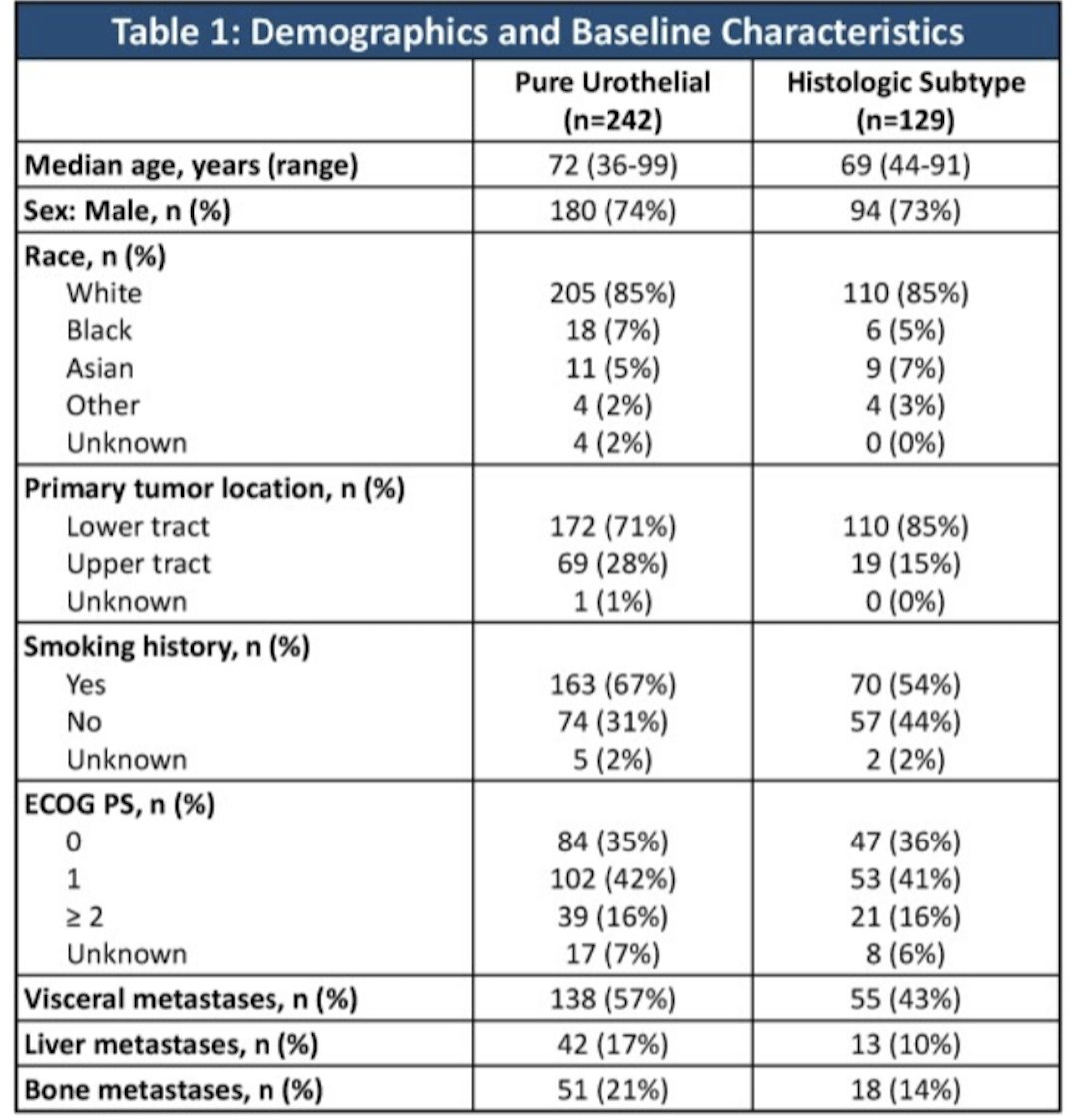
The patient demographics and baseline characteristics are summarized below. Patients with histologic subtypes were younger (69 vs 72 years), had lower tract disease more commonly (85% vs 71%), and were less likely to have visceral (43% vs 57%), liver (10% vs 17%), and bone (14% vs 21%) metastases.
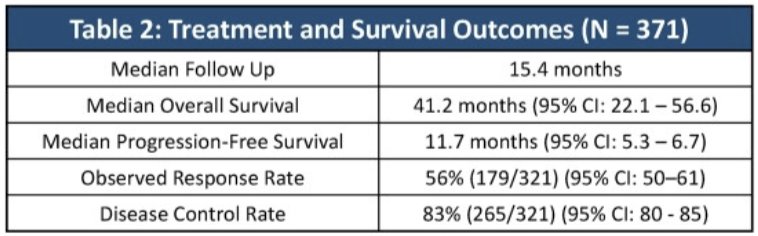
In the overall cohort of 371 patients, the median follow-up was 15.4 months. The median OS and PFS were 41.2 and 11.7 months, respectively. The ORR was 56%, and the disease control rate was 83%.
Patients with histologic subtypes had worse:
- DCR: 79% vs 84%
- OS: 20 months vs 45.3 months
- PFS: 10.4 months vs 12.7 months

The ORR by histologic subtype component is summarized below:
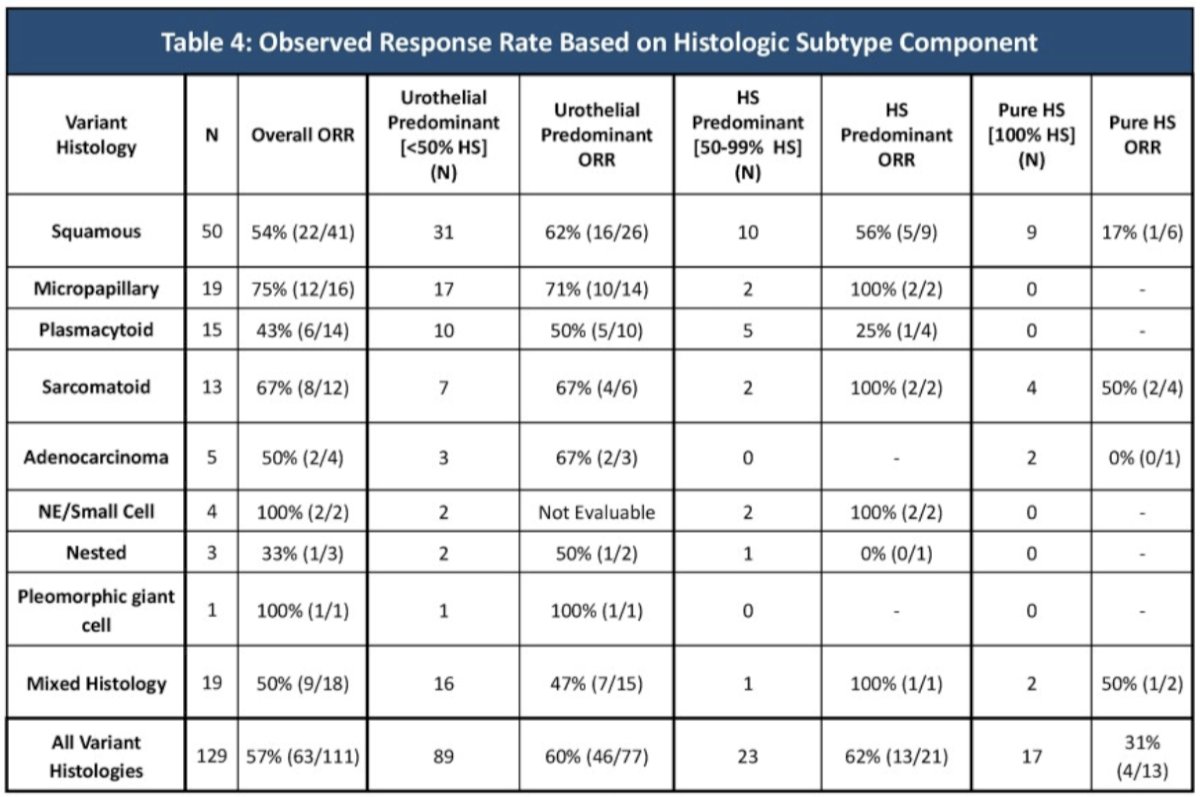
The study investigators concluded that EV+P demonstrated activity in advanced urothelial carcinoma tumors with histologic subtype component, including pure histologic subtypes and variants which have historically shown poor responses to conventional treatments for advanced urothelial carcinoma.
Presented by: Tanya Jindal, Senior Clinical Research Coordinator, HDF Comprehensive Cancer Center, University of California, San Francisco, CA
Written by: Rashid K. Sayyid, MD, MSc, Assistant Professor, Urologic Oncologist, Department of Urology at The University of Arizona and Banner University Medical Center – Tucson, AZ, @rksayyid on X during the 2025 European Society for Medical Oncology (ESMO) Annual Congress, Berlin, Germany, October 17–21, 2025
References:
- Powles T, Valderrama BP, Gupta S, et al. Enfortumab Vedotin with Pembrolizumab Treatment Outcomes in Patients with Histologic Subtypes of Advanced Urothelial Carcinoma: Analysis of the UNITE Study. N Engl J Med. 2024; 390:875-888.