

(UroToday.com) The 2025 European Society for Medical Oncology (ESMO) Annual Congress held in Berlin, Germany, was host to a urothelial carcinoma poster session. Dr. Nataliya Mar presented the results of an exploratory analysis of the EV-302 trial of enfortumab vedotin + pembrolizumab (EV+P) in older patients with previously untreated locally advanced or metastatic urothelial carcinoma.
The pivotal, phase III EV-302 study (NCT04223856) is a global, open-label, randomized study comparing the efficacy and safety of EV+P versus platinum-based chemotherapy in patients with previously untreated locally advanced or metastatic urothelial carcinoma.1 The results from EV-302 demonstrating significant improvements in progression-free (PFS) and overall survivals (OS) with EV+P, compared with chemotherapy,1 led to global approvals of EV+P as 1st line treatment for patients with locally advanced or metastatic disease2-5, with EV+P now the new standard of care in this setting.6,7
Updated results from EV-302 after ~2.5 years of median follow-up showed that the OS and PFS benefits in patients treated with EV+P were maintained, with median OS of 33.8 months.8 Notably, the clinical benefit of EV+P was consistent between the intent-to-treat (ITT) population and prespecified subgroups, including age (<65 or ≥65 years) and renal function (normal, mildly impaired, or moderately/severely impaired).8
Herein, the study investigators presented a subgroup analysis of clinical outcomes for EV+P in patients with clinically challenging characteristics at baseline:
- Older patients (≥75 years)
- Diabetes: ongoing hyperglycemia or HbA1c ≥6.5%
- Renal impairment (moderate or severe): GFR <60 mL/min
The study design of EV-302 is summarized below. Patients in this trial were randomized in a 1:1 fashion, stratified by cisplatin eligibility, PD-L1 expression, and presence/absence of liver metastases, to EV + P (continued until disease progression per BICR, clinical progression, unacceptable toxicity, or completion of maximum cycles [35 for pembrolizumab]) versus gemcitabine + cisplatin or carboplatin for a maximum of 6 cycles.

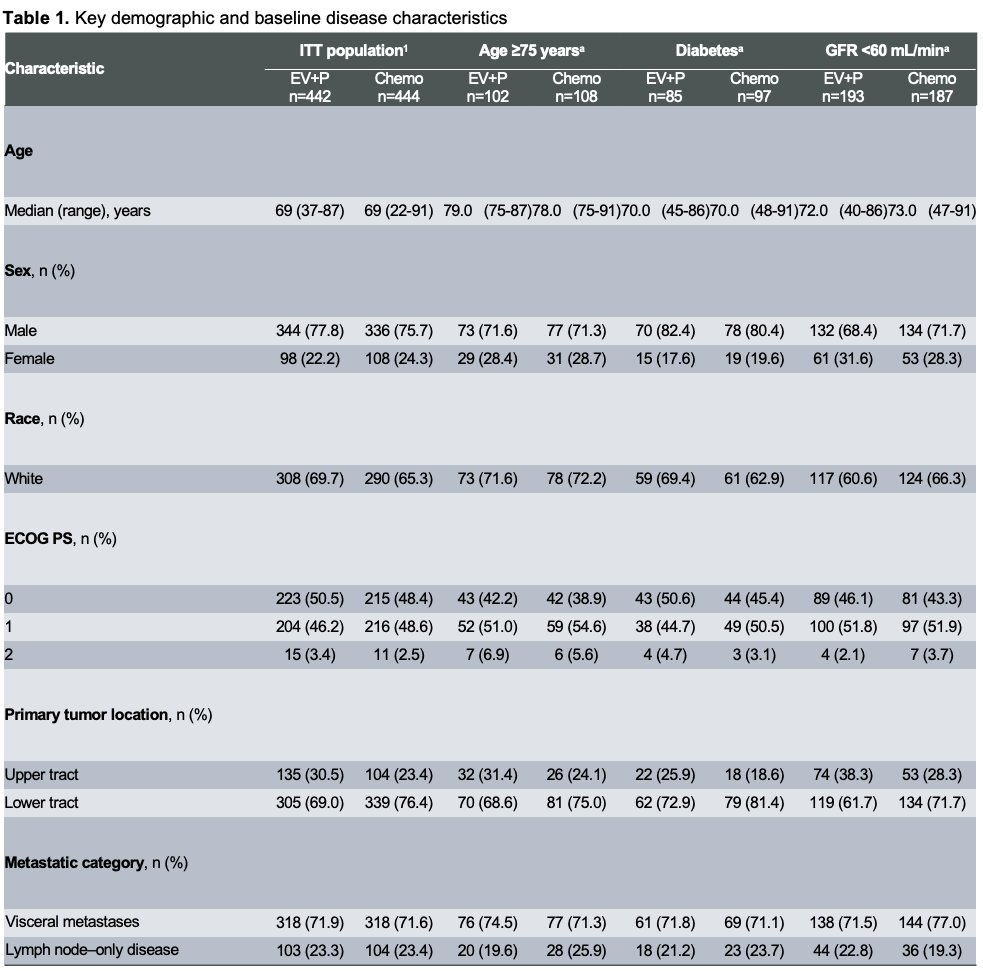
A total of 886 patients were randomized: 442 to the EV+P arm and 444 to the chemotherapy arm. The baseline characteristics across the subgroups are shown in Table 1 below.
At data cutoff (August 8, 2024), the median follow-up for the ITT population was 29.1 months. In the EV+P arm, the median (range) treatment duration of EV+P by subgroup was:
- ≥75 years: 10 cycles (1–39)
- Diabetes (ongoing hyperglycemia or HbA1C ≥6.5%): 17.5 cycles (1–45)
- Renal impairment (GFR <60 mL/min): 12 cycles (1–50)
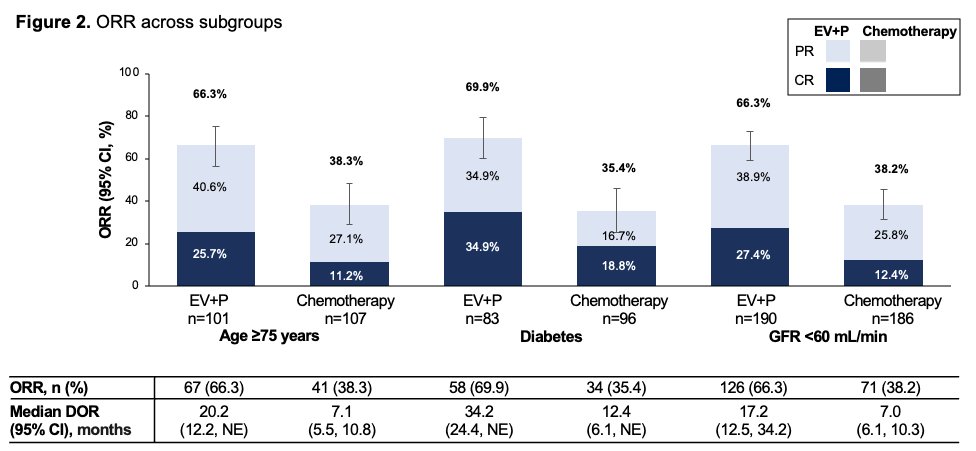
The confirmed objective response rate (ORR; Figure 2) was higher in the EV+P treatment arm than in the chemotherapy arm across all evaluated subgroups:
- ≥75 years: 66% vs 38%
- Diabetes (ongoing hyperglycemia or HbA1C ≥6.5%): 70% vs 35%
- Renal impairment (GFR <60 mL/min): 66% vs 38%
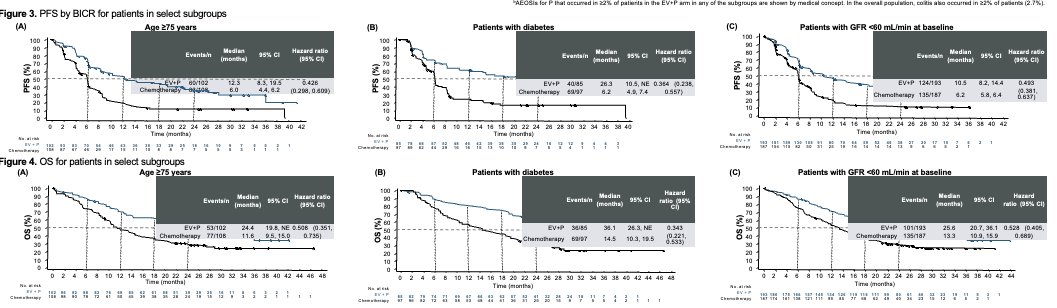
PFS (by BICR) and OS benefits in patients treated with EV+P versus chemotherapy were maintained across all evaluated subgroups (Figures 3 and 4).
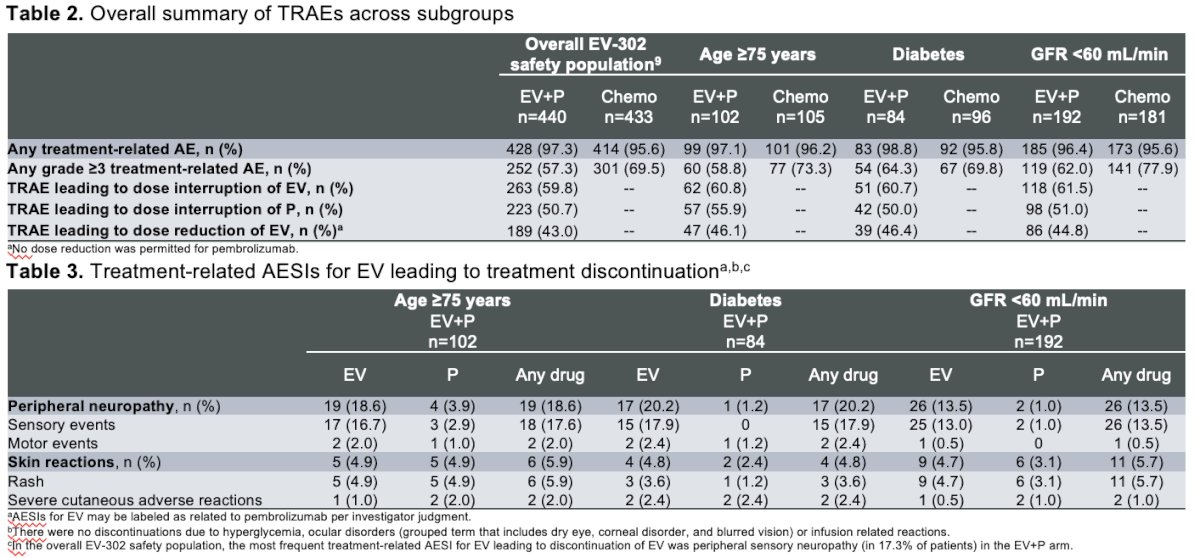
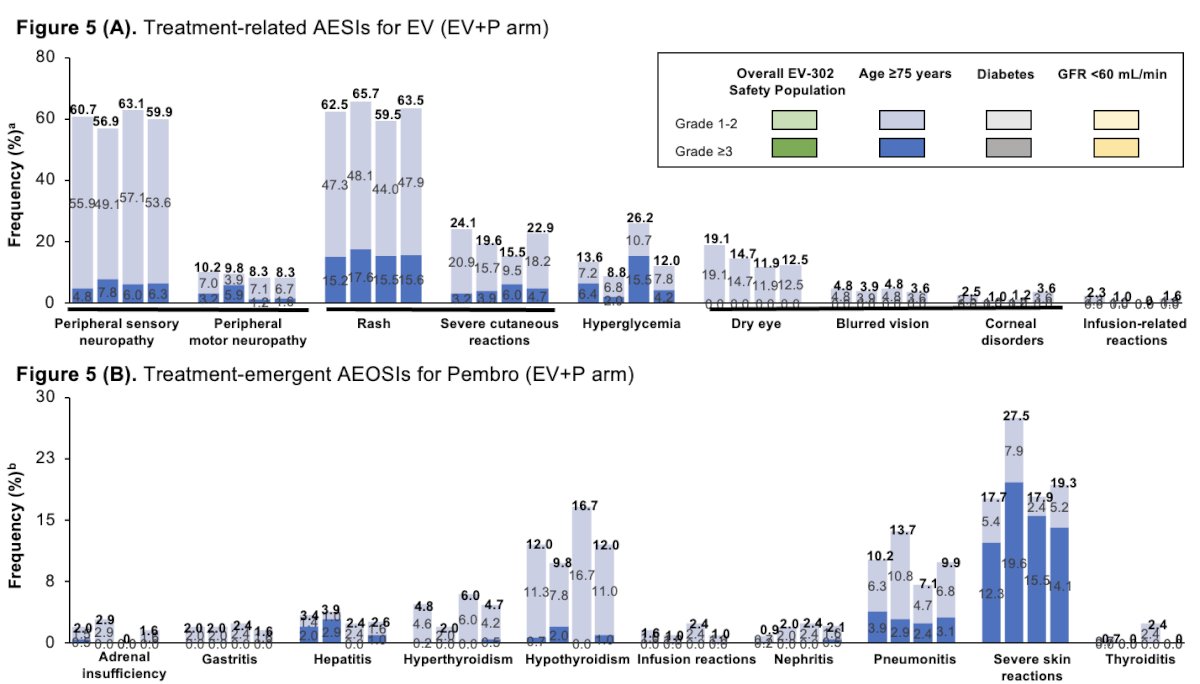
Safety data in the evaluated subgroups were generally consistent with those in the overall safety analysis population.8 The frequency of grade ≥3 treatment-related adverse events (TRAEs) was lower in the EV+P arm than in the chemotherapy arm across all subgroups (Table 2). In the EV+P arm, TRAEs of significant interest for EV were primarily low grade across subgroups, with those leading to treatment discontinuation shown in Table 3 below. Severe skin reactions were the most common TRAEs of significant interest for P in the EV+P arm.
Dr. Mar concluded as follows:
- OS and PFS benefits in patients treated with EV+P vs chemotherapy were maintained across patients aged ≥75 years and those with clinically challenging comorbidities of diabetes and renal impairment
- In these subgroups, the overall safety profile of EV+P was consistent with the overall population
- These data reinforce EV+P as the standard of care for the 1st line treatment of patients with locally advanced or metastatic urothelial carcinoma, when administered according to protocol-defined criteria, and further demonstrate that clinical benefit with EV+P in all key subgroups assessed to date is consistent with the overall population
Presented by: Nataliya Mar, MD, Associate Professor, Medical Oncologist, UC Irvine Cancer Center, Irvine, CA
Written by: Rashid K. Sayyid, MD, MSc, Assistant Professor, Urologic Oncologist, Department of Urology at The University of Arizona and Banner University Medical Center – Tucson, AZ, @rksayyid on X during the 2025 European Society for Medical Oncology (ESMO) Annual Congress, Berlin, Germany, October 17–21, 2025
References:
- Powles T, Sridhar SS, Grivas P, et al. Enfortumab vedotin plus pembrolizumab in previously untreated advanced urothelial carcinoma. N Engl J Med. 2024; 390:875-888.
- US Food and Drug Administration. FDA grants accelerated approval to enfortumab vedotin-ejfv with pembrolizumab for locally advanced or metastatic urothelial carcinoma. Accessed September 2025. https://www.fda.gov/drugs/resources-information-approved-drugs/fda-grants-accelerated-approval-enfortumab-vedotin-ejfv-pembrolizumab-locally-advanced-or-metastatic
- Astellas Pharma Inc. European Commission approves Astellas PADCEV (enfortumab vedotin) in combination with KEYTRUDA (pembrolizumab) for first-line treatment of advanced urothelial cancer. Accessed September 2025. https://newsroom.astellas.us/2024-08-27-European-Commission-Approves-Astellas-PADCEV-TM-enfortumab-vedotin-in-Combination-with-KEYTRUDA-R-pembrolizumab-for-First-Line-Treatment-of-Advanced-Urothelial-Cancer
- Pfizer Canada. PADCEV (enfortumab vedotin) in combination with pembrolizumab approved by Health Canada to treat advanced bladder cancer. Accessed September 2025. https://www.pfizer.ca/en/media-centre/padcev-enfortumab-vedotin-in-combination-with-pembrolizumab-approved-by-health-canada-to-treat-advanced-bladder-cancer
- Astellas Pharma Inc. Japan’s Ministry of Health, Labour and Welfare approves PADCEV (enfortumab vedotin) with KEYTRUDA (pembrolizumab) for first-line treatment of radically unresectable urothelial carcinoma. Accessed September 2025. https://newsroom.astellas.us/2024-09-24-Japans-Ministry-of-Health,-Labour-and-Welfare-Approves-PADCEV-TM-enfortumab-vedotin-with-KEYTRUDA-R-pembrolizumab-for-First-Line-Treatment-of-Radically-Unresectable-Urothelial-Carcinoma
- Powles T, Loriot Y, Gupta S, et al. Enfortumab vedotin plus pembrolizumab in locally advanced or metastatic urothelial carcinoma: updated analysis from EV-302. Ann Oncol. 2024; 35:485-490.
- Witjes JA, Bruins HM, Cathomas R, et al. European Association of Urology Guidelines on muscle-invasive and metastatic bladder cancer: 2024 update. Eur Urol. 2024; 85:17-31.
- Powles TB, Grivas P, Sridhar SS, et al. Enfortumab vedotin plus pembrolizumab as first-line treatment for advanced urothelial carcinoma: final analysis of EV-302. Ann Oncol. Published online June 1, 2025.