

(UroToday.com) The 2025 ESMO annual meeting featured a urothelial carcinoma mini oral session and a presentation by Dr. Michiel Van der Heijden discussing health related quality of life outcomes from the NIAGARA trial of perioperative durvalumab + neoadjuvant chemotherapy in muscle invasive bladder cancer. In the phase 3 NIAGARA trial,1 patients with muscle invasive bladder cancer treated with perioperative durvalumab + neoadjuvant chemotherapy with radical cystectomy demonstrated statistically significant and clinically meaningful improvement in event free survival (HR 0.69, 95% CI 0.56-0.82) and overall survival, and a numerical increase in pathological complete response rate versus neoadjuvant chemotherapy and radical cystectomy alone:

Perioperative durvalumab + neoadjuvant chemotherapy has been approved for the treatment of muscle invasive bladder cancer in several regions, including the USA and European Union, as well as having received a Category 1 recommendation by the NCCN and ESMO-MCGS score of AAT indicating substantial benefit in a curative setting. At the 2025 ESMO annual meeting, Dr. Van der Heijden and colleagues reported health related quality of life outcomes from NIAGARA.
Cisplatin-eligible patients with muscle invasive bladder cancer (cT2-T4aN0/1M0) planned for radical cystectomy were randomized 1:1 to 4 cycles of neoadjuvant durvalumab (1500 mg IV every 3 weeks) + neoadjuvant chemotherapy (cisplatin + gemcitabine IV every 3 weeks) followed by radical cystectomy then 8 cycles of adjuvant durvalumab monotherapy (1500 mg IV every 4 weeks) (durvalumab arm) or neoadjuvant chemotherapy followed by radical cystectomy alone (comparator arm):
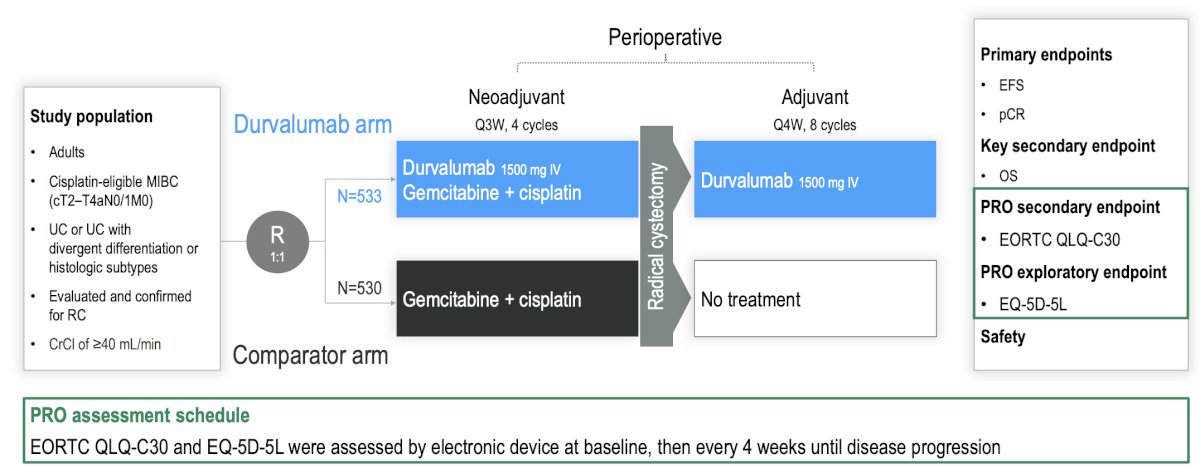
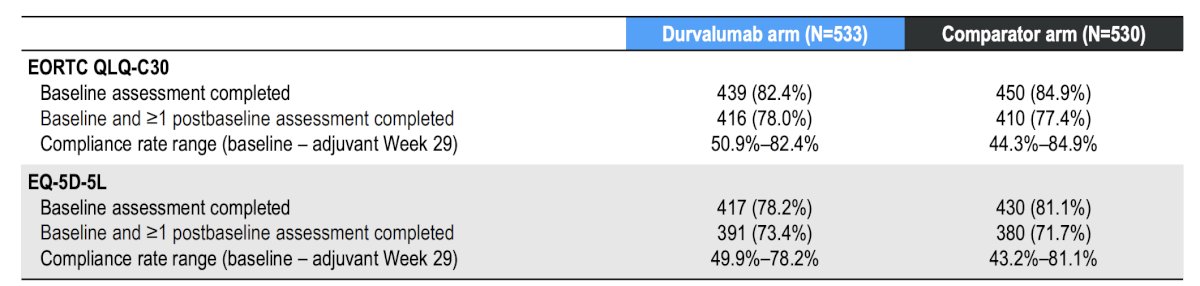
Health related quality of life was measured using the EORTC QLQ-C30 as a secondary endpoint. Global health status/quality of life, physical functioning, fatigue, and pain were the prespecified priority subscales. Change from baseline and time to definitive deterioration were all assessed. Additionally, health related quality of life per the EQ-5D-5L visual analogue scale was an exploratory endpoint. QLQ-C30 baseline compliance was ≥82% in both arms, and mean baseline scores were similar between arms:
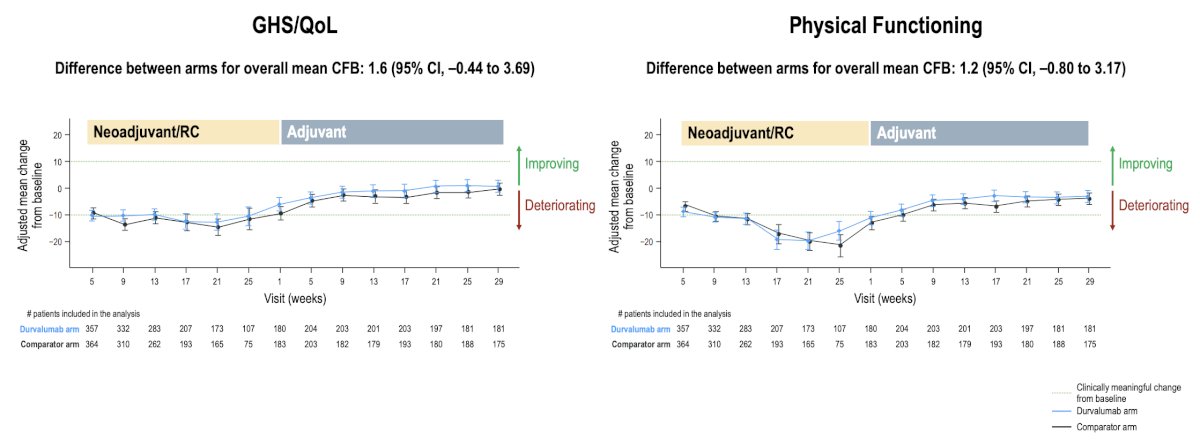
The addition of perioperative durvalumab to neoadjuvant chemotherapy did not adversely impact global health status/quality of life (difference between arms for overall mean CFB: 1.6, 95% CI -0.44 to 3.69), or physical functioning subscale scores (difference between arms for overall mean CFB: 1.2, 95% CI -0.80 to 3.17):
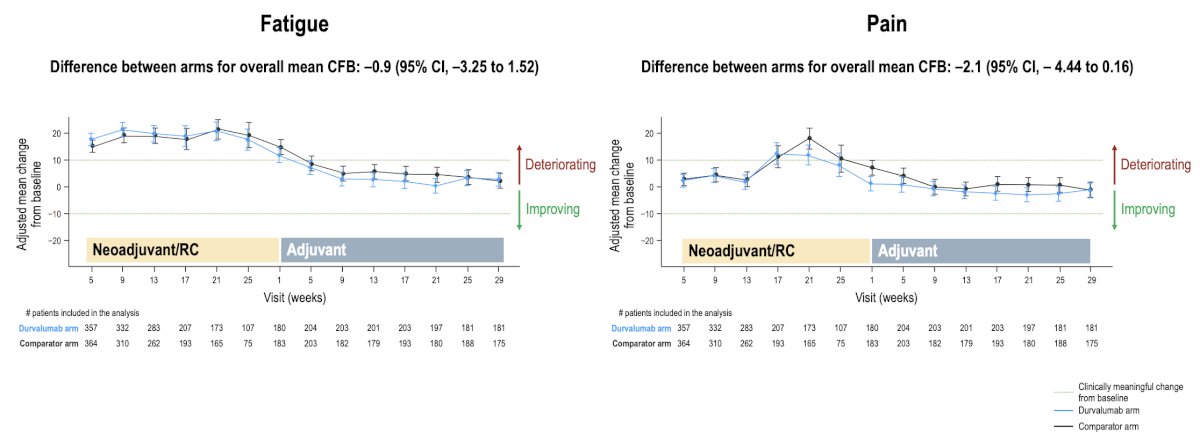
Furthermore, the addition of perioperative durvalumab to neoadjuvant chemotherapy did not adversely impact fatigue (difference between arms for overall mean CFB: -0.9, 95% CI -3.25 to 1.52) or pain subscale scores difference between arms for overall mean CFB: -2.1, 95% CI -4.44 to 0.16):
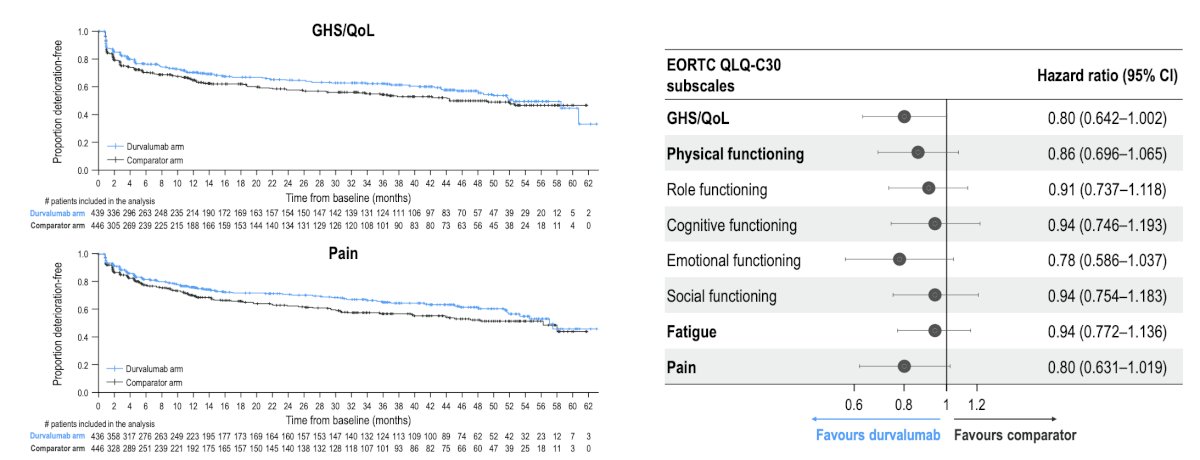
There was a comparable time to definitive deterioration between arms across all reported subscales, with a trend in favor or durvalumab:
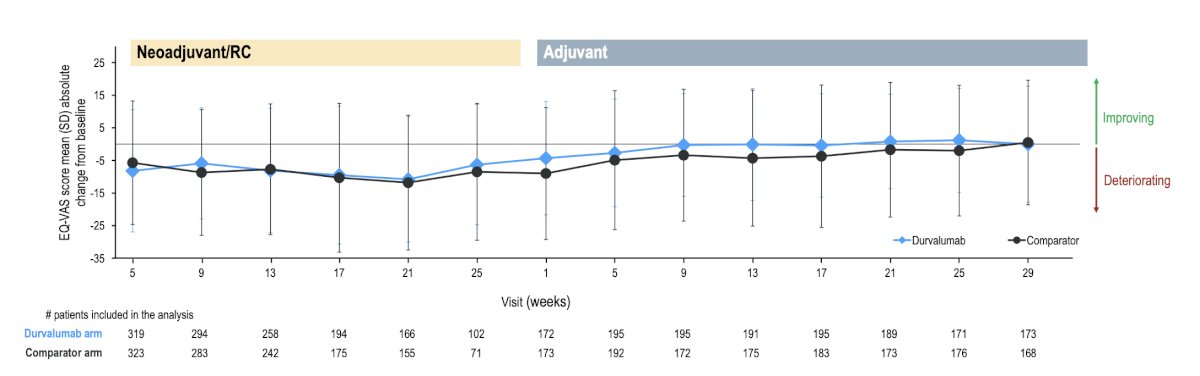
The addition of perioperative durvalumab to neoadjuvant chemotherapy did not adversely impact the EQ-visual analogue scale score. The mean baseline EQ-visual analogue scale score was 77.3 (SD 15.9) in the durvalumab arm and 74.9 (SD 16.9) in the comparator arm:
Dr. Van der Heijden concluded his presentation discussing health related quality of life outcomes from the NIAGARA trial with the following take home points:
- This study reports the largest prospective analysis of health related quality of life in patients with muscle invasive bladder cancer receiving perioperative treatment
- In the neoadjuvant and radical cystectomy period, both treatment arms had worsening health related quality of life scores, which improved in the adjuvant treatment period
- No clinically meaningful differences were observed between treatment arms for EORTC QLQ-C30 across the study period
- Comparable time to definitive deterioration was reported across all reported EORTC QLQ-C30 subscales
- There was no adverse impact on the EQ-5D-5L visual analogue scale score, with no differences between treatment arms across the study period
- The addition of perioperative durvalumab to neoadjuvant chemotherapy significantly improved event free survival and overall survival without adversely impacting patient-reported outcomes
Presented by: Michiel S. Van der Heijden, MD, PhD, Netherlands Cancer Institute, Amsterdam, Netherlands
Written by: Zachary Klaassen, MD, MSc – Urologic Oncologist, Associate Professor of Urology, Georgia Cancer Center, Wellstar MCG Health, @zklaassen_md on Twitter during the 2025 European Society of Medical Oncology (ESMO) Annual Congress held in Berlin, Germany, between September 17th and 21st.
References:
- Powles T, Catto JWF, Galsky MD, et al. Perioperative Durvalumab with Neoadjuvant Chemotherapy in Operable Bladder Cancer. N Engl J Med. 2024 Nov 14;391(1):1773-1786.
Health-Related Quality of Life Outcomes from the NIAGARA Trial in Bladder Cancer - Michiel Van Der Heijden