

Key Clinical Findings
The presentation highlighted several crucial preoperative risk factors that significantly impact surgical outcomes. Frailty assessment emerged as a central theme, with data showing that patients with higher modified frailty index scores (mFI-5-high) demonstrated significantly worse overall survival compared to low-risk patients (p=0.022). However, the challenge lies in the lack of consensus among the numerous available frailty assessment tools, including Charlson comorbidity index, ECOG, ASA scores, and various frailty scales.

Anemia management was identified as a critical but underutilized intervention. Research demonstrated that anemic cystectomy patients face a 50% increase in major complications within 90 days post-surgery, with comprehensive data showing significantly higher complication rates across all Clavien-Dindo classifications for anemic patients versus non-anemic patients.
Smoking Cessation and Lifestyle Interventions
The presentation addressed smoking cessation with mixed findings. While meta-analysis data confirmed that smoking status significantly increases major postoperative complications (HR 1.87), infections (HR 1.34), and mortality (HR 1.84), the STOP-OP randomized clinical trial showed no significant differences between intensive 6-week smoking/alcohol cessation interventions and standard care. This highlights the complexity of implementing effective preoperative lifestyle modifications.
Emerging Genomic Considerations
A significant portion focused on precision medicine approaches, particularly genomic profiling for neoadjuvant chemotherapy response prediction. The SWOG S1314 trial results demonstrated that mutations in ATM, RB1, ERCC2, or FANCC genes predicted pathologic complete response (pT0) after neoadjuvant chemotherapy, with 48% of patients with these mutations achieving pT0 compared to only 14% without mutations.
Comprehensive Assessment Protocols
The presentation introduced the GRACEM (Global Radical Cystectomy Evaluation and Management) pathway, a systematic 2-year prospective study protocol that incorporates multidisciplinary assessment including nutritional evaluation, frailty screening, geriatric consultation for patients ≥80 years, and comprehensive risk stratification. This approach represents a shift toward personalized, evidence-based preoperative optimization.

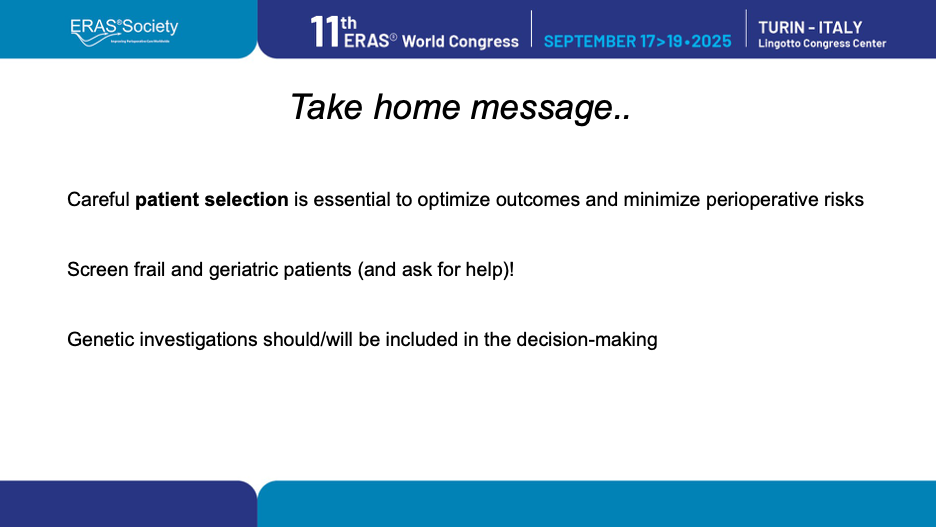
The overarching message emphasized that careful patient selection through comprehensive preoperative assessment—including frailty screening, anemia correction, and potentially genomic profiling—is essential for optimizing outcomes and minimizing perioperative risks in this high-risk surgical population.
Presented by: Ilaria Lucca, MD, University Hospital of Lausanne, Lausanne, Switzerland
Written by: Stephen B. Williams, MD, MBA, MS, FACS, FACHE @SWilliams_MD on Twitter during the 11th Enhanced Recovery After Surgery (ERAS®) World Congress, September 17-19, 2025, Turin, Italy