

(UroToday.com) The 2026 European Association of Urology (EAU) annual meeting featured a session exploring the frontier of upper tract urothelial carcinoma and a presentation by Dr. Zihao Tao discussing the preliminary results of a phase II study to evaluate the efficacy and safety of disitamab vedotin in combination with radiotherapy for adjuvant therapy in upper tract urothelial carcinoma. Although postoperative platinum-based adjuvant chemotherapy improved disease free survival in the POUT trial,1,2 many upper tract urothelial carcinoma patients were ineligible for cisplatin after radical nephroureterectomy. Moreover, adjuvant immunotherapy has shown little benefit for patients with upper tract urothelial carcinoma. Previous evidence demonstrated adjuvant radiotherapy improved cancer-specific survival in high risk upper tract urothelial carcinoma. Thus, further exploration of alternative adjuvant treatment strategies is needed. This study, presented at EAU 2026, aimed to evaluate the therapeutic potential of disitamab vedotin in combination with radiotherapy in HER2 overexpressing upper tract urothelial carcinomas.
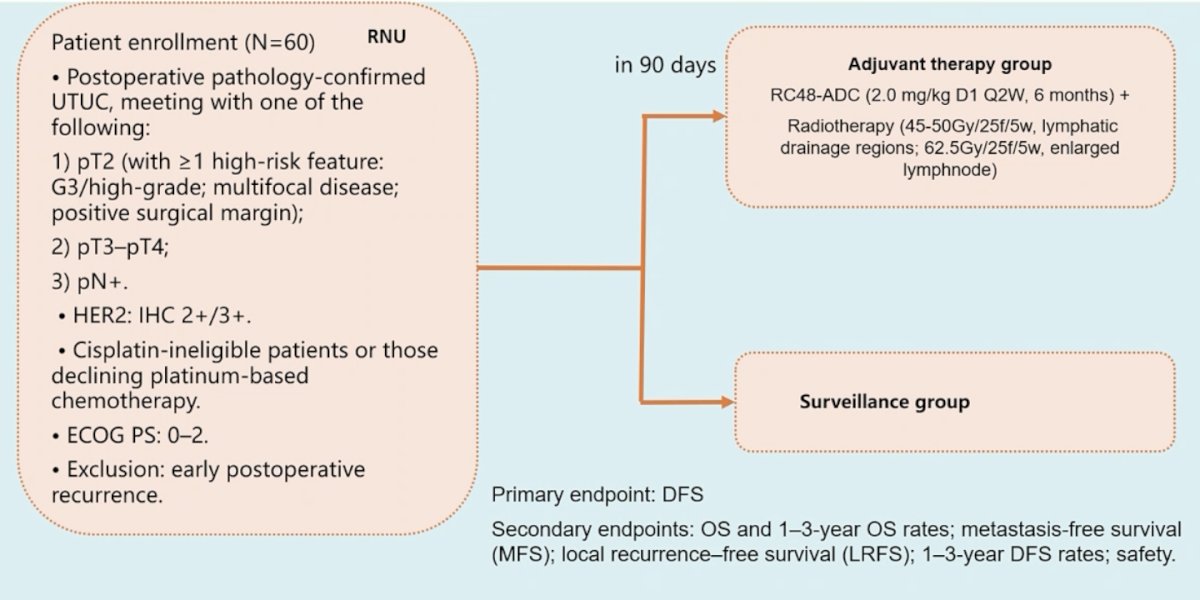
This is an open-label, phase II, non-randomized study to evaluate the efficacy and safety of disitamab vedotin, a humanized anti-HER2 antibody, in combination with radiotherapy as a novel adjuvant therapy strategy in upper tract urothelial carcinoma. The investigators recruited cisplatin intolerant patients with HER2-overexpressing (immunohistochemistry, IHC 2+, 3+) upper tract urothelial carcinoma after nephroureterectomy, staged as pT2N0M0 with high-grade/multifocal disease/positive surgical margin, pT3-4 N0 M0, or pTany N1-2 M0. Patients who declined any adjuvant therapy were assigned to the surveillance group. Patients in the adjuvant therapy group received disitamab vedotin (2.0 mg/kg D1 Q2W, 6 months) and radiotherapy (45-50Gy/25f) for 5 weeks in the lymphatic drainage regions, which was increased to 62.5Gy/25f for 5 weeks for those with enlarged lymph node(s). The therapy was initiated within 90 days of surgery. The primary endpoint was disease free survival, and secondary endpoints were overall survival, metastasis free survival, local recurrence free survival, and safety:
As of October 2025, 47 patients out of the planned 60 patients have been enrolled in the study, with median age of 66 years. Twenty-five patients were assigned to the adjuvant therapy group and 22 to surveillance. In the adjuvant therapy group, 16 patients completed adjuvant therapy, while 9 patients were undergoing treatment:

At a median follow-up of 12 months, one recurrence was observed in the adjuvant therapy group, while 8 patients in surveillance experienced recurrence. The 1-year disease free survival rates were 93.3% (95% CI 81.5–100) in the adjuvant therapy group and 72.7% (95% CI 56.3–93.9) in the surveillance group (p = 0.017).
As of now, the most common (≥20%) treatment related adverse events were peripheral sensory neuropathy (40%), increased AST (28%), asthenia (28%), and alopecia (20%). Grade ≥ 3 treatment related adverse events were observed in 2 patients (8%), and the patients experienced gastrointestinal hemorrhage and peripheral sensory neuropathy, respectively.
Dr. Tao concluded this presentation discussing the preliminary results of a phase II study to evaluate the efficacy and safety of disitamab vedotin in combination with radiotherapy for adjuvant therapy in upper tract urothelial carcinoma with the following take-home points:
- This study is the first to evaluate the efficacy and safety in adjuvant treatment of antibody drug conjugate + radiotherapy in upper tract urothelial carcinomas
- The combination of disitamab vedotin and radiotherapy as a new adjuvant therapy demonstrated a tolerable safety profile in patients with HER2-overexpressing upper tract urothelial carcinoma
- Further follow-up and full enrollment are ongoing
Presented by: Zihao Tao, Peking University First Hospital, Beijing, China
Written by: Zachary Klaassen, MD, MSc – Urologic Oncologist, Associate Professor of Urology, Georgia Cancer Center, Wellstar MCG Health, @zklaassen_md on Twitter during the 2026 European Association of Urology (EAU) Annual Meeting, London, United Kingdom, Fri, Mar 13 – Mon, Mar 16, 2026.
References:
- Birtle A, Johnson M, Chester J, et al. Adjuvant chemotherapy in upper tract urothelial carcinoma (the POUT trial): A phase 3, open-label, randomized controlled trial. Lancet 2020 Apr 18;395(10232):1268-1277.
- Birtle AJ, Jones R, Chester J, et al. Improved disease-free survival with adjuvant chemotherapy after nephroureterectomy for upper tract urothelial cancer: Final results of the POUT trial. J Clin Oncol. 2024 May 1;42(13):1466-1471.