

(UroToday.com) The 2026 European Association of Urology (EAU) annual meeting featured a biochemical recurrence and persistent PSA after local treatment of prostate cancer session and a presentation by Dr. Louise Emmett discussing the Co-PSMA trial, a prospective study comparing 64Cu-SAR-bis-PSMA versus 68Ga PSMA-11 PET/CT for prostate cancer detection in patients with biochemical recurrence after radical prostatectomy.
PSMA-PET has transformed the management of biochemical recurrence after radical prostatectomy due to higher diagnostic accuracy and management impact than previous imaging modalities. However, detection rates remain low at PSA levels at which men remain curable. 64Cu-SAR-bis-PSMA PET/CT is a novel PSMA peptide with a bivalently structured and 12-hour half-life. The objective of this study was to compare the detection rate (per patient) between 64Cu-SAR-bis-PSMA and 68Ga PSMA-11 PET/CT in patients with biochemical recurrence post radical prostatectomy prior to salvage radiotherapy.
Fifty patients with biochemical recurrence following radical prostatectomy (PSA 0.2-0.75ng/mL) were enrolled in this prospective comparative imaging trial (NCT06907641). 64Cu-SAR-bis-PSMA imaging (1 and 24 hours) was undertaken within 3 weeks of 68Ga PSMA-11 PET/CT on the same digital PET. Images were prospectively reported, and subsequently triple-read for reader concordance. Management impact questionnaires were undertaken after both 68Ga PSMA-11 and 64Cu-SAR-bis-PSMA. A standard of truth was used to determine accuracy and included biopsy, response to targeted treatment without ADT, or corroborative imaging (repeat 64Cu-SAR-bis-PSMA or MRI). The primary endpoint was the number of lesions per patient between 64Cu-SAR-bis-PSMA and 68Ga PSMA-11 PET/CT. Secondary endpoints included:
- Management impact questionnaires between 64Cu-SAR-bis-PSMA and 68Ga PSMA-11 PET/CT
- Reporting certainty: Blind expert triple reads (Cohen’s Kappa)
- Accuracy (composite reference standard): biopsy, response to targeted treatment without ADT, and PSA rise without treatment
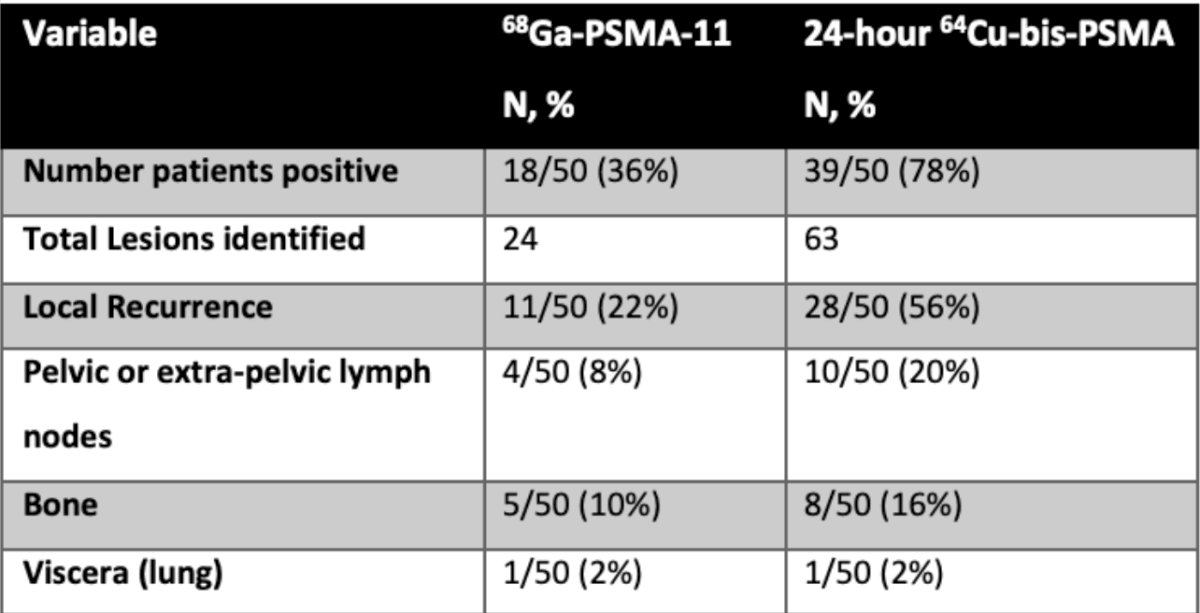
The median PSA was 0.43 (IQR: 0.31-0.63), with a median time since radical prostatectomy of 38 months (IQR: 16 - 82). All patients had pathological grade group ≥ 2, 37 (74%) were grade group > 2, and 37 (74%) pT3/4 disease. The mean per patient lesions were higher in 64Cu-SAR-bis-PSMA (n = 1.26) versus 68Ga PSMA-11 PET/CT (n = 0.48) (difference 0.78, 95% CI 0.52 – 1.04; ratio 2.63, 95% CI 1.64 – 4.20; p <0.0001). At a per-patient level, 36% (18/50) were positive on 68Ga PSMA-11 PET/CT compared to 78% (39/50) on the 24-hour 64Cu-SAR-bis-PSMA PET/CT (including all lesions confirmed on 68Ga PSMA-11 PET/CT). Total lesions identified were 24 versus 63 for 68Ga PSMA-11 PET/CT and 24-hour 64Cu-SAR-bis-PSMA respectively:
Planned management changed between scans in 22/50 (44%), with 12/22 (55%) changing from surveillance to radiotherapy. Cohen’s Kappa was 0.94 for 64Cu-SAR-bis-PSMA versus 0.75 for 68Ga PSMA-11 PET/CT based on blinded expert triple read using SPARC criteria. The diagnostic accuracy is as follows:
- True positive: 71% (24/34) for 64Cu-SAR-bis-PSMA versus 29% (10/34) for 68Ga PSMA-11 PET/CT
- False negative: 21% (7/34) for 64Cu-SAR-bis-PSMA versus 65% (22/34) for 68Ga PSMA-11 PET/CT
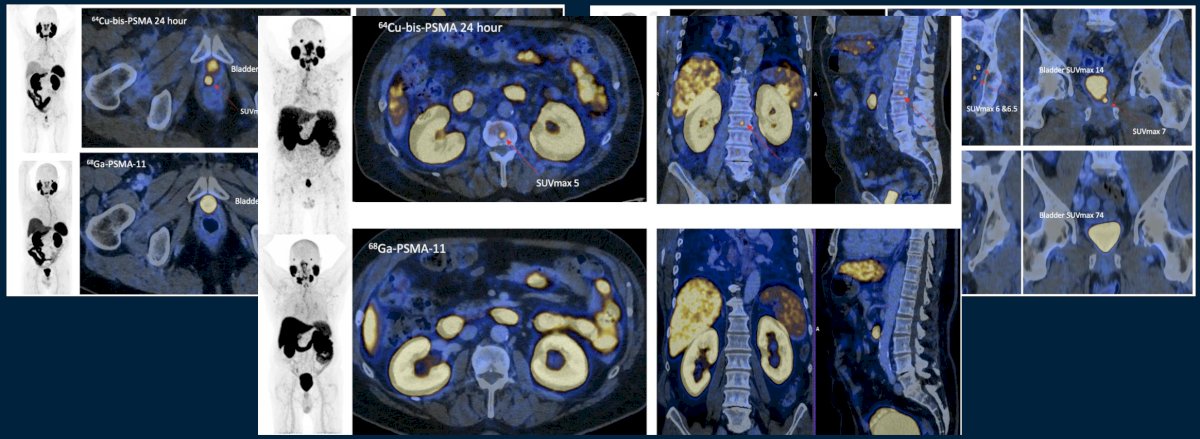
Dr. Emmett concluded her presentation discussing the Co-PSMA trial by emphasizing that 64Cu-SAR-bis-PSMA PET/CT (24-hour) identifies a higher number of disease recurrences than 68Ga PSMA-11 PET/CT, with substantial management impact and a high composite reference standard true positive rate in men with biochemical recurrence post radical prostatectomy.
Presented by: Louise Emmett, MD, MBChB, FRACP, FAANMS, Professor, Director of Theranostics and Nuclear Medicine, St. Vincent’s Hospital Sydney, University of New South Wales, Sydney, Australia
Written by: Zachary Klaassen, MD, MSc – Urologic Oncologist, Associate Professor of Urology, Georgia Cancer Center, Wellstar MCG Health, @zklaassen_md on Twitter during the 2026 European Association of Urology (EAU) Annual Meeting, London, United Kingdom, Fri, Mar 13 – Mon, Mar 16, 2026.
Related content: The Co-PSMA Trial: Comparing PSMA PET Tracers in Biochemically Recurrent Prostate Cancer - Louise Emmett
Co-PSMA Trial Explores Tracer for Detecting Recurrence After Radical Prostatectomy - Louise Emmett