

(UroToday.com) The 2026 European Association of Urology (EAU) annual meeting featured an advancement in metastatic castration resistant prostate cancer (mCRPC) therapy session and a presentation by Dr. Takuma Kato discussing a multicenter retrospective analysis in Japan assessing safety and skeletal event profile of radium-223 combined with enzalutamide in mCRPC. The PEACE-3 trial showed improved radiographic progression-free survival with radium-223 + enzalutamide compared to enzalutamide alone in mCRPC.1
However, data on treatment safety and skeletal event risk in real-world settings are still limited. This study examined hematologic and non-hematologic toxicities, as well as the incidence and risk factors for symptomatic skeletal events in patients receiving radium-223 with or without enzalutamide.
Dr. Kato and colleagues retrospectively analyzed patients with mCRPC who received radium-223 from January 2020 to December 2023 across 84 Japanese institutions. Eligible cases included those treated with radium-223 + ADT + enzalutamide or radium-223 with ADT alone. Patients receiving other systemic therapies were excluded, and propensity score matching balanced baseline variables. The primary endpoints were safety and symptomatic skeletal event incidence, and secondary endpoints included time to progression, overall survival, 6-cycle completion, and pain non-deterioration rate.
A total of 386 patients were analyzed after matching (n = 192 receiving radium-223 + enzalutamide; n = 194 receiving radium-223 monotherapy), with a median age of 74 years, 82% had ECOG performance status 0–1, and 74% had ≤EOD2 disease. Prior androgen receptor pathway inhibitor exposure during the CRPC phase was higher in the radium-223 + enzalutamide group (111.4% versus 90.2%; multiple responses allowed), while prior chemotherapy was less common (30.2% versus 51.5%). Over 70% of patients in both groups completed at least six cycles:

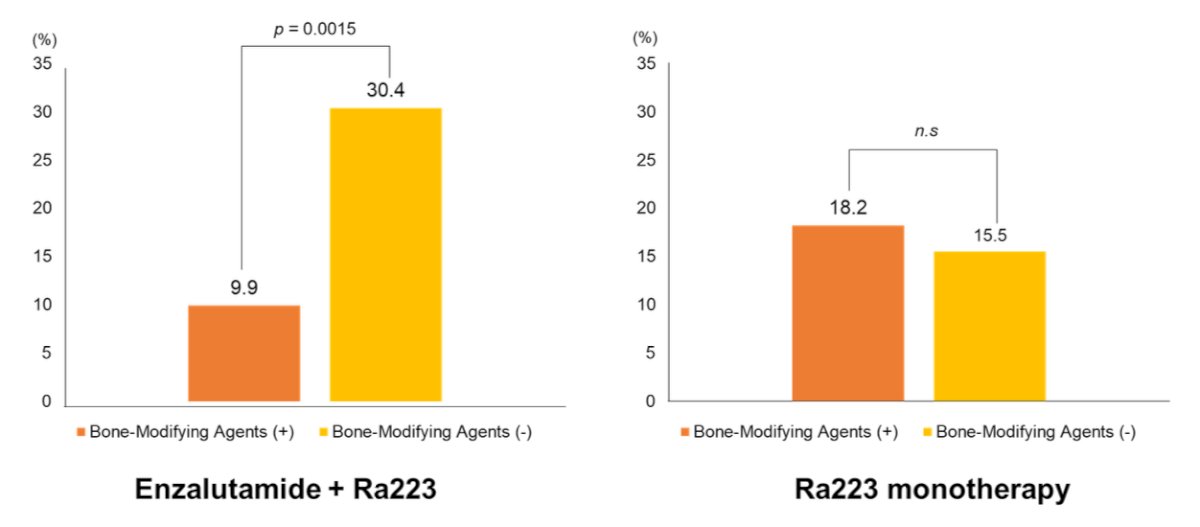
Grade ≥3 hematologic toxicities were uncommon (anemia 6.1%, neutropenia 5.2%), and non-hematologic adverse events were rare. The absence of bone-modifying agents was the strongest predictor of symptomatic skeletal events occurrence (RR 3.09, p = 0.0015):
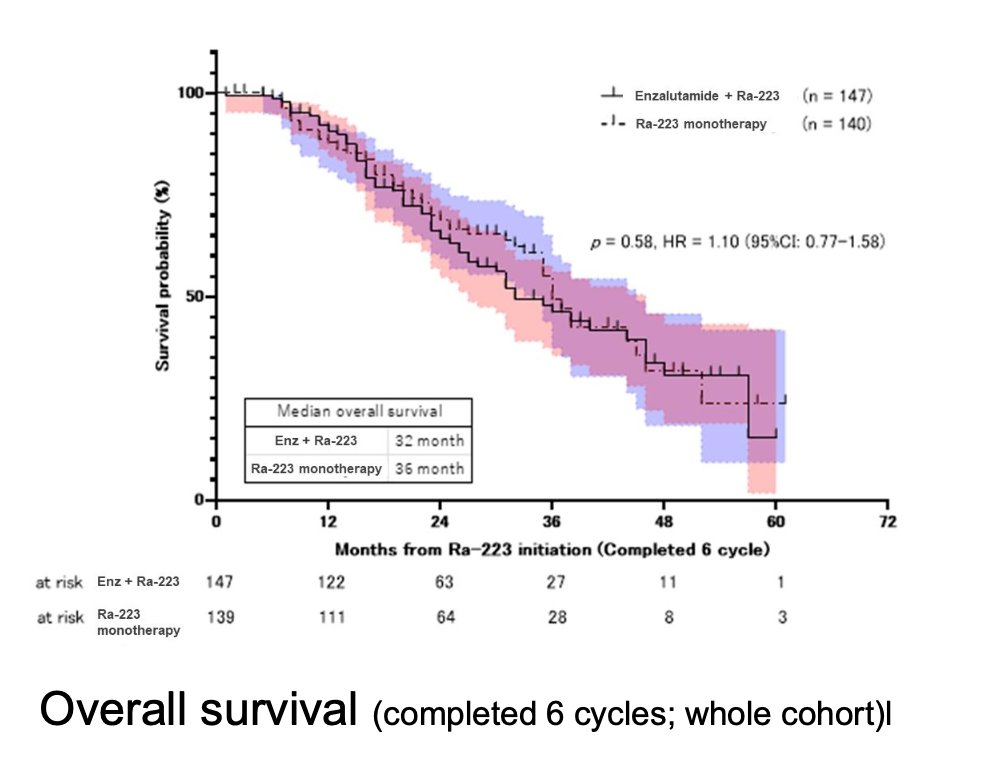
No treatment-related deaths were observed. The median time to progression was longer in the ADT + enzalutamide group (6 versus 5 months, p = 0.01), while overall survival and cancer-specific survival were similar between groups (32 versus 36 months; 35 versus 37 months):
Dr. Kato concluded this presentation discussing a multicenter retrospective analysis in Japan assessing safety and skeletal event profile of radium-223 combined with enzalutamide in mCRPC with the following take-home points:
- Radium-223 combined with enzalutamide showed good tolerability and low rates of severe toxicities in patients with mCRPC
- The absence of bone-modifying agents greatly increased the risk of symptomatic skeletal events, emphasizing the importance of preventive bone management during combination therapy
Presented by: Takuma Kato, MD, PhD, Kagawa University, Miki-Cho, Japan
Written by: Zachary Klaassen, MD, MSc – Urologic Oncologist, Associate Professor of Urology, Georgia Cancer Center, Wellstar MCG Health, @zklaassen_md on Twitter during the 2026 European Association of Urology (EAU) Annual Meeting, London, United Kingdom, Fri, Mar 13 – Mon, Mar 16, 2026.
Reference: