

(UroToday.com) The 2026 European Association of Urology (EAU) annual meeting featured a late breaking abstracts session and a presentation by Dr. Karen Buch-Olsen discussing results from the PRISMA-PET randomized trial assessing progression free survival following primary staging with 18F-PSMA-1007-PET/CT versus 18NaF-PET/CT in prostate cancer. Newly diagnosed high-risk and unfavorable intermediate-risk prostate cancer patients (PSA > 20 ng/mL or cT2c disease or Gleason >= 4+3 or clinical suspicion of metastases) were enrolled in the multicenter, randomized, controlled clinical trial, PRISMA-PET. All participants underwent staging with 18NaF-PET/CT or 18F-PSMA-1007-PET/CT following 1:1 randomization. The study followed the intention to treat principle, and patient management adhered to routine clinical practice. After a minimum of one year of follow-up, the investigators extracted data on time to progression or death from the patient records. Progression free survival was compared between the groups as the primary endpoint using Cox proportional hazards regression, and model-based Kaplan-Meier plots were generated. Secondary endpoints included a group comparison of pelvic lymph node and metastatic stage, and treatment allocation.
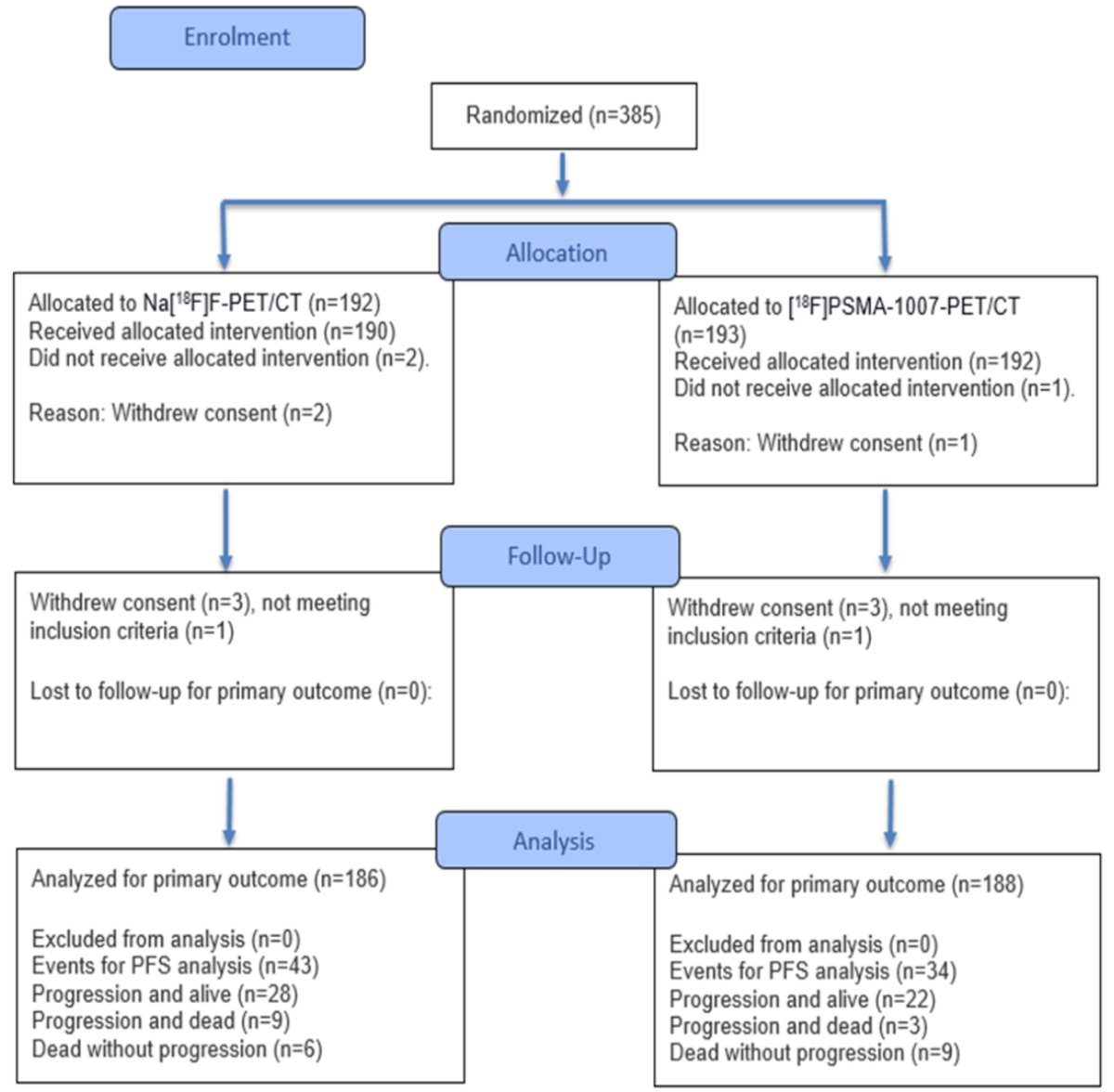
PRISMA-PET enrolled 385 patients from October 2021 to January 2025, of which 11 were excluded, leaving 186 patients in the 18NaF-PET/CT group and 188 patients in the 18F-PSMA-1007-PET/CT group:
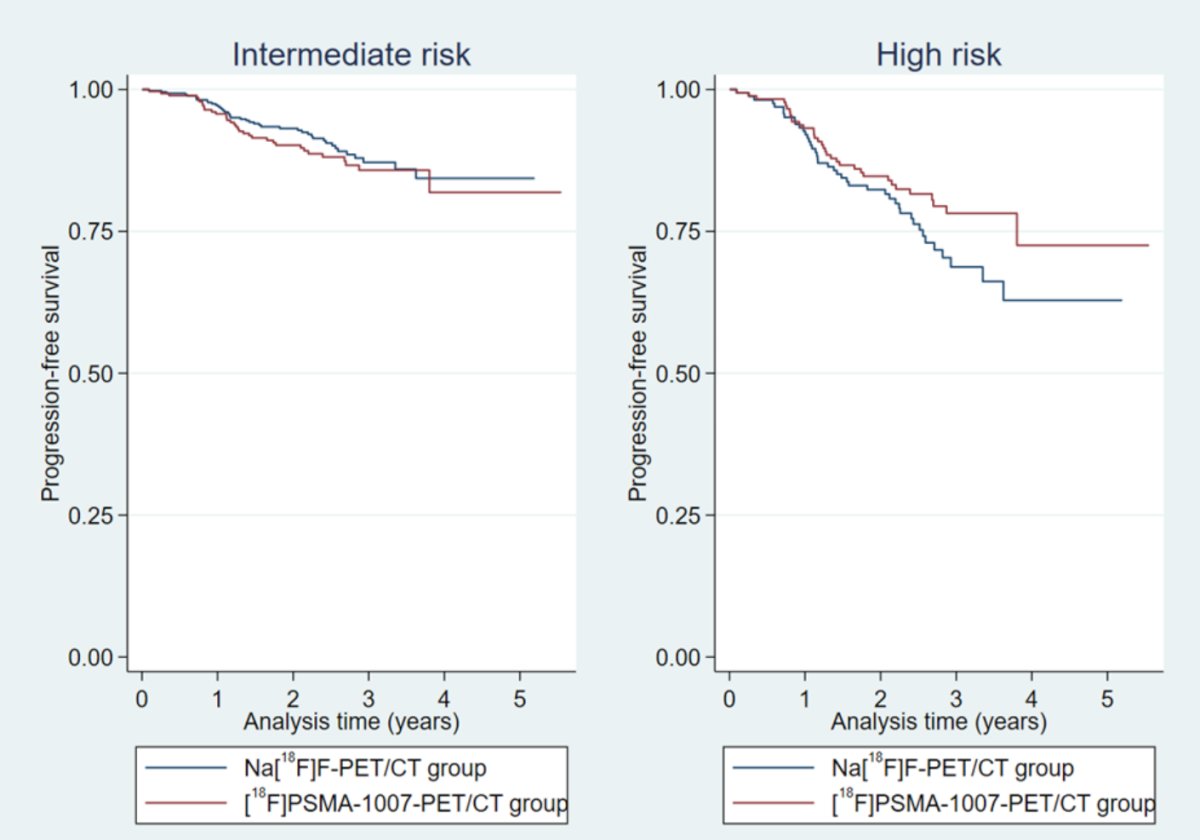
Baseline characteristics were balanced. Progression occurred more often in the 18NaF-PET/CT group (n = 43, 23%) than in the 18F-PSMA-1007-PET/CT group (n = 34, 18%; p = 0.25). The adjusted hazard ratio was 0.74 (95% CI: 0.47–1.16; p = 0.19), indicating a trend favoring 18F-PSMA-1007-PET/CT. Model-based Kaplan-Meier plots showed similar progression free survival during the first 2 years, with a subsequent tendency toward longer progression free survival in the 18F-PSMA-1007-PET/CT group in high-risk patients:
There was a difference in disease stage between groups (NxM1a): 18NaF-PET/CT 3 patients (1.6%) versus 18F-PSMA-1007-PET/CT 12 patients (6.4%). Additionally, there was a difference in treatment plans between groups: radiotherapy + life-long ADT – 18NaF-PET/CT 10 patients (5.4%) versus 18F-PSMA-1007-PET/CT 23 patients (12.2%).
Dr. Buch-Olsen concluded her presentation discussing results from the PRISMA-PET randomized trial with the following take-home points:
- Staging with 18F-PSMA-1007-PET/CT affected disease stage and treatment allocation compared with 18NaF-PET/CT in newly diagnosed prostate cancer
- Although progression free survival did not differ significantly between groups, a late-emerging trend suggested a potential long-term benefit for high-risk patients staged with 18F-PSMA-1007-PET/CT
Presented by: Karen M. Buch-Olsen, MD, Odense University Hospital, Odense, Denmark
Written by: Zachary Klaassen, MD, MSc – Urologic Oncologist, Associate Professor of Urology, Georgia Cancer Center, Wellstar MCG Health, @zklaassen_md on Twitter during the 2026 European Association of Urology (EAU) Annual Meeting, London, United Kingdom, Fri, Mar 13 – Mon, Mar 16, 2026.