

(UroToday.com) The 2026 European Association of Urology (EAU) annual meeting featured a late-breaking abstracts session and a presentation by Dr. Shuang Hao discussing health-related quality of life and health anxiety in men undergoing screening for prostate cancer.
Due to a persistent lack of preference-based health state values (also called utilities) for men undergoing prostate cancer screening, existing economic evaluations have relied on assumptions or values derived from breast cancer. The primary aim of this study, presented at EAU 2026, was to assess the impact of prostate cancer screening on the health-related quality of life and health anxiety of men. A secondary aim was to derive preference-based values for health states alongside screening. Dr. Hao and colleagues also estimated the participants’ willingness to pay for an alternative test with equivalent efficacy that avoids discomfort associated with MRI and biopsy procedures.
The investigators conducted a panel study among men aged 50-74 years in the third round (December 2024 – January 2026) of the STHLM3-MRI trial. Participants were invited to complete digital surveys up to four time points: baseline (T1), and after receiving results of blood test (T2), MRI (T3), and biopsy (T4), depending on individual test outcomes. The surveys included:
- EQ-5D-5L, the most widely used health-related quality of life measure in Europe
- The Short Health Anxiety Inventory (SHAI-14), a validated 14-item measure of health anxiety
- Two willingness to pay questions
EQ-5D-5L dimension responses, index values, and willingness to pay values were presented descriptively:
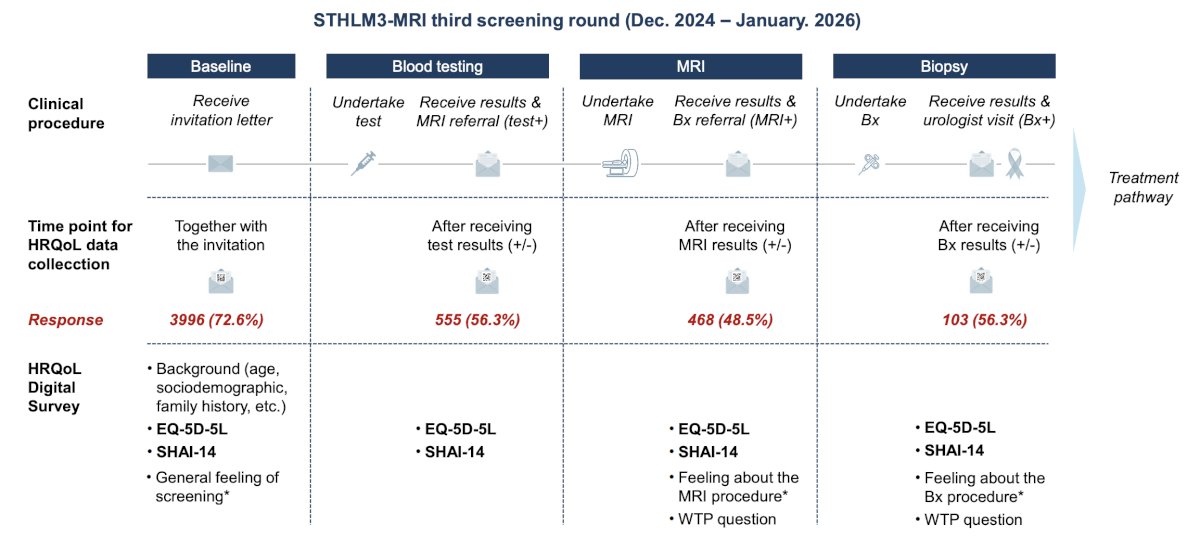
Linear mixed models were used to assess whether screening affected EQ-5D-5L index values and SHAI-14 scores, adjusting for social-demographic characteristics and test results.
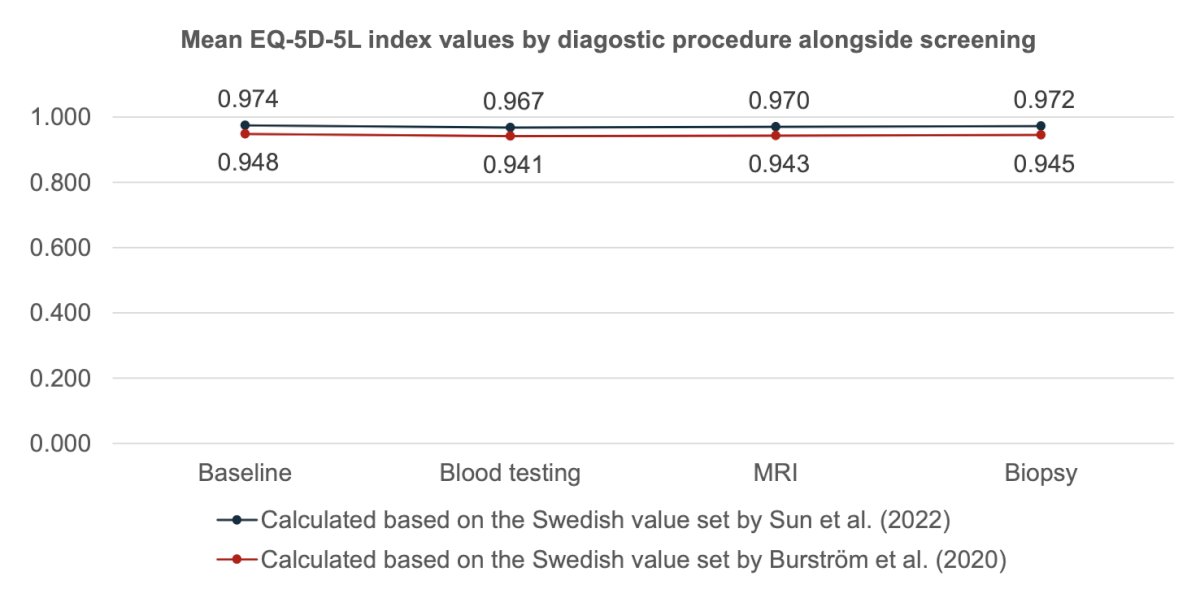
Among men invited to digital surveys, 3,996 (72.6%), 555 (56.3%), 468 (48.5%), and 103 (56.3%) responded at T1-T4, respectively. Screening had a limited impact on health-related quality of life and health anxiety. Mean adjusted EQ-5D-5L index values ranged from 0.941 to 0.975 per the choice of value set:
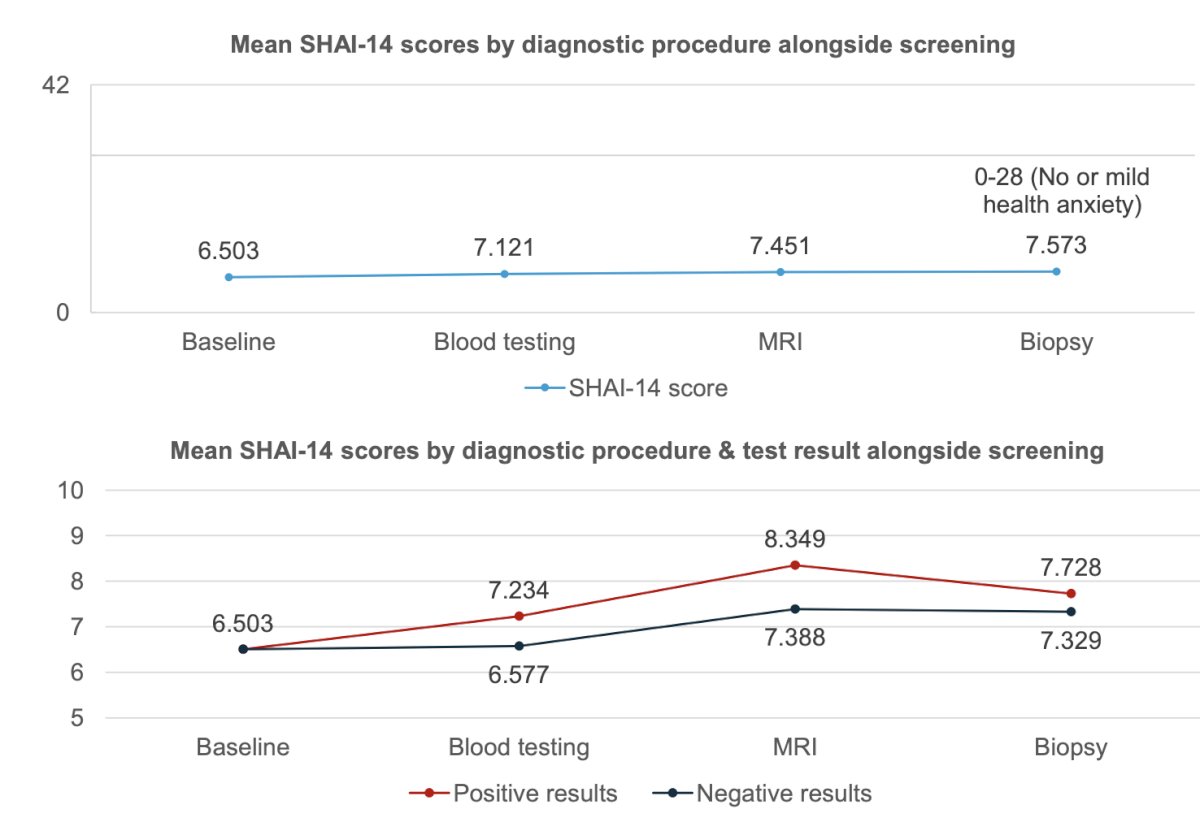
Mean adjusted SHAI-14 scores rose from 6.503 (95% CI 6.483, 6.522) at T1, to 7.573 (7.422, 7.723) at T4, but remained within the no or mild anxiety range. Having positive tests were associated with higher health anxiety:
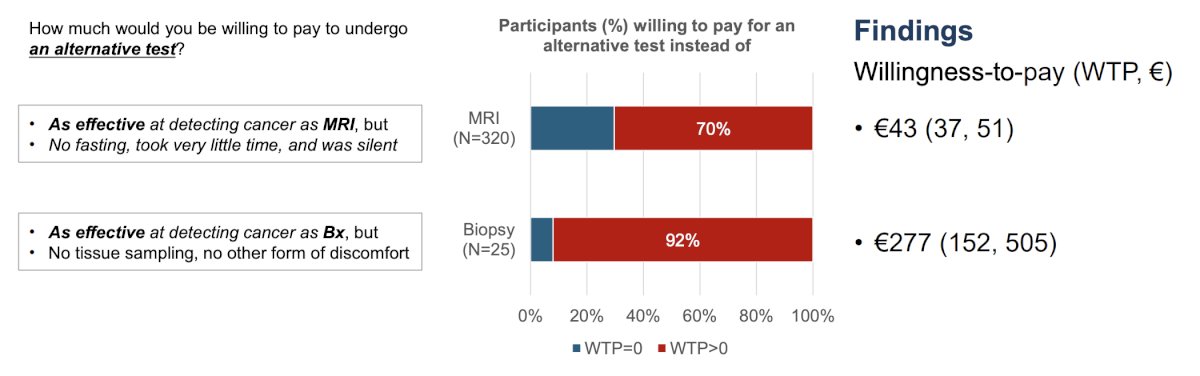
Among men who were willing to pay for alternatives to MRI and biopsy, mean willingness to pay was €43 (37, 51) and €277 (152, 505), respectively:
Limitations of this analysis noted by Dr. Hao include a potential selection bias, given that respondents had at least one prior screening.
Dr. Hao concluded this presentation discussing health-related quality of life and health anxiety in men undergoing screening for prostate cancer with the following take-home points:
- This is the first study measuring health-related quality of life and health anxiety alongside MRI-based screening
- Screening has a modest impact on health-related quality of life and health anxiety among participants
- This is a prerequisite for the establishment of a screening program
- This data fills in a long-standing evidence gap
- This data provides critical inputs for future economic evaluations to inform screening policy
Presented by: ZShuang Hao, PhD, MPH, MSc, BSc, Karolinska Institutet, Stockholm, Sweden
Written by: Zachary Klaassen, MD, MSc – Urologic Oncologist, Associate Professor of Urology, Georgia Cancer Center, Wellstar MCG Health, @zklaassen_md on Twitter during the 2026 European Association of Urology (EAU) Annual Meeting, London, United Kingdom, Fri, Mar 13 – Mon, Mar 16, 2026.