

(UroToday.com) The 2026 European Association of Urology (EAU) annual meeting featured an advancements in diagnosis and prognosis, and personalized treatment for renal cell carcinoma (RCC) session and a presentation by Dr. T.J. van der Werff discussing the impact of girentuximab based radionuclide imaging in patients with RCC on virtual tumor board decision making. Girentuximab is a monoclonal antibody targeting carbonic anhydrase IX (CAIX), which is overexpressed in clear cell RCC:
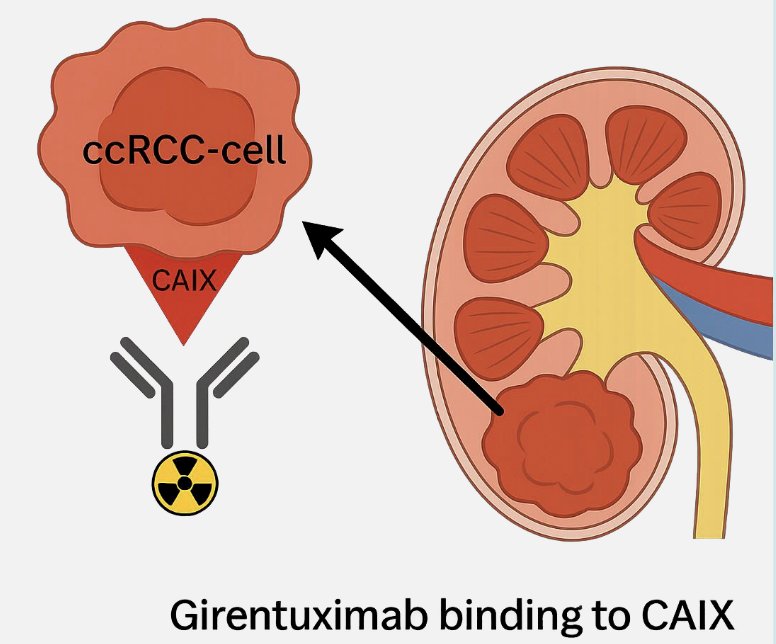
In recent years, promising results have been reported with girentuximab which was proven to be capable of accurately detecting both primary (ZIRCON trial [1]) and metastatic clear cell RCC. This study further explores the additional value of girentuximab-based imaging on clinical decision making.
In this single center, retrospective study, a total of 99 patients with the suspicion of primary or recurrent RCC were identified who had undergone girentuximab based imaging (SPECT or PET/CT) between January 1, 2007 and June 1, 2024. A virtual tumor board meeting was composed including urologists, a medical oncologist and a radiologist. First, the pseudonymized cases were discussed in a virtual tumor board where the healthcare professionals were blinded for the results of the girentuximab imaging (virtual tumor board 1 – standard of care diagnostics, including contrast enhanced CT and/or MRI). The multidisciplinary team was asked to formulate an advice per case. Following virtual tumor board 1, the same cases were discussed in a subsequent tumor board meeting (virtual tumor board 2 – standard of care diagnostics + girentuximab-based imaging), with the addition of the results of the girentuximab imaging. The results of virtual tumor board 1 and virtual tumor board 2 were compared and analyzed descriptively.
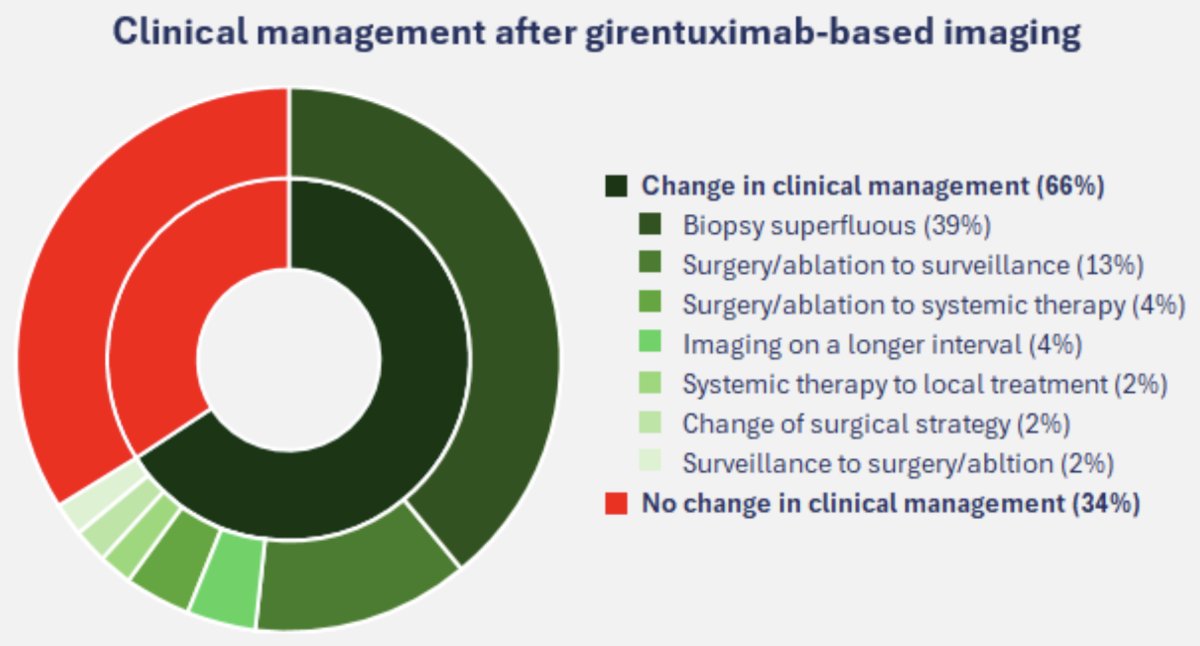
To date, data from 53 out of 99 patients have been collected and discussed in the virtual tumor board meetings. In the majority of cases a change in clinical management was found in 66% of the cases, where the advice from virtual tumor board 1 differed from that of virtual tumor board 2. In 39% of cases a biopsy would be omitted. A change of therapeutic approach was recommended in 23% of cases. The proposed therapeutic modifications included a shift from active local treatment (surgery/ablation) to surveillance (13%) and vice versa (2%), local treatment to systemic therapy (4%) and vice versa (2%), or a change of surgical strategy (2%):
Dr. van der Werff concluded this presentation discussing the impact of girentuximab based radionuclide imaging in patients with RCC on virtual tumor board decision making with the following take-home points:
- Interim analysis of the impact of girentuximab based imaging on clinical decision making demonstrates a marked reduction for the need of biopsies
- Moreover, major changes in clinical management were obtained in a substantial number of patients with suspected clear cell RCC
Presented by: T.J. van der Werff, MD, Radboud University Medical Center, Nijmegen, The Netherlands
Written by: Zachary Klaassen, MD, MSc – Urologic Oncologist, Associate Professor of Urology, Georgia Cancer Center, Wellstar MCG Health, @zklaassen_md on Twitter during the 2026 European Association of Urology (EAU) Annual Meeting, London, United Kingdom, Fri, Mar 13 – Mon, Mar 16, 2026.
References: