

(UroToday.com) The 2026 European Association of Urology (EAU) annual meeting featured a surgical and non-surgical treatment of non-muscle invasive bladder cancer session and a presentation by Dr. Aaryan Sandhu discussing blue-light guided transurethral laser ablation for non-muscle invasive bladder cancer.
Blue light cystoscopy enhances the visualization of urothelial tumors and may help reduce recurrence in non-muscle invasive bladder cancer. Transurethral laser ablation has more recently emerged as a minimally invasive alternative to conventional resection for selected non-muscle invasive bladder cancer cases, with favorable perioperative outcomes. However, the use of blue-light guidance in laser ablation remains unstudied. This study, presented at EAU 2026, reports the first UK single-center experience evaluating recurrence-free survival following blue light-guided transurethral laser ablation compared with white light transurethral laser ablation, and explores which risk groups may derive the most benefit.
A retrospective review was conducted using a prospectively maintained database at Guy’s and St Thomas’ NHS Foundation Trust (2020–2025). All patients undergoing transurethral laser ablation for non-muscle invasive bladder cancer were considered, and cases with prior muscle invasive disease were excluded. Data on demographics, tumor pathology, and treatment were collated, and subjects were stratified by EAU 2025 risk categories (low, intermediate, high, very high). Recurrence-free survival was assessed using Kaplan–Meier survival curves, and compared between blue light-guided transurethral laser ablation and white light transurethral laser ablation groups.
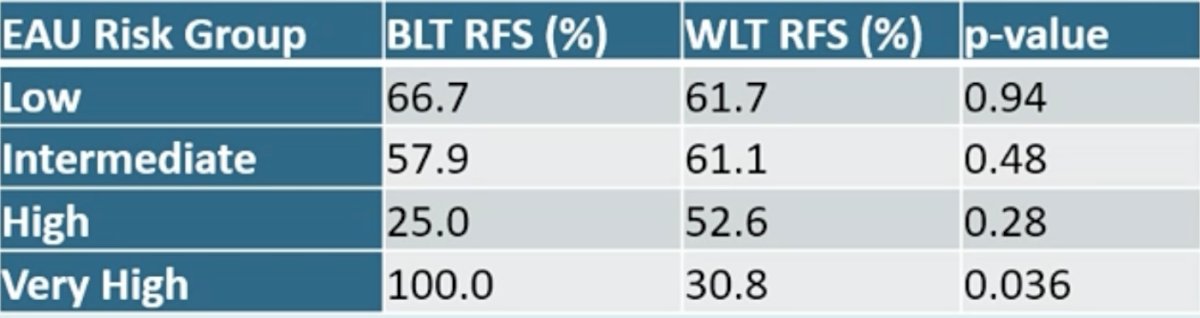
A total of 253 patients were included (70 blue light guided transurethral laser ablation, 183 white light transurethral laser ablation). The median age was 73.8 years (IQR 67–81), and 71% were male. Distribution by EAU risk was 56 low-, 133 intermediate-, 46 high-, and 18 very high-risk. Overall, 112 patients (44%) developed recurrence within 12 months, and Kaplan Meier analysis confirmed a progressive decline in recurrence-free survival with increasing EAU risk (p < 0.001). However, there was no significant overall difference between blue light and white light transurethral laser ablation, although there was a trend towards improved recurrence-free survival with blue light-guided transurethral laser ablation noted in very high-risk cases:
Dr. Sandhu concluded his presentation discussing blue-light guided transurethral laser ablation for non-muscle invasive bladder cancer with the following take-home points:
- Blue light-guided transurethral laser ablation demonstrated recurrence-free survival comparable to white light procedures
- When analyzed by EAU risk, outcomes were similar in low-, intermediate-, and high-risk groups, but a potential advantage for blue light emerged in very high-risk non-muscle invasive bladder cancer
- These findings suggest that optical enhancement may aid tumor control in selected high-risk patients
- As transurethral laser ablation continues to expand as a minimally invasive option for non-muscle invasive bladder cancer, further multicenter studies are warranted to confirm these results and better define where blue-light guidance adds clinical value
Presented by: Aaryan Sandhu, Guy’s Hospital, Guy’s and St. Thomas’ Foundation Trust, London, United Kingdom
Written by: Zachary Klaassen, MD, MSc – Urologic Oncologist, Associate Professor of Urology, Georgia Cancer Center, Wellstar MCG Health, @zklaassen_md on Twitter during the 2026 European Association of Urology (EAU) Annual Meeting, London, United Kingdom, Fri, Mar 13 – Mon, Mar 16, 2026.