

(UroToday.com) The 2026 European Association of Urology (EAU) annual meeting featured a surgical and non-surgical treatment of non muscle invasive bladder cancer session and a presentation by Dr. Jethro Kwong discussing the prediction of progression in BCG-naïve high-risk non muscle invasive bladder cancer using PROGRxN-BCa. Dr. Kwong and colleagues previously developed PROGRxN-BCa, an artificial intelligence-based tool to predict progression risk in non muscle invasive bladder cancer.1 For this study at EAU 2026, they aimed to evaluate whether PROGRxN-BCa can predict progression in high-risk non muscle invasive bladder cancer patients treated with intravesical BCG.
PROGRxN-BCa was previously trained on 14 clinicopathological features from 3,324 non muscle invasive bladder cancer patients treated from 2005-2022 at four Canadian institutions, without restrictions to non muscle invasive bladder cancer risk groups. External testing was performed in 1,903 BCG-naïve patients with high-risk non muscle invasive bladder cancer (per EAU criteria) treated from 2005 to 2023 across 30 North American and European centers. All patients were treated with BCG following tumour resection. The primary outcome was time to progression (muscle invasive or metastatic disease). PROGRxN-BCa classified patients as low- or high-risk for progression based on the 80th percentile cutoff from the training cohort risk scores. Cumulative incidence curves and multivariable Cox regression were performed to determine the association between this dichotomization and progression risk.
The cohort included 507 Ta, 1,195 T1, and 201 CIS-only patients. Among Ta/T1 patients, 354 had concomitant CIS. Over a median follow-up of 3.3 years (IQR 1.7-5.6), 195 patients progressed. The estimated five-year progression rates were 23% in high-risk versus 12% in low-risk patients (log-rank p < 0.0001). Among those who received adequate BCG, these rates were 15% versus 8%, respectively (log-rank p = 0.0009):

PROGRxN-BCa high-risk classification was associated with worse progression (HR 2.52, 95% CI 1.78-3.58, p < 0.0001). This finding was consistent regardless of age group, tumour history, presence of concomitant CIS, number of tumors, tumor diameter, or treatment group (HRs 2.08-2.97).
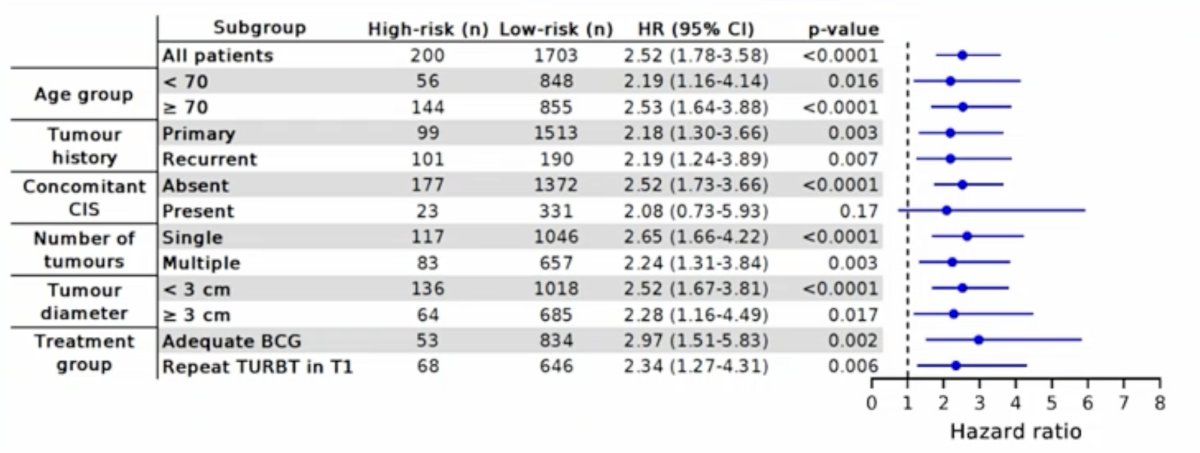
PROGRxN-BCa also remained an independent predictor of progression after adjusting for known clinicopathological risk factors (HR 1.97, 95% CI 1.33-2.93, p = 0.0008).
Dr. Kwong concluded his presentation discussing the prediction of progression in BCG-naïve high-risk non muscle invasive bladder cancer using PROGRxN-BCa with the following take-home points:
- In this international cohort of BCG-naïve patients with high-risk non muscle invasive bladder cancer, PROGRxN-BCa identified individuals at increased risk of progression despite BCG treatment
- This tool can inform personalized non muscle invasive bladder cancer management and selection of alternative bladder sparing therapies
Presented by: Jethro Kwong, MD, University of Toronto, Toronto, Ontario, Canada
Written by: Zachary Klaassen, MD, MSc – Urologic Oncologist, Associate Professor of Urology, Georgia Cancer Center, Wellstar MCG Health, @zklaassen_md on Twitter during the 2026 European Association of Urology (EAU) Annual Meeting, London, United Kingdom, Fri, Mar 13 – Mon, Mar 16, 2026.
References:
- Kwong JCC, Al-Daqqaq Z, Chelliahpillai Y, et al. Development and International Evaluation of an Artificial Intelligence-based Model (PROGRxN-BCa) Using the World Health Organization 2004/2022 Grading System to Predict Progression Risk and Improve Substratification for Non-muscle-invasive Bladder Cancer. Eur Urol. 2025 Oct 7 [Epub ahead of print].