

(UroToday.com) The 2026 European Association of Urology (EAU) annual meeting featured a urology trials in bladder and prostate cancer session and a presentation by Dr. Meghan McNamara discussing a trial in progress evaluating urinary minimal residual disease and outcomes in high-risk non-muscle invasive bladder cancer surveilled with blue light compared to white light cystoscopy.
Management of high-risk non-muscle invasive bladder cancer remains a significant clinical challenge, as up to 70% of cases recur and 45% of cases progress to muscle invasive bladder cancer. Previous studies have demonstrated a nine-fold higher recurrence risk in minimal residual disease-positive patients after visually complete TURBT and a correlation between lower Genomic Disease Burden scores and improved intravesical therapy response. These findings highlight that TURBT completeness is a pivotal predictor of clinical outcomes.
Blue light cystoscopy has shown improved detection for high-risk lesions, including CIS, compared to white light cystoscopy. UroAmp offers a non-invasive urinary genomic profiling highlighting 60 genes associated with urothelial carcinoma, assesses minimal residual disease, and quantifies Genomic Disease Burden. To date, no study has quantitatively compared the efficacy of blue light cystoscopy versus white light cystoscopy using urinary minimal residual disease and Genomic Disease Burden assessments. This prospective randomized controlled trial seeks to evaluate whether blue light cystoscopy-guided TURBT leads to greater reductions in Genomic Disease Burden scores and improved clinical outcomes compared to white light cystoscopy in patients with high-risk non-muscle invasive bladder cancer.
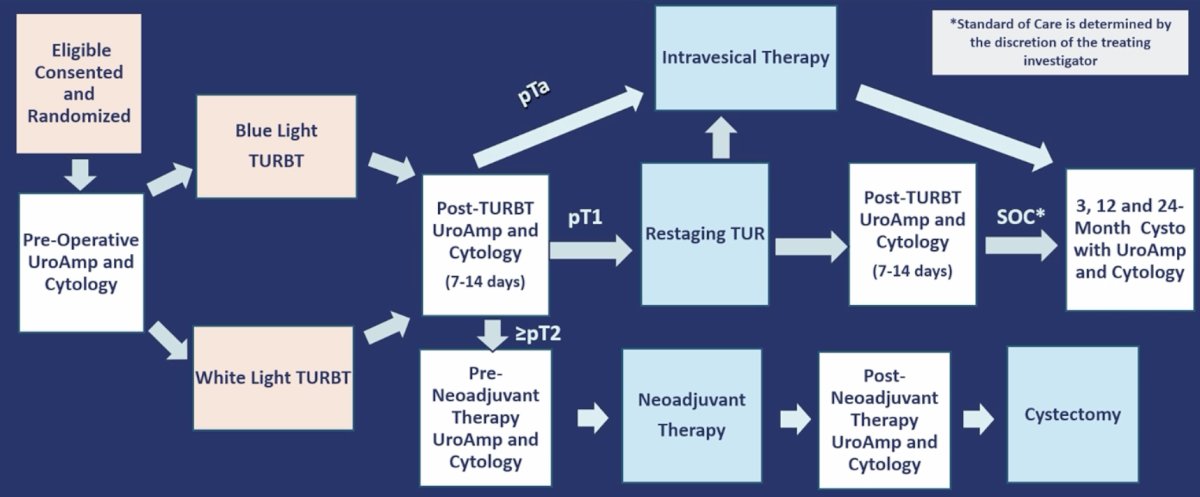
This prospective randomized controlled trial will enroll 200 subjects undergoing TURBT for suspected high-risk non-muscle invasive bladder cancer. Participants are randomized to receive either blue light cystoscopy or white light cystoscopy. Subsequent cystoscopies follow standard of care indications. Subjects aged ≥18 years with suspected high-risk non-muscle invasive bladder cancer and TURBT candidates are eligible. Key exclusion criteria include prior systemic therapy for bladder cancer, history of pelvic radiation, or current diagnosis of muscle-invasive bladder cancer or upper tract urothelial carcinoma. Study time points and UroAmp collections are specified in the following figure:
The primary endpoint is the post-TURBT difference in Genomic Disease Burden scores between the blue light cystoscopy and white light cystoscopy arms, assessed using a multiple linear regression model controlling for pathologic stage and pre-TURBT Genomic Disease Burden score. Secondary endpoints include recurrence-free survival stratified by minimal residual disease risk group. This study has currently enrolled 59 participants, and an interim analysis is expected by the end of 2026.
Presented by: Meghan McNamara, MD, Johns Hopkins University, Brady Urologic Institute, Baltimore, MD
Written by: Zachary Klaassen, MD, MSc – Urologic Oncologist, Associate Professor of Urology, Georgia Cancer Center, Wellstar MCG Health, @zklaassen_md on Twitter during the 2026 European Association of Urology (EAU) Annual Meeting, London, United Kingdom, Fri, Mar 13 – Mon, Mar 16, 2026.