

(UroToday.com) The 2026 European Association of Urology (EAU) annual meeting featured a cutting-edge strategies in bladder cancer session and a presentation by Dr. Rueben Ben David discussing how pre-cystectomy ctDNA burden may identify patients who can benefit from upfront radical cystectomy. The objective of this study was to assess whether pre-cystectomy ctDNA burden is predictive of disease recurrence among patients who underwent upfront radical cystectomy. This was a bi-center analysis of patients who underwent radical cystectomy and had prospectively and longitudinally collected tumor-informed ctDNA analyses (SignateraTM) between 2021 and 2024. ctDNA status was determined from the pre-radical cystectomy specimen. Patients who underwent upfront radical cystectomy and had follow-up ≥3 months (n = 120), and patients who received neoadjuvant treatment were excluded. Recurrence free survival was evaluated with the Kaplan-Meier method. ctDNA burden was classified as low (<2.5 mean tumor molecules/milliliter [MTM/mL]) or high (≥2.5 MTM/mL).
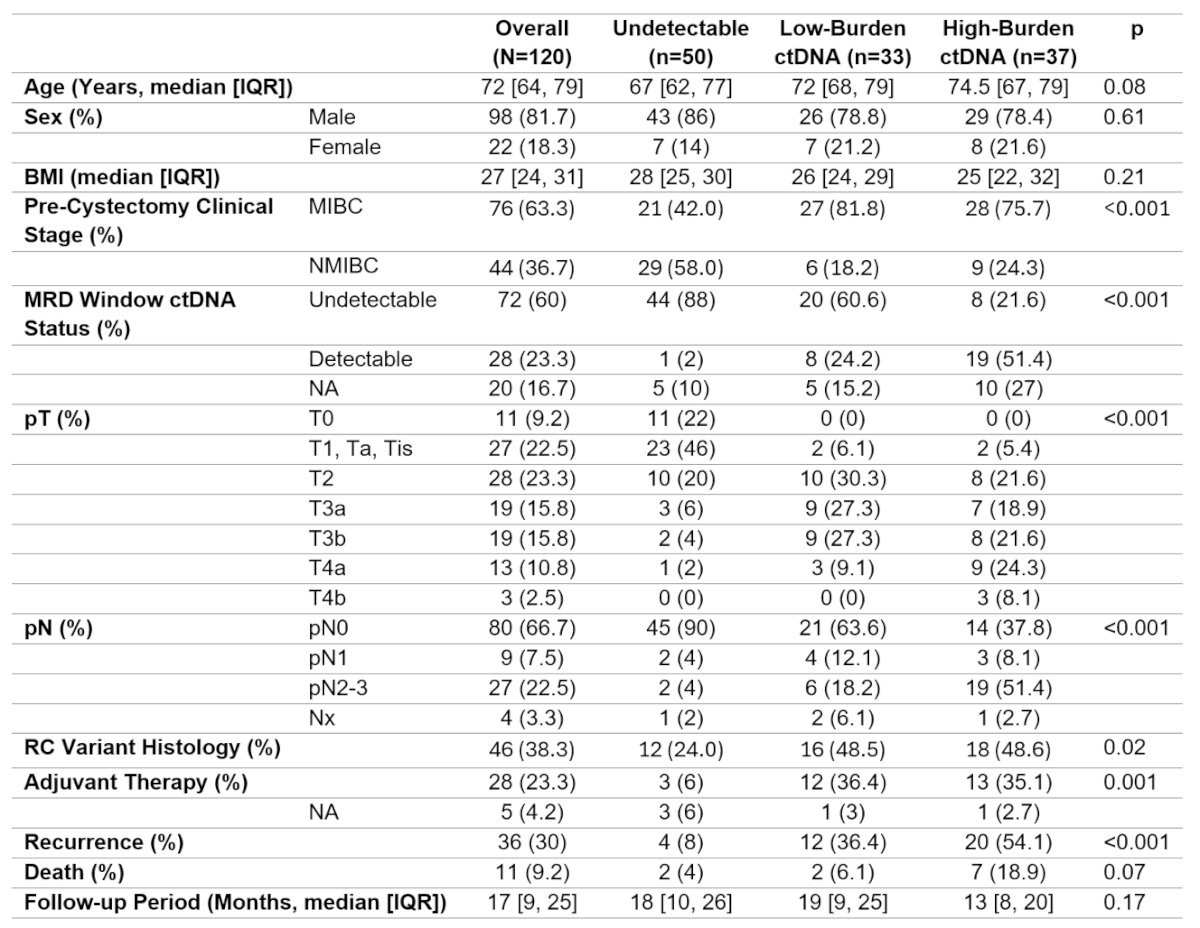
The cohort consisted of 221 patients, of whom 160 had pre-radical cystectomy ctDNA available. Among these 160 patients, 120 underwent upfront radical cystectomy. The median age was 72 years (IQR 64-79), and 63.3% pre-radical cystectomy patients had muscle invasive disease. During a median follow-up time of 17 months (IQR 9-25), 36 patients (30%) experienced recurrence:
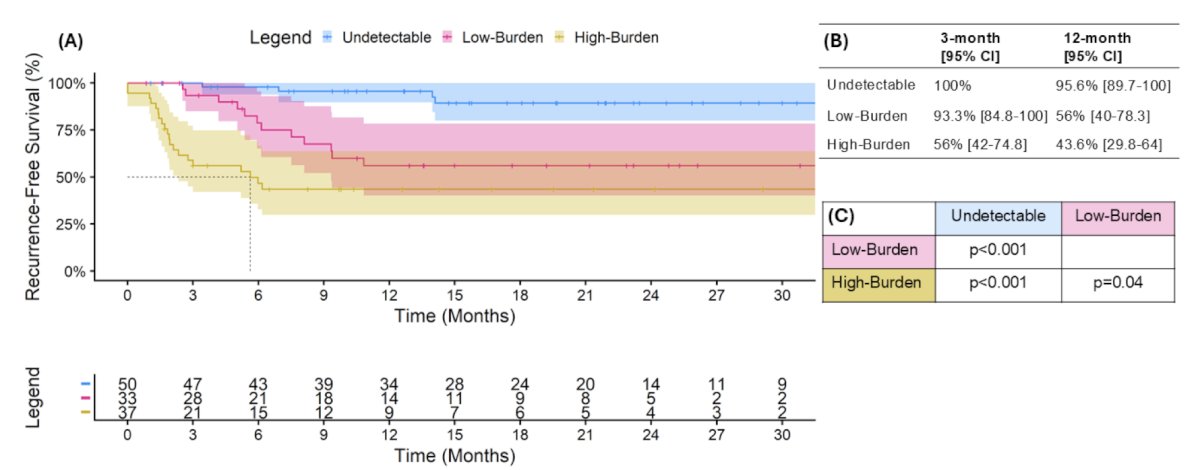
In survival analysis, detectable high-burden pre-radical cystectomy ctDNA was associated with the worst recurrence free survival. Recurrence free survival at 3 months was 100% for undetectable patients, 93.3% (95% CI 84.8-100) for low-burden patients, and 56% (95% CI 42-74.8) for high-burden:
Upfront radical cystectomy cleared ctDNA at the minimal residual disease window in 71.4% of low-burden, while only in 29.6% of patients in the high-burden group (p < 0.001). On multivariate analysis, adjusting for clinical stage and pre-radical cystectomy variant histology, only pre-radical cystectomy ctDNA burden was predictive of recurrence:
Dr. Ben David concluded this presentation discussing how pre-cystectomy ctDNA burden may identify patients who can benefit from upfront radical cystectomy with the following take-home points:
- Pre-radical cystectomy ctDNA burden was predictive of oncological outcomes in patients undergoing upfront radical cystectomy
- Patients with high-burden ctDNA have a high risk of recurrence and may require treatment intensification before radical cystectomy
- Patients with undetectable ctDNA may benefit from upfront radical cystectomy alone
- Further investigation is warranted
Presented by: Rueben Ben David, MD, Tel Aviv Medical Center, Tel Aviv, Israel
Written by: Zachary Klaassen, MD, MSc – Urologic Oncologist, Associate Professor of Urology, Georgia Cancer Center, Wellstar MCG Health, @zklaassen_md on Twitter during the 2026 European Association of Urology (EAU) Annual Meeting, London, United Kingdom, Fri, Mar 13 – Mon, Mar 16, 2026.