

(UroToday.com) The 2026 European Association of Urology (EAU) annual meeting featured a urology trials in bladder and prostate cancer session and a presentation by Dr. Francesco Del Giudice discussing the CUT-less randomized clinical trial assessing VI-RADS and Photodynamic diagnosis-assisted transurethral resection of bladder tumor (PDD-TURBT) to avoid second-look and resection (re-TURBT) in non-muscle invasive bladder cancer.
Bladder cancer is the 6th most common malignancy in Europe, with 75-80% of patients presenting with non-muscle invasive disease. There are noted limitations of standard TURBT, including operator dependency and high recurrence rates with incomplete tumor removal. Thus, re-TURBT is recommended by the EAU Guidelines for non-muscle invasive bladder cancer for incomplete resection, absence of muscle in the sample, and T1 high-grade tumors.
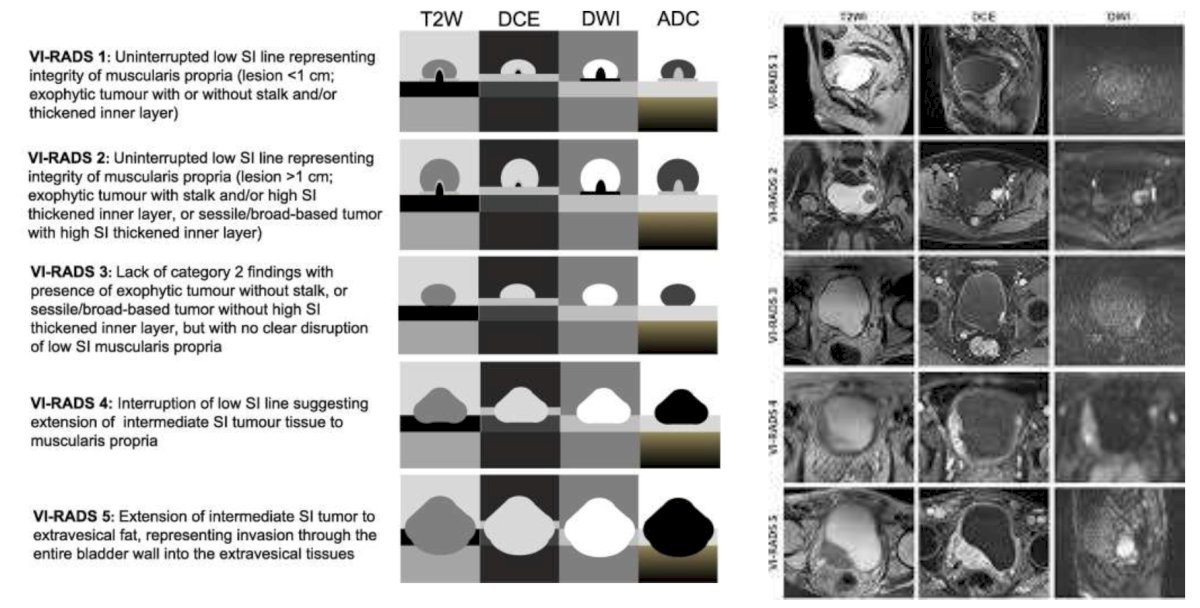
The CUT-less randomized clinical trial aims to combine the preoperative staging accuracy of Vesical Imaging-Reporting and Data System (VI-RADS) and the intraoperative enhanced ability of photodynamic diagnosis (PDD) to overcome the primary TURBT pitfalls, thus potentially redefining criteria for re-TURBT indications. A summary of VI-RADS scoring is highlighted in the following figure:
This is a single-center, non-inferiority, phase IV, open-label, randomized trial (1:1). Patients with a VI-RADS score of 1-2 will be randomized to TURBT with PDD versus standard of care TURBT with white light cystoscopy. Patients who are T1 LG, T1 HG, or Ta HG without detrusor muscle present will have no re-TURBT in the experimental arm versus white light re-TURBT in the standard of care arm:
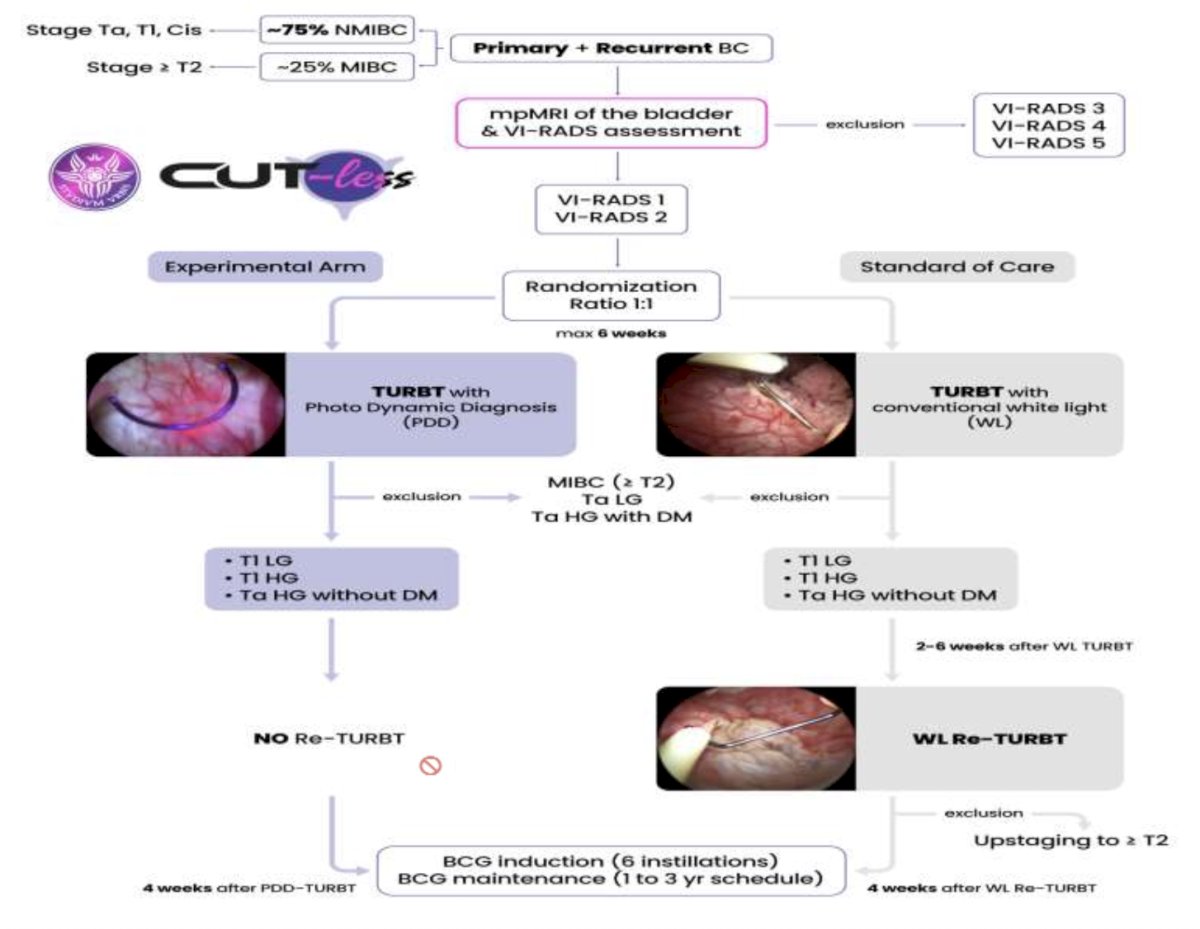
A total of 327 patients with intermediate-/high-risk non-muscle invasive bladder cancer, candidates for re-TURBT will be enrolled over 3-years. The measure of the primary outcome will be the relative proportion of bladder cancer recurrences within 4.5 months (ie. any 'early' recurrence detected at first follow-up cystoscopy). Secondary outcomes will be the relative proportion of late bladder cancer recurrences and/or bladder cancer progression after 4.5 month follow-up. Health-related quality of life variation from non-muscle invasive bladder cancer questionnaires modelled over a patient lifetime horizon. A health-economic analyses will be performed, including a short-term cost-benefit assessment of incremental costs per re-TURBT avoided and a longer-term cost-utility per quality-adjusted life year gained using 2-year clinical outcomes to drive a lifetime model across the two arms of treatment.
To date, 3 patients have been enrolled, and recruitment and enrollment are ongoing. The CUT-less randomized trial will aim to provide a paradigm shift towards a more personalized, socially, and economically sustainable updated non-muscle invasive bladder cancer therapeutic pathway across the European Union and potentially worldwide
Presented by: Francesco Del Giudice, MD, PhD, FEBU, Sapienza University of Rome, Rome, Italy
Written by: Zachary Klaassen, MD, MSc – Urologic Oncologist, Associate Professor of Urology, Georgia Cancer Center, Wellstar MCG Health, @zklaassen_md on Twitter during the 2026 European Association of Urology (EAU) Annual Meeting, London, United Kingdom, Fri, Mar 13 – Mon, Mar 16, 2026.