

(UroToday.com) The 2026 European Association of Urology (EAU) Annual Meeting held in London, U.K., was host to the Urothelial Cancer: Towards Integrated Therapeutic Strategies plenary session. Dr. Jørgen Bjerggaard Jensen, in the Beyond the Muscle debate session on Redefining MIBC management, discussed the pros of ctDNA and how it should guide adjuvant decisions.
Dr. Jensen began by highlighting the potential role of ctDNA to guide decisions on adjuvant chemotherapy or immunotherapy after radical cystectomy, noting that many patients may currently be overtreated, as illustrated by experiences from the CheckMate 274 trial. He reframed the question to ask whether conventional risk stratification alone can adequately guide decisions regarding adjuvant therapy following radical cystectomy. In CheckMate 274, a substantial proportion of patients who likely did not require additional treatment still received adjuvant therapy, while conversely some higher-risk patients who might have benefited from treatment may not have been optimally identified.1,2

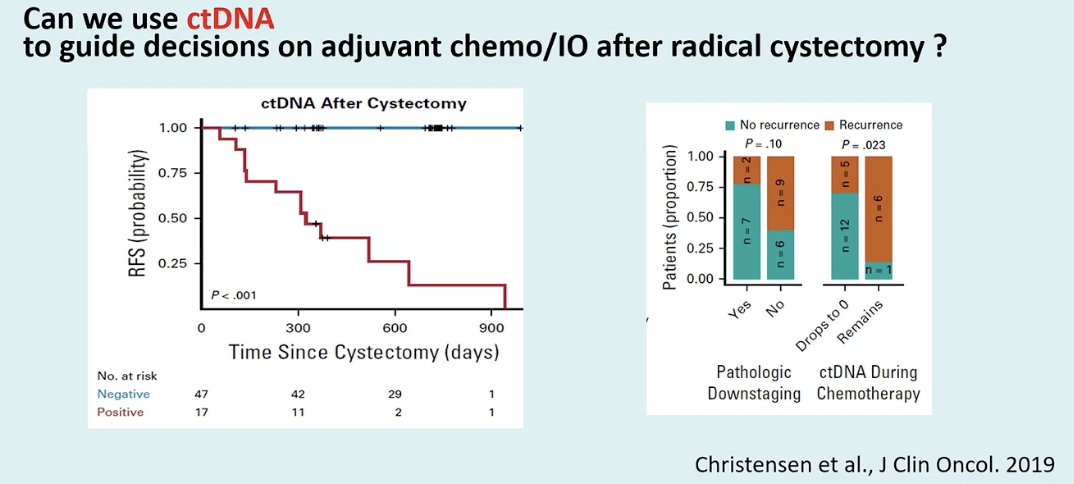
He highlighted that ctDNA appears to be a much stronger predictor of recurrence than conventional pathologic features. Data from Christensen et al. demonstrated that patients who were ctDNA-positive after cystectomy had a markedly higher risk of recurrence compared with those who were ctDNA-negative (p < 0.001).3 Moreover, ctDNA dynamics during chemotherapy also appeared informative, as patients whose ctDNA cleared had better outcomes than those in whom ctDNA remained detectable. These findings suggest that ctDNA may provide a more accurate tool than pathology alone to identify patients who truly require adjuvant therapy after radical cystectomy, as shown in the graphics below.
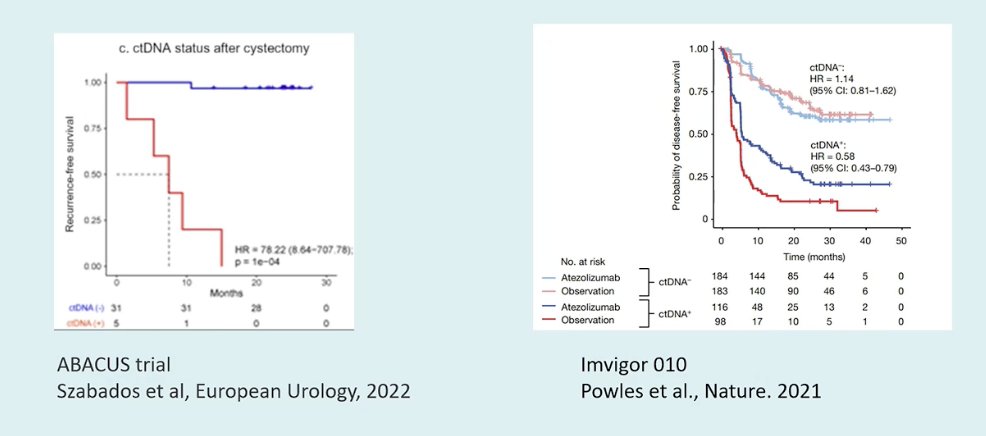
Moreover, data from prospective studies further support the prognostic value of ctDNA after radical cystectomy. In the ABACUS trial,4 ctDNA positivity following cystectomy was strongly associated with recurrence, with ctDNA-positive patients demonstrating a markedly higher risk of relapse compared with ctDNA-negative patients. Similarly, exploratory analyses from the IMvigor010 trial5 showed that ctDNA status identified patients most likely to benefit from adjuvant immunotherapy. In this study, patients who were ctDNA-positive derived a clear disease-free survival benefit from atezolizumab compared with observation, whereas ctDNA-negative patients did not appear to benefit from adjuvant treatment. These findings suggest that ctDNA may serve as a powerful biomarker to refine patient selection for adjuvant therapy following radical cystectomy.
More recently, the phase 3 randomized IMvigor011 trial evaluated a ctDNA-guided strategy for adjuvant therapy after radical cystectomy. In this study, only patients with detectable ctDNA were randomized to receive atezolizumab or placebo. The trial demonstrated an improvement in disease-free survival among ctDNA-positive patients treated with atezolizumab compared with placebo, supporting the concept that ctDNA can help identify patients most likely to benefit from adjuvant immunotherapy.6

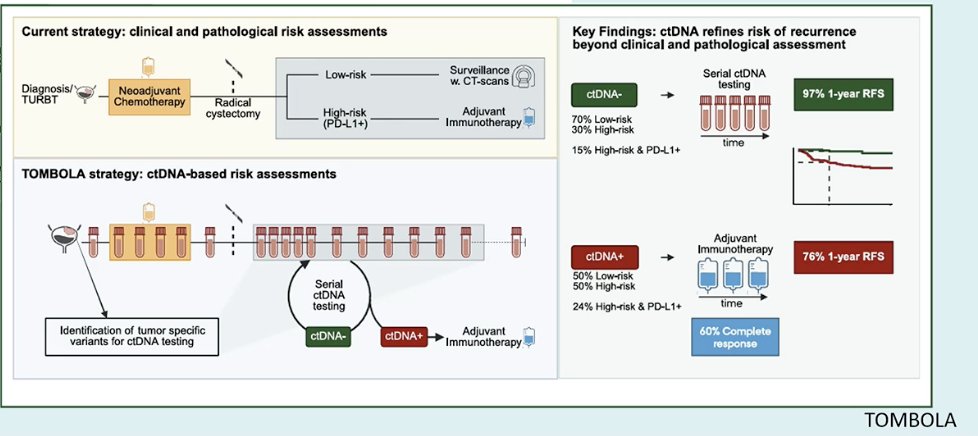
Similarly, in the TOMBOLA study, although not a randomized controlled trial, investigators performed serial ctDNA testing after radical cystectomy in both high- and low-risk patients to determine who should receive adjuvant immunotherapy with atezolizumab. Notably, approximately half of the patients who developed detectable ctDNA were initially classified as low risk based on conventional clinicopathologic features, and these patients appeared to derive significant benefit from adjuvant immunotherapy.7
Dr. Jensen concluded his presentation by emphasizing that ctDNA should play a central role in guiding adjuvant treatment decisions in patients with MIBC undergoing radical cystectomy. Based on the accumulating evidence, he argued that ctDNA has the potential to better identify patients who truly require adjuvant therapy, helping avoid overtreatment in low-risk patients while ensuring that those with molecular evidence of residual disease receive appropriate postoperative treatment.
Presented by: Jørgen Bjerggaard Jensen, MD, Professor and Chair, Department of Urology, Aarhus University, Aarhus, Denmark
Written by: Julian Chavarriaga, MD, Assistant Professor, Urologic Oncologist, Department of Urology at Penn State Health. @chavarriagaj on X during the 2026 European Association of Urology (EAU) Annual Meeting, London, United Kingdom, Fri, Mar 13 – Mon, Mar 16, 2026.
References:- Bajorin DF, Witjes JA, Gschwend JE, Schenker M, Valderrama BP, Tomita Y, Bamias A, Lebret T, Shariat SF, Park SH, Ye D, Agerbaek M, Enting D, McDermott R, Gajate P, Peer A, Milowsky MI, Nosov A, Neif Antonio J Jr, Tupikowski K, Toms L, Fischer BS, Qureshi A, Collette S, Unsal-Kacmaz K, Broughton E, Zardavas D, Koon HB, Galsky MD. Adjuvant Nivolumab versus Placebo in Muscle-Invasive Urothelial Carcinoma. N Engl J Med. 2021 Jun 3;384(22):2102-2114. doi: 10.1056/NEJMoa2034442. Erratum in: N Engl J Med. 2021 Aug 26;385(9):864. doi: 10.1056/NEJMx210012. PMID: 34077643; PMCID: PMC8215888.
- Galsky MD, Gschwend JE, Milowsky MI, Schenker M, Valderrama BP, Tomita Y, Bamias A, Lebret T, Shariat SF, Park SH, Agerbaek M, Jha G, Stenner F, Ye D, Giudici F, Connors J, Gupta S, Chhibber A, Zhang J, Bajorin DF, Witjes JA. Adjuvant nivolumab versus placebo for high-risk muscle-invasive urothelial carcinoma: 5-year efficacy and ctDNA results from CheckMate 274. Ann Oncol. 2026 Jan;37(1):69-78. doi: 10.1016/j.annonc.2025.09.139. Epub 2025 Oct 17. PMID: 41110694.
- Christensen E, Birkenkamp-Demtröder K, Sethi H, Shchegrova S, Salari R, Nordentoft I, Wu HT, Knudsen M, Lamy P, Lindskrog SV, Taber A, Balcioglu M, Vang S, Assaf Z, Sharma S, Tin AS, Srinivasan R, Hafez D, Reinert T, Navarro S, Olson A, Ram R, Dashner S, Rabinowitz M, Billings P, Sigurjonsson S, Andersen CL, Swenerton R, Aleshin A, Zimmermann B, Agerbæk M, Lin CJ, Jensen JB, Dyrskjøt L. Early Detection of Metastatic Relapse and Monitoring of Therapeutic Efficacy by Ultra-Deep Sequencing of Plasma Cell-Free DNA in Patients With Urothelial Bladder Carcinoma. J Clin Oncol. 2019 Jun 20;37(18):1547-1557. doi: 10.1200/JCO.18.02052. Epub 2019 May 6. PMID: 31059311.
- Szabados B, Kockx M, Assaf ZJ, van Dam PJ, Rodriguez-Vida A, Duran I, Crabb SJ, Van Der Heijden MS, Pous AF, Gravis G, Herranz UA, Protheroe A, Ravaud A, Maillet D, Mendez MJ, Suarez C, Linch M, Prendergast A, Tyson C, Stanoeva D, Daelemans S, Rombouts M, Mariathasan S, Tea JS, Mousa K, Sharma S, Aleshin A, Banchereau R, Castellano D, Powles T. Final Results of Neoadjuvant Atezolizumab in Cisplatin-ineligible Patients with Muscle-invasive Urothelial Cancer of the Bladder. Eur Urol. 2022 Aug;82(2):212-222. doi: 10.1016/j.eururo.2022.04.013. Epub 2022 May 14. PMID: 35577646.
- Powles T, Assaf ZJ, Davarpanah N, Banchereau R, Szabados BE, Yuen KC, Grivas P, Hussain M, Oudard S, Gschwend JE, Albers P, Castellano D, Nishiyama H, Daneshmand S, Sharma S, Zimmermann BG, Sethi H, Aleshin A, Perdicchio M, Zhang J, Shames DS, Degaonkar V, Shen X, Carter C, Bais C, Bellmunt J, Mariathasan S. ctDNA guiding adjuvant immunotherapy in urothelial carcinoma. Nature. 2021 Jul;595(7867):432-437. doi: 10.1038/s41586-021-03642-9. Epub 2021 Jun 16. PMID: 34135506.
- Powles T, Kann AG, Castellano D, Gross-Goupil M, Nishiyama H, Bracarda S, Bjerggaard Jensen J, Makaroff L, Jiang S, Ku JH, Park SH, Reig Torras O, Ye D, Maruzzo M, Necchi A, Morales-Barrera R, Giunta EF, Lee JL, Tortora G, Ürün Y, Dolowy L, Erdem D, Pinto A, Grando F, Zou W, Assaf ZJ, Vuky J, Degaonkar V, Steinberg EE, Bellmunt J, Gschwend JE; IMvigor011 Investigators. ctDNA-Guided Adjuvant Atezolizumab in Muscle-Invasive Bladder Cancer. N Engl J Med. 2025 Dec 18;393(24):2395-2408. doi: 10.1056/NEJMoa2511885. Epub 2025 Oct 20. PMID: 41124204.
- Dyrskjøt L, Birkenkamp-Demtröder K, Nordentoft I, Strandgaard T, Lindskrog SV, Milling RV, Körner SK, Brandt SB, Knudsen M, Andreasen TG, Hansen CF, Lamy P, Lam G, Dohn LH, Fabrin K, Carus A, Petersen AC, Joensen UN, Pappot H, Holt PS, Jensen NV, Agerbæk M, Jensen JB. ctDNA-guided immunotherapy following radical cystectomy for muscle-invasive bladder cancer: results from the TOMBOLA trial. Ann Oncol. 2026 Jan 14:S0923-7534(26)00011-6. doi: 10.1016/j.annonc.2025.12.018. Epub ahead of print. PMID: 41544704.