

(UroToday.com) The 2025 European Association of Urology (EAU) Annual Meeting held in Madrid, Spain was host to the Biomarkers to guide peri-operative management in Uro-oncology Plenary Session. Dr. Robert Hamilton delivered his presentation on miRNAs for testicular cancer.
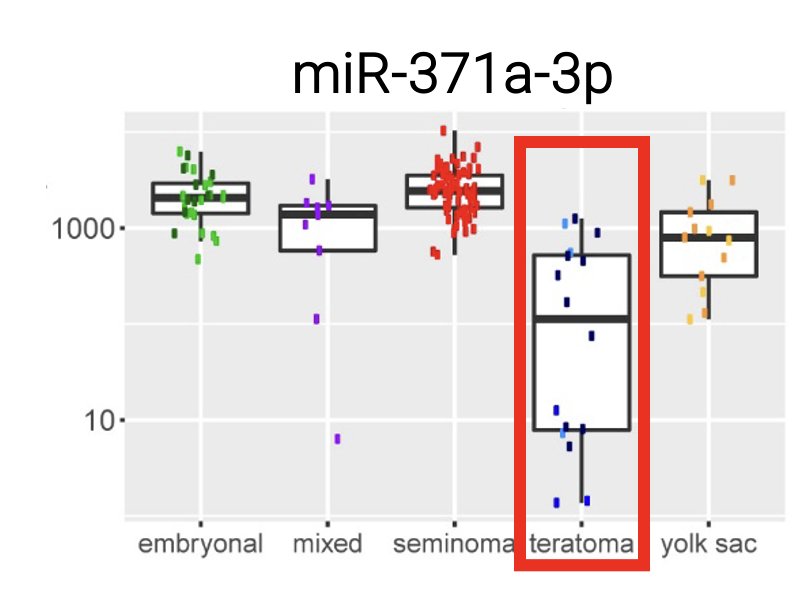
Dr. Hamilton highlighted the key properties that make miR-371a-3p an ideal biomarker for testicular germ cell tumors (GCTs). Its expression is unique to GCTs and detectable in blood, allowing for non-invasive monitoring. It is easy and cost-effective to measure with high reproducibility, and it correlates with tumor size and stage, making it clinically relevant. Additionally, miR-371a-3p is rapidly cleared from circulation with a half-life of less than 24 hours, enabling dynamic assessment of treatment response, and is resistant to degradation, ensuring stability in biological samples. Notably, it is effective for nearly all GCTs except for teratoma.
The evidence supporting miR-371a-3p as a promising biomarker for GCTs is derived from retrospective studies and two prospective studies. This biomarker has demonstrated high diagnostic accuracy, with sensitivity and specificity ranging from approximately 90-100%, making it a highly reliable tool for detecting and monitoring GCTs.

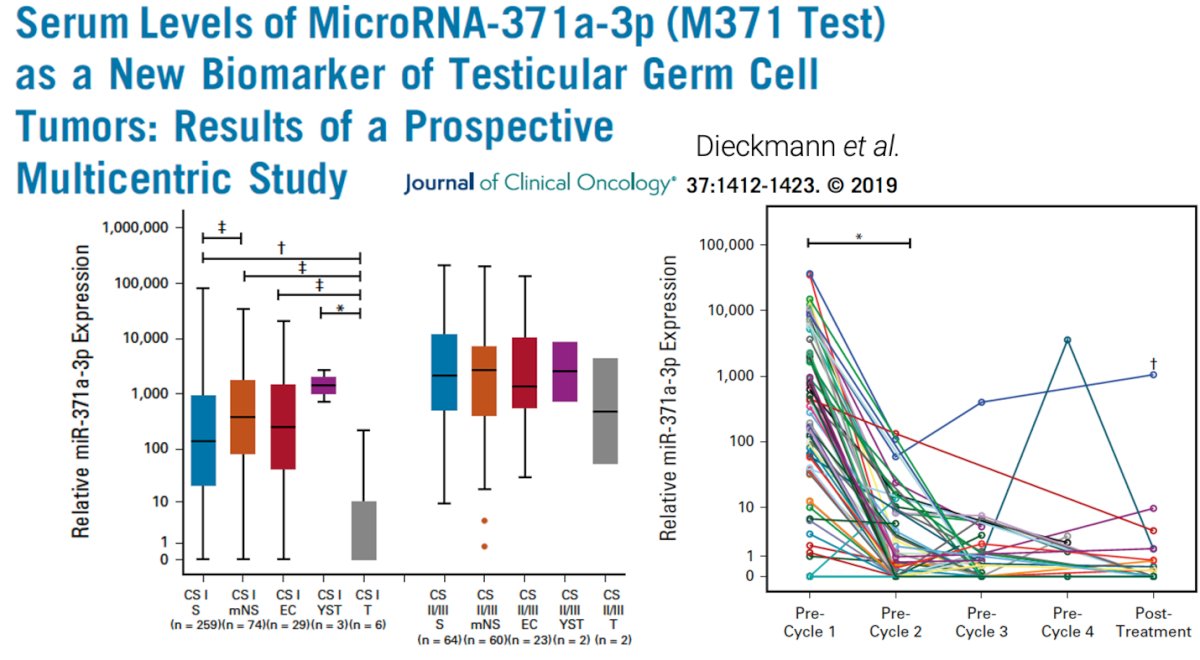
The largest prospective study to date, published by Professor Dieckmann et al., analyzed 616 patients with germ cell tumors (GCTs) and 258 controls. miR-371a-3p demonstrated a sensitivity of 90.1% and a specificity of 94%, with an area under the curve (AUC) of 0.966, highlighting its strong diagnostic performance.1 Moreover, miR-371a-3p levels were significantly associated with clinical stage, primary tumor size, and response to treatment as shown below.
Similarly, the other prospective study was led by Dr. Lucia Nappi et al., they analyzed 111 patients with GCT, of whom approximately one-third had confirmed active disease, while 86 served as controls. Plasma miR-371a-3p expression demonstrated a sensitivity of 92-98%, a specificity of 100%, a positive predictive value of 100%, and a negative predictive value of 98%, further supporting its utility as a highly accurate biomarker.2

The question to answer is how miRNA performs in actual clinical scenarios? Dr Hamilton discussed four clinical scenarios:
- miRNA in small testicular masses
- After orchiectomy in CS I
- Before primary RPLND
- Before PC-RPLND
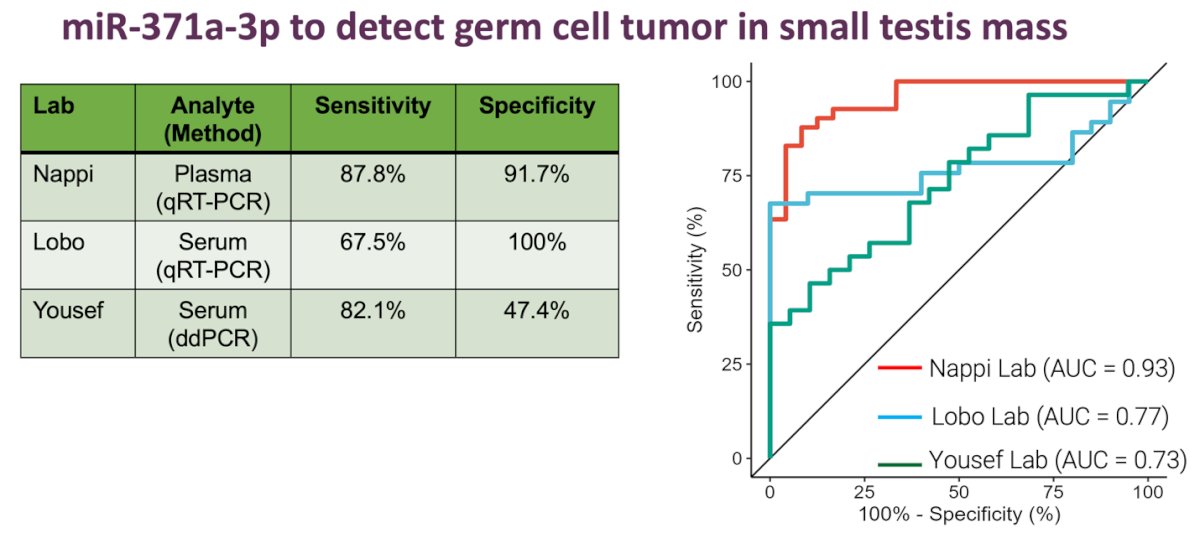
Dr. Hamilton discussed a study conducted at the Princess Margaret Cancer Centre evaluating miRNA for detecting GCT in patients with small testicular masses (<2 cm). The investigators included 65 patients with banked blood samples prior to orchiectomy, 41 with confirmed GCTs, and 24 with benign histology. The median tumor size in this cohort was 14 mm (IQR 9-19). Notably, miRNA analysis was performed simultaneously at three laboratories: in Portugal (João Lobo) using serum and qRT-PCR, in Vancouver (Lucia Nappi) using plasma and qRT-PCR, and at UHN (Yousef) using serum and ddPCR.
This study demonstrated for the first time that miRNA can detect cancer in small testicular masses, with high sensitivity (67.5%-87.8%) influenced by the method of analysis (qRT-PCR) and the sample source (plasma vs. serum). If these findings are validated in their ongoing prospective series (55/100 accrued), they could significantly impact the management of small testicular masses.3
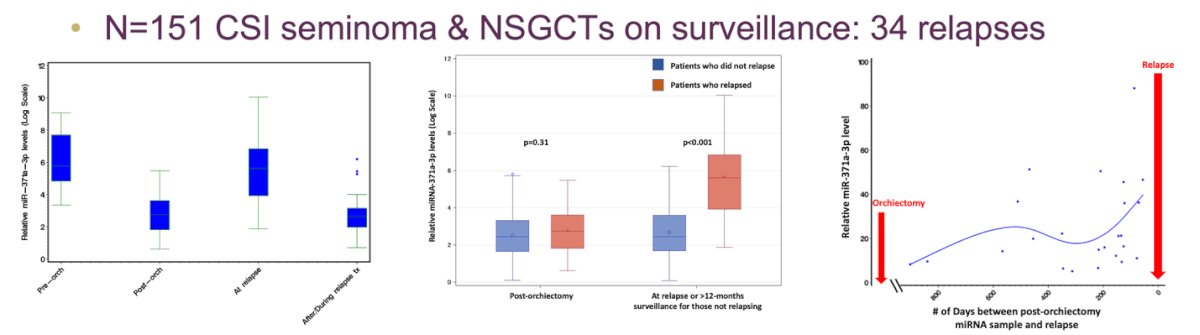
These findings have been confirmed by others, including Fankhauser et al. (2022) and Belge et al. (2024), who also noted the failure of post-orchiectomy miR-371a-3p to predict future relapses. However, multiple studies have demonstrated that miR-371a-3p can detect current relapses earlier than conventional serum tumor markers and imaging.5,6
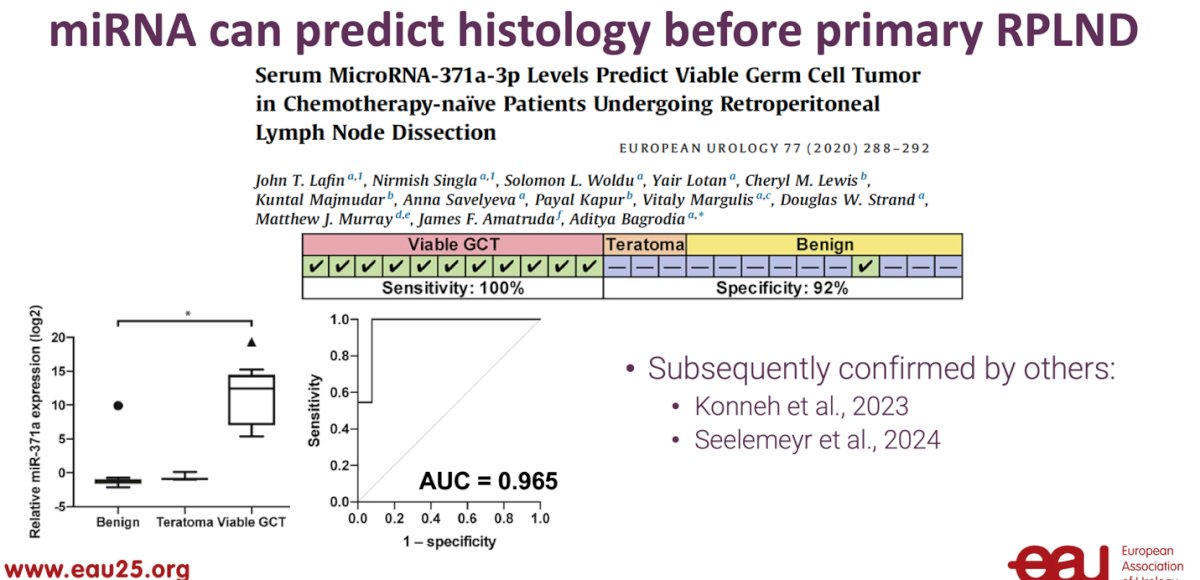
miRNA Before Primary RPLNDIn a cohort of 24 chemotherapy-naïve patients with clinical stage I (50%) or II (50%) GCT undergoing primary RPLND, serum samples were analyzed and compared to RPLND pathology. miR-371a-3p demonstrated an AUC of 0.965, a sensitivity of 100%, and a specificity of 92%, with only one false positive in patients with negative surgical pathology. Notably, all three patients with teratoma had a negative assay as shown below.7 These findings have also been confirmed in two separate studies.
In the post-chemotherapy RPLND setting, Ricardo Leão assessed 82 patients with post-orchiectomy and pre-PC-RPLND serum samples. miR-371a-3p reliably identified viable germ cell tumors in residual masses, with an AUC of 0.87.8
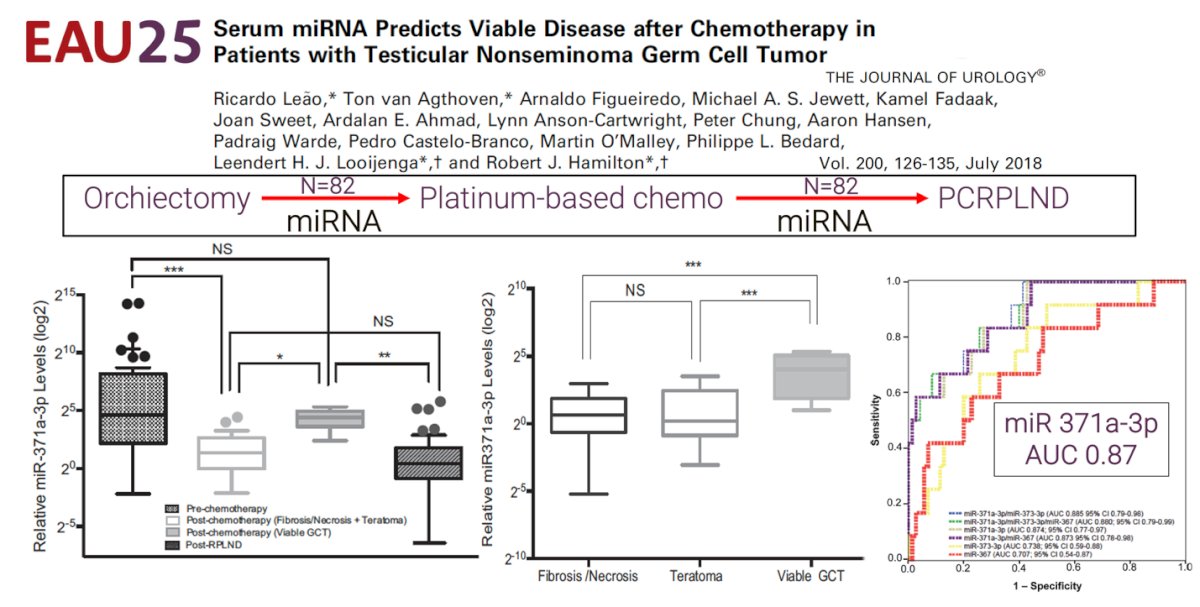
These findings have been confirmed by two other groups. Li et al. reported that combining radiomics with miRNA achieved an AUC of 0.91 for predicting viable disease in this setting. Similarly, Dieckmann et al. found an AUC of 0.81 for miR-371a-3p, which correlated with the percentage of viable cancer in the RPLND specimens.9
The issue of TeratomaTeratoma is a big deal in GCT, it is associated with an increased risk of disease recurrence and mortality. There is strong evidence that pure teratoma does not express miR-371a-3p, nor does malignant somatic transformation. To date, no other blood-detectable miRNA has been identified that can reliably distinguish teratoma, making this an area of ongoing research.
The future in Europe is now. The “M371 test” is an in vitro diagnostic test with (Conformité Européenne) CE certification since April 4, 2024. It is already being used clinically in Germany, Switzerland, Portugal, and Italy, with patients paying approximately €250.
Multiple future prospective studies are underway to assess miR-371a-3p in various clinical scenarios, including CS I surveillance, relapse detection, and guiding Stage I/II management.

Dr. Hamilton concluded by summarizing the role of miR-371a-3p in guiding perioperative management. It has demonstrated sensitivity in detecting cancer in small testicular masses, improving relapse detection during surveillance after orchiectomy in CS I, predicting the presence of GCT before primary RPLND, and identifying viable tumor before post-chemotherapy RPLND. The caveat is that miR-371a-3p has no ability to detect teratoma/somatic transformation.
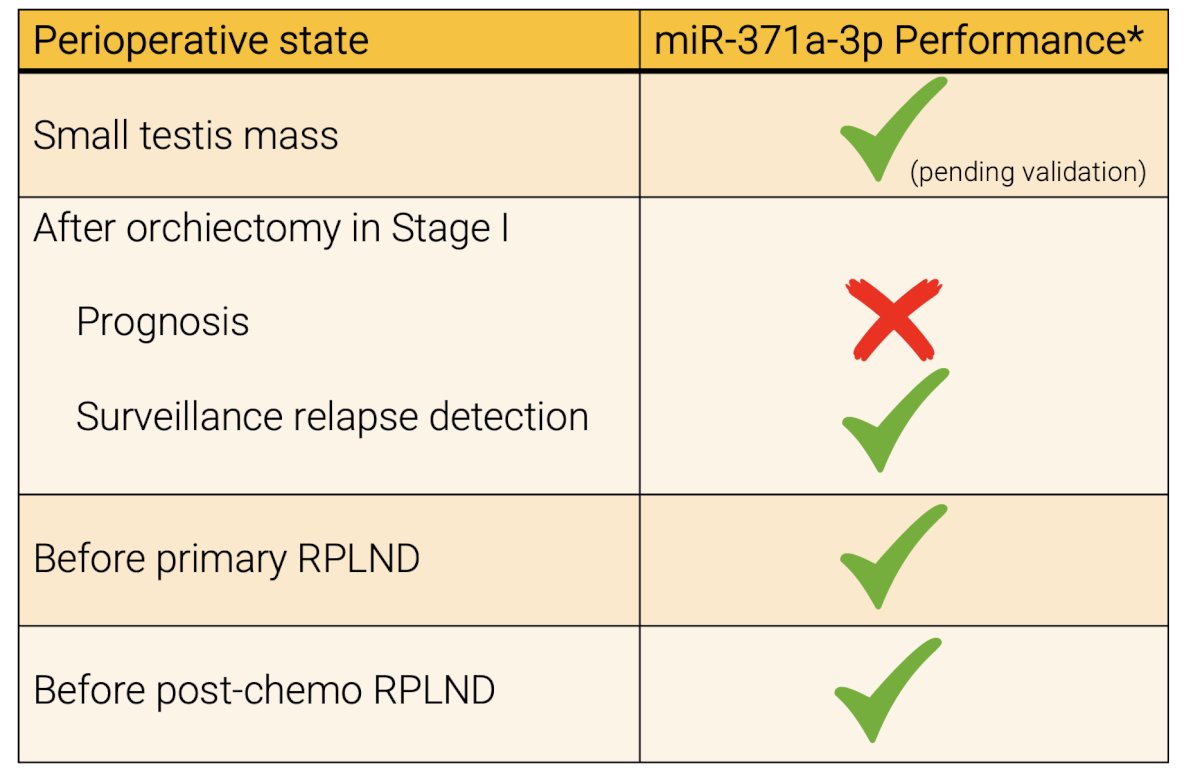
Dr. Hamilton wrapped up his presentation with the following key takeaways:
- miR-371a-3p is a biomarker breakthrough for testis cancer
- It will help with peri-operative decision making in different clinical scenarios including:
- Small testis masses
- Before primary RPLND
- Before post-chemo RPLND
- The caveat remains that miR-371a-3p can’t detect teratoma and analytic methods still need further honing
Presented by: Robert J. Hamilton, MD, MPH, Urologic Oncologist Division of Urology at Princess Margaret Cancer Centre, Toronto, ON.
Written by: Julian Chavarriaga, MD – Urologic Oncologist at Cancer Treatment and Research Center (CTIC) via Society of Urologic Oncology (SUO) Fellow at The University of Toronto. @chavarriagaj on Twitter during the European Association of Urology (EAU) 2025 Annual Meeting, Madrid, Spain, Fri, Mar 21 – Mon, Mar 24, 2025.
References:- Dieckmann KP, Radtke A, Geczi L, Matthies C, Anheuser P, Eckardt U, Sommer J, Zengerling F, Trenti E, Pichler R, Belz H, Zastrow S, Winter A, Melchior S, Hammel J, Kranz J, Bolten M, Krege S, Haben B, Loidl W, Ruf CG, Heinzelbecker J, Heidenreich A, Cremers JF, Oing C, Hermanns T, Fankhauser CD, Gillessen S, Reichegger H, Cathomas R, Pichler M, Hentrich M, Eredics K, Lorch A, Wülfing C, Peine S, Wosniok W, Bokemeyer C, Belge G. Serum Levels of MicroRNA-371a-3p (M371 Test) as a New Biomarker of Testicular Germ Cell Tumors: Results of a Prospective Multicentric Study. J Clin Oncol. 2019 Jun 1;37(16):1412-1423. doi: 10.1200/JCO.18.01480. Epub 2019 Mar 15. PMID: 30875280; PMCID: PMC6544462.
- Nappi L, Thi M, Lum A, Huntsman D, Eigl BJ, Martin C, O'Neil B, Maughan BL, Chi K, So A, Black PC, Gleave M, Wyatt AW, Lavoie JM, Khalaf D, Bell R, Daneshmand S, Hamilton RJ, Leao RRN, Nichols C, Kollmannsberger C. Developing a Highly Specific Biomarker for Germ Cell Malignancies: Plasma miR371 Expression Across the Germ Cell Malignancy Spectrum. J Clin Oncol. 2019 Nov 20;37(33):3090-3098. doi: 10.1200/JCO.18.02057. Epub 2019 Sep 25. PMID: 31553692; PMCID: PMC7351323.
- Chavarriaga J, Langleben C, Lobo J, Nappi L, Yousef GM, Janfaza S, Tavares NT, Ding Q, Bobrowski A, Prendeville S, Anson-Cartwright L. miRNA as a liquid biomarker to detect malignancy in small testicular masses. European Urology. 2024 Mar 1;85:S735.
- Lobo J, Leão R, Gillis AJM, van den Berg A, Anson-Cartwright L, Atenafu EG, Kuhathaas K, Chung P, Hansen A, Bedard PL, Jewett MAS, Warde P, O'Malley M, Sweet J, Looijenga LHJ, Hamilton RJ. Utility of Serum miR-371a-3p in Predicting Relapse on Surveillance in Patients with Clinical Stage I Testicular Germ Cell Cancer. Eur Urol Oncol. 2021 Jun;4(3):483-491. doi: 10.1016/j.euo.2020.11.004. Epub 2020 Dec 4. PMID: 33288479.
- Belge G, Dumlupinar C, Nestler T, Klemke M, Törzsök P, Trenti E, Pichler R, Loidl W, Che Y, Hiester A, Matthies C, Pichler M, Paffenholz P, Kluth L, Wenzel M, Sommer J, Heinzelbecker J, Schriefer P, Winter A, Zengerling F, Kramer MW, Lengert M, Frey J, Heidenreich A, Wülfing C, Radtke A, Dieckmann KP. Detection of Recurrence through microRNA-371a-3p Serum Levels in a Follow-up of Stage I Testicular Germ Cell Tumors in the DRKS-00019223 Study. Clin Cancer Res. 2024 Jan 17;30(2):404-412. doi: 10.1158/1078-0432.CCR-23-0730. PMID: 37967143; PMCID: PMC10792362.
- Fankhauser CD, Christiansen AJ, Rothermundt C, Cathomas R, Wettstein MS, Grossmann NC, Grogg JB, Templeton AJ, Hirschi-Blickenstorfer A, Lorch A, Gillessen S, Moch H, Beyer J, Hermanns T. Detection of recurrences using serum miR-371a-3p during active surveillance in men with stage I testicular germ cell tumours. Br J Cancer. 2022 May;126(8):1140-1144. doi: 10.1038/s41416-021-01643-z. Epub 2021 Dec 15. PMID: 34912073; PMCID: PMC9023438.
- Lafin JT, Singla N, Woldu SL, Lotan Y, Lewis CM, Majmudar K, Savelyeva A, Kapur P, Margulis V, Strand DW, Murray MJ, Amatruda JF, Bagrodia A. Serum MicroRNA-371a-3p Levels Predict Viable Germ Cell Tumor in Chemotherapy-naïve Patients Undergoing Retroperitoneal Lymph Node Dissection. Eur Urol. 2020 Feb;77(2):290-292. doi: 10.1016/j.eururo.2019.10.005. Epub 2019 Nov 5. PMID: 31699528; PMCID: PMC7756387.
- Leão R, van Agthoven T, Figueiredo A, Jewett MAS, Fadaak K, Sweet J, Ahmad AE, Anson-Cartwright L, Chung P, Hansen A, Warde P, Castelo-Branco P, O'Malley M, Bedard PL, Looijenga LHJ, Hamilton RJ. Serum miRNA Predicts Viable Disease after Chemotherapy in Patients with Testicular Nonseminoma Germ Cell Tumor. J Urol. 2018 Jul;200(1):126-135. doi: 10.1016/j.juro.2018.02.068. Epub 2018 Feb 21. PMID: 29474847.
- Dieckmann KP, Grobelny F, Soave A, Che Y, Nestler T, Matthies C, Heinzelbecker J, Winter A, Heidenreich A, Niemzok T, Dumlupinar C, Angerer M, Wülfing C, Paffenholz P, Belge G. Serum Levels of MicroRNA-371a-3p for Predicting the Histology of Postchemotherapy Residual Masses of Germ Cell Tumours. Eur Urol Focus. 2024 Sep;10(5):851-857. doi: 10.1016/j.euf.2024.05.002. Epub 2024 May 9. PMID: 38729824.