

(UroToday.com) The 2025 European Association of Urology (EAU) Annual Congress held in Madrid, Spain between March 21st and 24th 2025, was host to an abstract session on the latest advances in the diagnosis and follow-up of non-muscle invasive bladder cancer (NMIBC). Dr. Jun Mutaguchi presented an artificial intelligence system for detecting flat bladder tumors in cystoscopic images to reduce post-TURBT intravesical recurrence rates.
Intravesical recurrence rates following TURBT for NMIBC remain high and may, in part, be related to missing smaller/flat tumors at the time of the procedure. Significantly, a number of such lesions may represent CIS, which underlies the importance of detecting such lesions.
Recent advances in artificial intelligence (AI) may offer novel avenues for improving the diagnostic accuracy of cystoscopy. YOLO is a fast object detection AI system – a deep neural network that detects objects in an image. This technique has the potential to improve the detection of flat tumors during cystoscopy. To date, only a few studies have evaluated the utility of an AI system for the detection of flat tumors during cystoscopy. In this study, the study investigators aimed to develop an AI system to detect flat tumors in cystoscopic images.
An object detection system utilizing the YOLO framework was constructed to identify flat bladder lesions in cystoscopic images obtained during TURBT procedures. White light imaging (WLI) cystoscopic images were collected (n=2,625) and split into training and testing datasets in an 80:20 ratio. The training dataset, consisting of 1896 images, was used to train the YOLO model. The system’s performance was evaluated by assessing key metrics including sensitivity, specificity, and the area under the receiver operating characteristic curve (AUC) for detecting flat tumors.
The dataset included a total of 2,625 images, comprising 2,371 non-tumor images and 254 flat tumor images. The YOLO model was trained on 1,896 images and tested on the remaining 729 images. The model achieved a sensitivity of 90% and specificity of 90.6%. The area under the receiver operating characteristic curve (AUC) for detecting flat tumors was calculated at 93.4% with a likelihood score of 0.163, indicating robust performance for distinguishing flat tumors from non-tumor images.
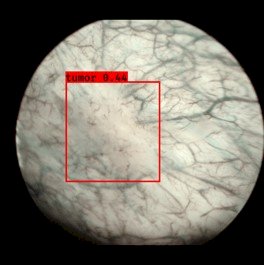
Dr. Mutaguchi concluded that the proposed YOLO-based AI system demonstrated a high level of accuracy for detecting flat bladder tumors in cystoscopic images. This technology may have significant potential for enhancing the detection accuracy during TURBTs, with the aim of reducing intravesical recurrence rates post-TURBT.
Presented by: Jun Mutaguchi, MD, Department of Urology, Kyushu University Hospital, Fukuoka, Japan
Written by: Rashid K. Sayyid, MD, MSc – Robotic Urologic Oncology Fellow at The University of Southern California, @rksayyid on Twitter during the 2025 European Association of Urology (EAU) Annual Congress held in Madrid, Spain between March 21st and 24th, 2025