

(UroToday.com) The Bladder Cancer Advocacy Network (BCAN) Bladder Cancer Think Tank 2025, held in Washington D.C., United States, was host to the session: BCAN 2023 Bladder Cancer Research Innovation Awardees. Dr. John Taylor explored therapeutic vulnerabilities for drug development in bladder cancer using Down Syndrome as a novel model
Dr. Taylor opened his presentation by discussing Down Syndrome (Trisomy 21), emphasizing its association with a higher incidence of hematologic malignancies but a strikingly lower incidence of solid tumors, including urologic cancers. He noted that individuals with Down Syndrome have a significantly reduced risk of dying from bladder cancer (RR=0.27, p=0.0017). While early mortality has been proposed as a potential explanation, age-adjusted studies challenge this notion. Other contributing factors may include lower tobacco exposure or environmental risks, as well as a broader reduction in carcinogen- and hormone-driven tumors across different organ systems.1
Potential mechanisms that may underlie the reduced incidence of solid tumors in individuals with Down Syndrome. Proposed explanations include decreased angiogenesis driven by overexpression of DSCR1, an anti-angiogenic gene on chromosome 21, and increased tumor suppression via genes such as ETS2, which may promote p53-mediated apoptosis. Additionally, distinct and recurrent epigenetic alterations, particularly in DNA methylation patterns, have been identified in this population. While these hypotheses offer biological plausibility, no single mechanism has been confirmed as definitive or canonical.2
Dr. Taylor highlighted that we are lucky to have mouse models that accurately replicate Down Syndrome (DS) phenotypes and have been used to explore cancer risk. The Ts65Dn model, which carries a segmental trisomy including distal mouse chromosome 16 and part of chromosome 17, mimics human DS features such as learning deficits. The TcMac21 model, a non-mosaic model with freely segregating human chromosome 21, contains 93% of human protein-coding genes without an orthologue or extra trisomic regions. Both models faithfully recapitulate the DS phenotype and were used in the presented research.
In a pilot study using the BBN/Ts65Dn mouse model, Dr. Taylor and colleagues observed reduced tumor volumes and a trend toward lower stage disease. Interestingly, these changes occurred without significant differences in angiogenesis. Transcriptomic profiling through RNA-Seq followed by Reactome Pathway Analysis revealed alterations in mitotic pathways, including a reduction in Aurora kinase B (AURKB), suggesting a potential mechanistic link between trisomy and tumor suppression.
AURKB plays a key role in mitosis and cell cycle regulation, including phosphorylation of histone H3, a marker of its activity. It is frequently overexpressed in cancer and associated with a proliferative advantage. Analysis of TCGA data shows that AURKB is upregulated in bladder cancer, further supporting its role as a potential therapeutic target or biomarker in this context. In xenograft models, inhibition of AURKB led to a decrease in tumor volume and weight. Barasertib (AZD1152-HQPA) is a selective AURKB inhibitor.
In Down syndrome, the discovery of targetable pathways such as AURKB opens new avenues for drug development. Preliminary analyses provided proof-of-principle evidence that AURKB, which had not previously been reported in this context, may be a viable therapeutic target. These findings formed the basis for the aims of Dr. Taylor’s Innovation Award project:
- Specific Aim 1: Define commonly altered signaling pathways in BCa using murine models of DS (Ts65Dn, TcMac21)
- Specific Aim 2: Evaluate effect of AURKB inhibition on BCa in trisomic and non-trisomic animals
In this study, N-butyl-N-(4-hydroxybutyl) nitrosamine (BBN) was used to induce bladder cancer in murine models. BBN is a well-established bladder-specific carcinogen that mimics environmental exposure and allows for the study of tumor initiation and progression in vivo. In the 16-week BBN model, reduced bladder weights and delayed tumor formation were observed as illustrated below.
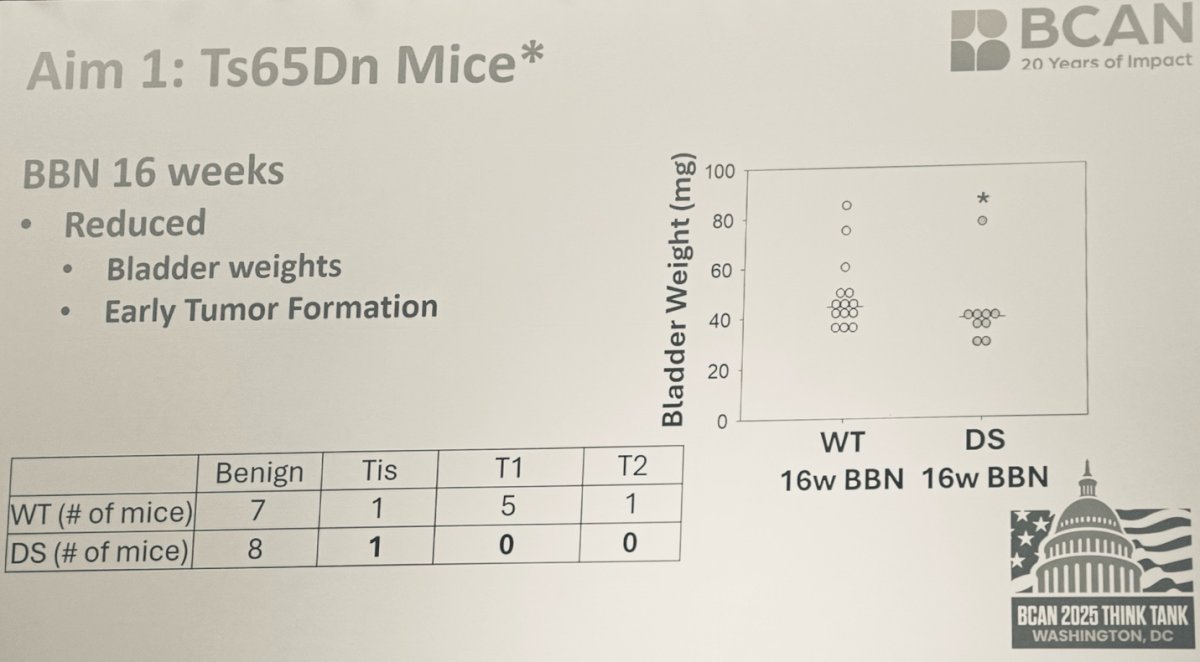
Similarly, in the second cohort using the 14-week BBN model, bladder weights were comparable between groups (shown below), but there was a reduction in early tumor formation. The findings in the Ts65Dn mouse model were highly consistent with their earlier observations, further reinforcing the reproducibility of the protective phenotype in Down syndrome models.

Dr. Taylor and colleagues performed RNA sequencing of bladders exposed to BBN for 16 weeks and identified genes that were broadly up- and downregulated, as illustrated below. They further conducted Metascape pathway analysis, which revealed relatively modest transcriptional changes even under the most liberal interpretation of the data. Notably, AURKB was not identified through this analysis, suggesting that its role may be more evident at the protein level or in earlier stages of tumor development. Notably, Dr. Taylor pointed out that in their Ts65Dn mouse models, the original line carried a mutation affecting retinal regeneration, resulting in blindness, whereas the second Ts65Dn line did not express this mutation

With respect to the TcMAC21 mouse model, Dr. Taylor noted delays in acquiring the mice but confirmed that Cohort 1 had been completed, with pathology review pending. Interestingly, despite over two decades of experience with this model, this was the first time they observed apparent upper tract urothelial carcinoma (UTUC) in the renal pelvis, potentially linked to vesicoureteral reflux associated with the strain. Cohort 2 is currently in progress.
Aim 2: Evaluate effect of AURKB inhibition on BCa in trisomic and non-trisomic animalsThe experimental design for Aim 2 involves testing the efficacy of Barasertib (25 mg/kg intraperitoneally, 5 times per week for 3 weeks) following exposure to the bladder-specific carcinogen (BBN). In Aim 2a, wild-type C57BL/6J mice receive 0.05% BBN in drinking water for 16 weeks, after which BBN is discontinued and Barasertib or vehicle control is administered until euthanasia at 19 weeks. In Aim 2b, Ts65Dn wild-type and Down syndrome mice are treated similarly but for 14 weeks of BBN exposure followed by Barasertib or vehicle treatment, with euthanasia at 17 weeks as illustrated below.

In Aim 2a, using C57BL/6J wild-type mice, Barasertib failed to reduce BBN-induced bladder cancer burden. In fact, there was a strong trend suggesting a possible detrimental effect, with Barasertib appearing to worsen outcomes rather than improve them. Interestingly, the overall tumor incidence in this cohort was lower than typically observed in this model. Barasertib did not confer any therapeutic benefit and may have been a burden, particularly in the immunocompetent setting. However, reduced phospho-Histone H3 staining was noted in animals treated with Barasertib.
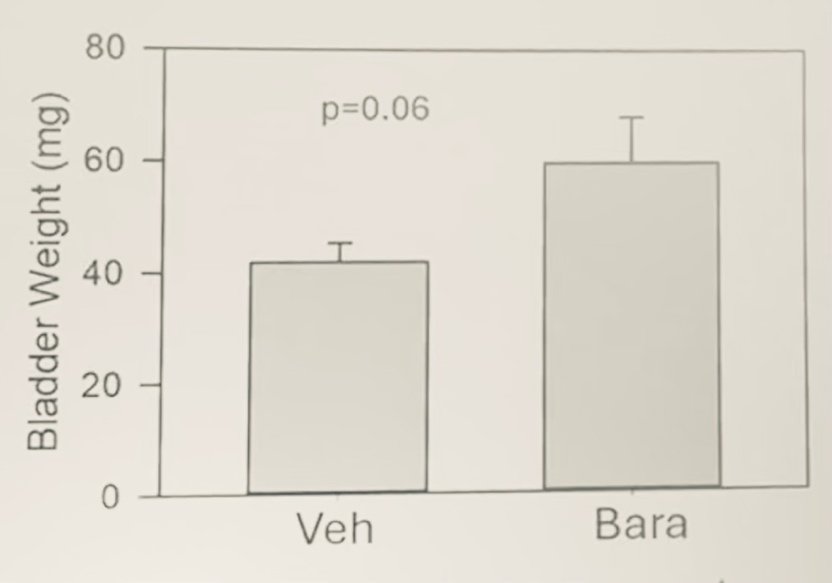
In Aim 2b, using the Ts65Dn Down syndrome mouse model, Barasertib again failed to reduce BBN-induced bladder cancer and appeared to worsen outcomes. There was no reduction in bladder weight or tumor volume, and a shift toward more invasive and aggressive tumors (as illustrated in the table below) was observed, directly contradicting the initial hypothesis.

Dr. Taylor addressed the contradictory results seen with Barasertib, noting its potential immunosuppressive and myelotoxic properties. Despite these concerns, there were no significant histological differences observed in neutrophil or T-cell infiltration between treated and control groups. To further investigate the immune landscape and the unexpected outcomes, the team plans to conduct spatial sequencing to characterize tumor-infiltrating cell types and their expression profiles.
Future directions for Dr. Taylor’s team research include conducting spatial analysis of the bladder and surrounding tissues to better understand local tumor–immune interactions and investigating potential immune or autoimmune activation in Down syndrome models. They also aim to assess intrinsic changes within bladder cancer tissue and evaluate the role of BBN-induced activation, though early RNA-seq data have not indicated major differences in bladder P450 enzyme expression. The team plans to define targetable protective mechanisms, explore Down syndrome–associated therapeutic targets such as DYRK1A inhibitors or activators while acknowledging their context-dependent effects, and further characterize distinctions between the Ts65Dn model and other Down syndrome mouse models.
Dr. Taylor concluded his presentation with the following remarks:
- They observed a reduced tumor formation and lower tumor stage in Ts65Dn mice, reflecting a leftward shift in tumorigenesis that mirrors clinical observations in individuals with Down syndrome.
- Preliminary data from the TcMac21 model suggests potential protective effects; studies are ongoing with estimated completion in August 2025.
- There is a distinct contrast between the flank and BBN models regarding the impact of Barasertib, highlighting the importance of model selection in preclinical drug evaluation.
Presented by: John Taylor III, MD, MS, PhD, Urologic Oncologist at University of Kansas Medical Center Research Institute. Kansas City, Kansas, United States.
Written by: Julian Chavarriaga, MD – Urologic Oncologist at Cancer Treatment and Research Center (CTIC) via Society of Urologic Oncology (SUO) Fellow at The University of Toronto. @chavarriagaj on Twitter during the Bladder Cancer Advocacy Network (BCAN) Bladder Cancer Think Tank 2025 held in Washington D.C., United States, between July 30th and August 1st.
Reference:
- Satgé D, Sasco AJ, Day S, Culine S. A lower risk of dying from urological cancer in Down syndrome: clue for cancer protecting genes on chromosome 21. Urol Int. 2009;82(3):296-300. doi: 10.1159/000209361. Epub 2009 May 11. PMID: 19440017.
- Osuna-Marco MP, López-Barahona M, López-Ibor B, Tejera ÁM. Ten Reasons Why People With Down Syndrome are Protected From the Development of Most Solid Tumors -A Review. Front Genet. 2021 Nov 5;12:749480. doi: 10.3389/fgene.2021.749480. PMID: 34804119; PMCID: PMC8602698.