

(UroToday.com) The Bladder Cancer Advocacy Network (BCAN) Bladder Cancer Think Tank 2025 held in Washington D.C., United States, was host to the Session: Lessons Learned from Clinical Trials. Dr. Robert Svatek discussed The PRIME (S1602) trial is a randomized phase III study designed to evaluate the effectiveness of different Bacillus Calmette-Guérin (BCG) regimens in patients with CIS, high-grade Ta, or high-grade T1 non–muscle-invasive bladder cancer (NMIBC). A total of 969 patients will be randomized across three arms:
- Intravesical BCG TICE strain (50 mg/dose)
- Intravesical BCG Tokyo strain (80 mg/dose)
- Priming arm: Intradermal Tokyo BCG (100 µL at 0.5 mg/mL) administered prior to intravesical BCG Tokyo strain (80 mg/dose)
Accrual is planned over 3 years with 5 years of follow-up.1
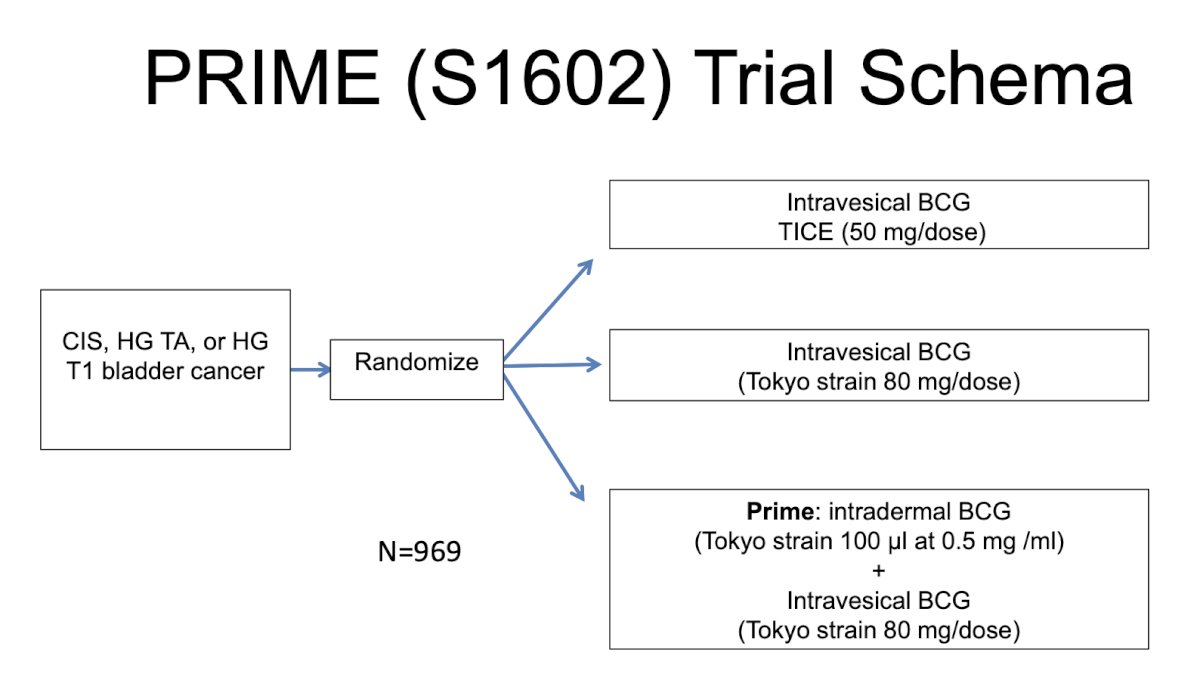
As outlined in the schema, the study is designed to address three key hypotheses:
- Whether the Tokyo strain is non-inferior to the TICE strain in terms of efficacy
- Whether intradermal priming enhances the immune response and improves clinical outcomes compared to intravesical BCG alone
- Whether these regimens are safe and tolerable in a broad NMIBC population across CIS and high-grade lesions
Dr. Svatek recalled that his first meaningful encounter with patient advocates occurred at a SWOG meeting, where advocates expressed deep concern about a trial that was struggling to meet accrual targets and faced premature closure. Motivated by their urgency, he returned to his institution and focused on patient recruitment, eventually making his site the second-highest accruing center for that study. Reflecting on that experience, he emphasized the importance of integrating patient advocates throughout the research process. He advised investigators to advocate for their involvement, engage them early, starting with the informed consent process, and invest the time to explain why the trial matters. When patients and advocates understand the purpose, they are far more likely to support and champion the effort.
Dr. Svatek emphasized the critical role of mentorship in clinical trials, noting that much of what’s required to navigate cooperative group research isn’t taught in residency or fellowship. He encouraged early-career investigators to actively seek out mentors who are already doing the kind of work they aspire to and who have demonstrated success in the field. Mentorship, he said, should be cultivated intentionally, not just for guidance, but as a relationship built on mutual investment. He described his greatest professional pride not in his own accomplishments, but in serving as a mentor to others. Being part of someone else’s growth and success, he reflected, is among the most meaningful aspects of his career.
Dr. Svatek concluded his presentation with the following lessons from the PRIME trial:
- Know the field: understand the scientific landscape and clinical climate
- Participate early: don’t wait until the system is fully built, get involved and help shape it
- Design a good experiment: whether it’s a small lab study or a large clinical trial, solid design is key
- There’s no such thing as a negative trial if the experiment is reasonable; every study advances knowledge
Presented by: Robert S. Svatek, MD, Professor and Chair, Gary and Glenda Woods President’s Distinguished University Chair in GU Oncology, Department of Urology, UT Health San Antonio, TX
Written by: Julian Chavarriaga, MD – Urologic Oncologist at Cancer Treatment and Research Center (CTIC) via Society of Urologic Oncology (SUO) Fellow at The University of Toronto. @chavarriagaj on Twitter during the Bladder Cancer Advocacy Network (BCAN) Bladder Cancer Think Tank 2025 held in Washington D.C., United States, between July 30th and August 1st.
Reference: