

(UroToday.com) Radical cystectomy (RC) in women often involves the removal of gynecologic organs, which can increase the risk of female sexual dysfunction (FSD) and pelvic organ prolapse (POP). Even though there are guidelines for screening and management of these complications, practices still vary quite a bit between surgeons. This study looked at current practice patterns among Society of Urologic Oncology (SUO) members performing female RC, with a focus on how often surgeons screen for FSD and POP and what surgical techniques they commonly use.
To study this, Dr. Francis Jefferson and his team conducted a cross-sectional survey of SUO members who perform female radical cystectomy. The survey asked about both perioperative screening practices and surgical decision-making during RC. They then used descriptive and comparative statistics to see whether factors like surgeon age, practice setting, years since fellowship, gender, and surgical volume were associated with certain practice patterns.
A total of 72 providers responded to the survey. Most respondents were male, worked at academic centers, and were more than five years out from fellowship training. The study found that radical cystectomy was performed more frequently at academic institutions. Screening practices for FSD and POP varied among providers. While many surgeons reported assessing sexual function and prolapse both before and after surgery at least some of the time, these assessments were not performed consistently across all providers. Nerve-sparing procedures and prophylactic vaginal vault suspension were also relatively uncommon.
The team also looked at how surgeon characteristics influenced screening and surgical practices. Older surgeon age and performing at least five cystectomies per year were associated with more routine postoperative prolapse assessment.

Table 1. Univariate analysis of provider characteristics associated with routine preoperative and postoperative sexual function and prolapse screening in women undergoing radical cystectomy.
Meanwhile, surgeons working in academic settings had lower odds of routinely performing oophorectomy.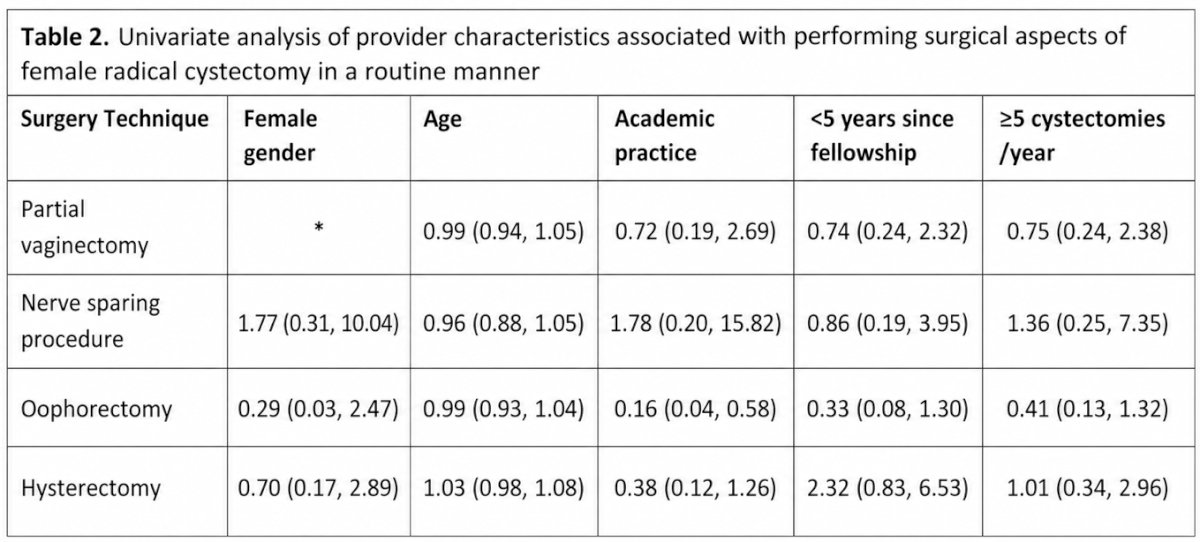
Table 2. Univariate analysis of provider characteristics associated with routinely performing surgical aspects of female radical cystectomy.
These findings suggest that provider experience and practice environment may play a role in perioperative counseling, screening habits, and surgical decision-making for women undergoing RC.
During the Q&A session, one of the moderators asked for clarification regarding what specifically qualified as “screening” in the survey, including whether providers were directly asking patients about symptoms such as vaginal bulge or prolapse complaints. Dr. Jefferson responded that this represented another limitation of the study, as the survey was not highly detailed and broadly categorized screening as any form of assessment, including the use of questionnaires or other general screening methods. The moderator commented that although approximately 60% screening rates were reported, which is encouraging, 100% is obviously the goal.
Overall, this study highlights how much variability still exists in the screening and management of FSD and POP among surgeons performing female radical cystectomy. Although removal of gynecologic organs was common, nerve-sparing approaches and preventative prolapse procedures were used much less often. The findings suggest that surgeon experience, case volume, and practice setting all influence perioperative assessment and surgical decision-making in female RC patients.Presented by: Francis Jefferson, MD, UT Southwestern Medical Center, Dallas, TX, USA.
Written by: Kriselle Madamba, Researcher, Department of Urology, University of California Irvine, during the 2026 American Urological Association (AUA) Annual Meeting, May 15– 18, 2026, Washington D.C.
Reference:
- Francis Jefferson, Christine Herforth, Christina Sze, Gary E. Lemack, Maude E. Carmel, Phillipe E. Zimmern, Kris Gaston, and Ramy S. Goueli. Contemporary Practice Patterns Among Urologic Oncologists for the Assessment of Women’s Sexual and Pelvic Health After Radical Cystectomy [abstract]. In: American Urological Association Annual Meeting, May 15-18, 2026, Washington, DC.