

(UroToday.com) During the first day of the 2026 American Urological Association (AUA) Annual Meeting, Dr. Robert C. Chan of Marin Health UCSF Health Clinic, in collaboration with Dr. Kymora Scotland and colleagues from UCLA, presented a novel artificial intelligence (AI)-powered mobile application designed to support dietary counseling and kidney stone prevention through automated oxalate and nutritional analysis. The study evaluated an application leveraging Google Gemini 2.5 and trained using the Harvard Oxalate Database to estimate dietary oxalate content from both verbal and image-based food entries.
Calcium oxalate nephrolithiasis is the most common kidney stone type, affecting up to 80% of stone formers. Dietary oxalate remains one of the most important modifiable risk factors for calcium oxalate stone formation, yet obtaining accurate dietary histories in routine clinical practice remains challenging. Traditional dietary assessment tools often rely on patient recall, food diaries, or manual dietary review and are limited by recall bias, underreporting, and inconsistent food composition data. To address this gap, the investigators developed a patient-centered mobile application capable of rapidly analyzing meals through spoken or written descriptions as well as uploaded food images, with the goal of providing scalable, real-time dietary monitoring and nutritional guidance for stone prevention.
To validate the application, the research team evaluated 804 verbal food entries alongside 276 image-based food entries obtained from the ASA24 portion-size image database. Verbal entries were compared directly against known oxalate reference values from the Harvard Oxalate Database, with accuracy defined as estimates within ±1 mg of the expected oxalate content. Image-based analyses were further categorized according to specific sources of error, including incorrect food identification, inaccurate portion sizing, ingredient misclassification, incorrect oxalate reference selection, and inability to analyze the image.
The verbal-entry component of the application demonstrated strong performance. Overall, 82.1% of oxalate estimates fell within ±1 mg of reference values, while 91.5% and 94.5% fell within ±5 mg and ±10 mg, respectively (Figure 1).

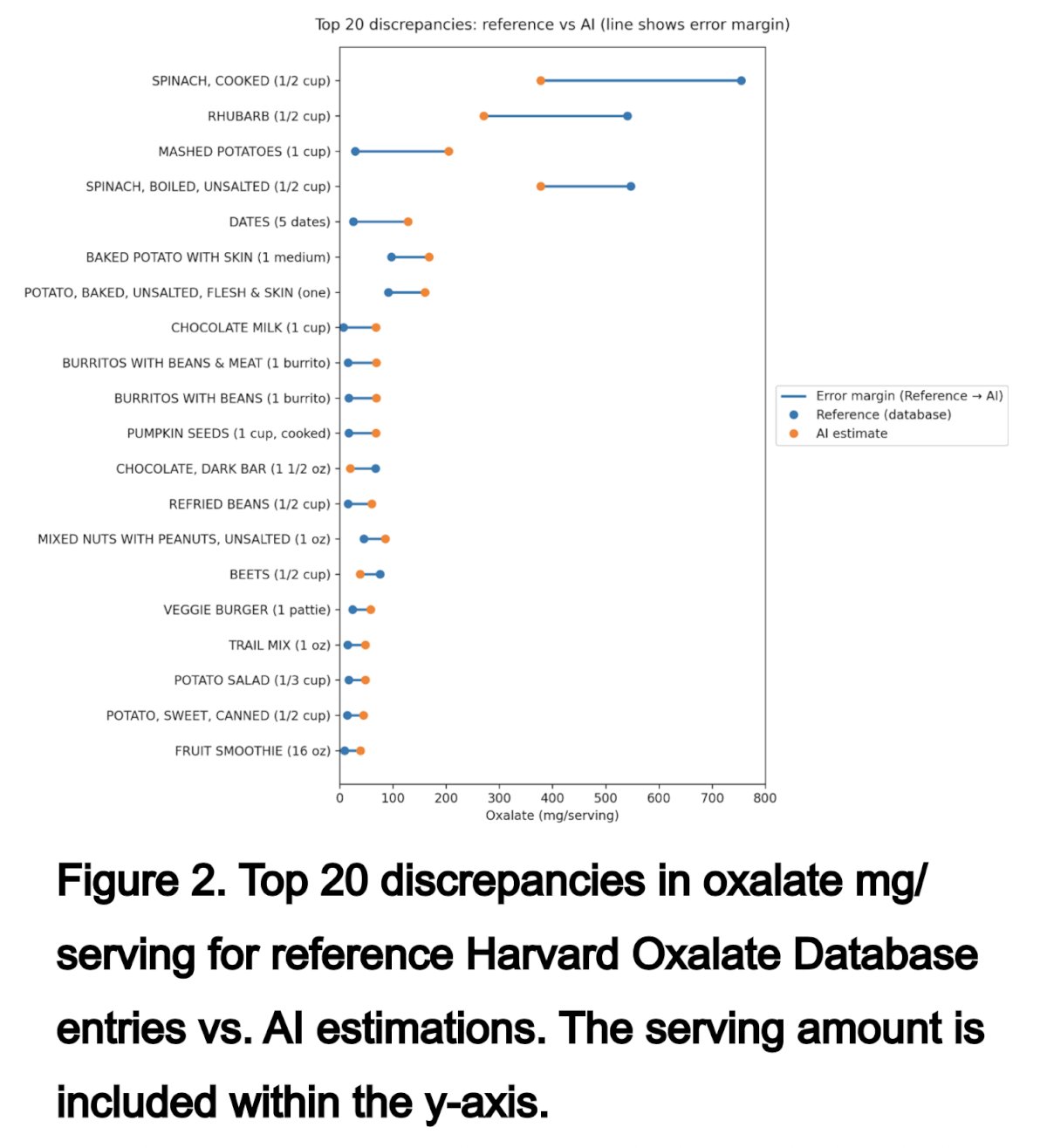
The mean oxalate estimation difference was 3.32 mg with a median absolute error of 0.10. These findings suggest that large language model-based dietary interpretation may provide sufficiently accurate oxalate estimation to support routine patient counseling and individualized stone prevention strategies. Dr. Chan noted that the verbal-input model was “pretty accurate” overall and appeared considerably more robust than the computer vision component in its current form. Accuracy was highest when food names were specific, portion sizes were clearly stated, and preparation methods such as raw versus cooked were included (Figure 2).
Performance with image-based analysis was more variable. The investigators reported an overall error rate of 61%, driven primarily by incorrect food-type recognition, followed by portion-size estimation errors and incorrect ingredient identification (Figure 3). Additional failures included incorrect oxalate reference selection and inability to analyze the provided image. Dr. Chan explained that many of these inaccuracies stemmed from the inherent challenge of estimating portion size and volume from photographs without reliable visual reference points.
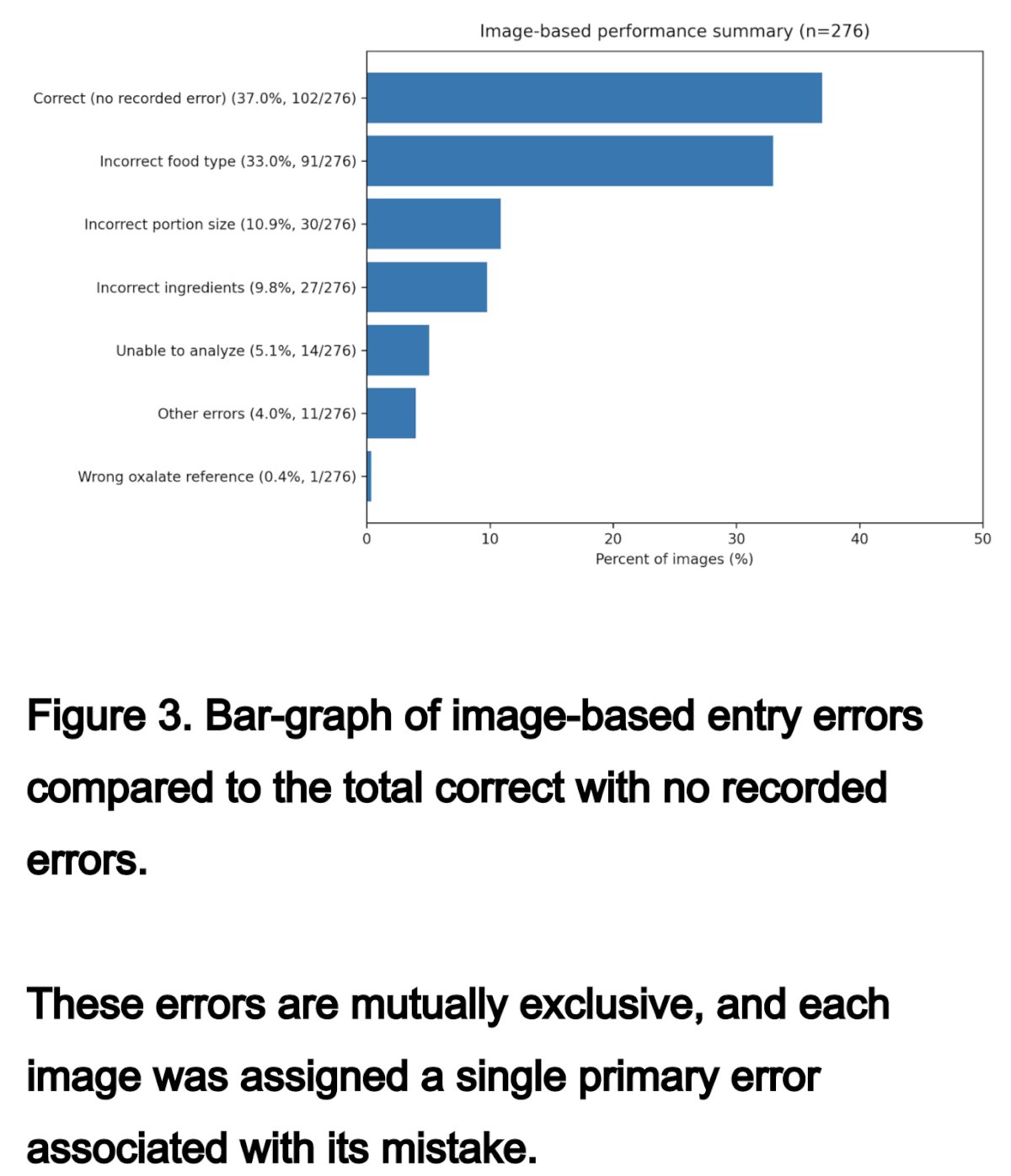
Despite these limitations, Dr. Chan emphasized that the image-analysis findings help identify key areas for future refinement. In particular, the relatively low rate of incorrect oxalate-reference selection suggests that once foods are correctly identified, the underlying nutritional database performs reliably. Future improvements in computer vision, portion-size recognition, and multimodal AI interpretation may substantially improve the platform’s real-world performance (Figure 4).

During the audience discussion, several attendees questioned the future scalability and accuracy of the platform, particularly regarding the image-analysis component. Audience members asked whether the photo-recognition functionality would improve over time, to which Dr. Chan noted that the underlying AI models continue to evolve rapidly. Additional discussion explored whether similar AI-driven nutritional platforms could eventually expand into broader dietary monitoring applications, including sodium analysis, although the presenters clarified that those areas were outside the scope of the current study. Audience members also inquired about the validation methodology and database infrastructure used to support the model’s development. Finally, Dr. Clayman asked about the app’s ability to estimate portion size and volume from food images alone. In response, Dr. Chan acknowledged that while the system attempts to perform these calculations, image-based estimation remains difficult without reliable visual reference points. He illustrated this limitation using the example of “a giant bowl of spaghetti,” noting that highly variable meals remain challenging for current AI systems to quantify accurately from photographs.
Dr. Chan and colleagues concluded that this AI-powered mobile application demonstrates a feasible and scalable approach to personalized dietary counseling for kidney stone prevention (Figure 5). While verbal input analysis already appears highly accurate, image-based functionality will require additional optimization before widespread clinical deployment. Nonetheless, the platform highlights the growing role AI may play in preventive stone care, enabling more proactive, data-driven, and patient-friendly nutritional management outside the clinic setting.
Presented by: Robert C. Chan, MD, Marin Health UCSF Health Clinic, during the 2026 American Urological Association (AUA) Annual Meeting, May 15-18, 2026, Washington DC
Co-Authors: Olumide Ojo, Janelly Jimenez, Jessica Javaherforoush, Andersen Teoh, Ferdinand Anokwuru, Bhushan Suryavanshi, and Kymora Scotland
Moderated by: Joseph Crivelli (UAB Urology), Marawan El Tayeb (Baylor Scott and White Health), Ryan His (University of California, Irvine)
Written by: Seyed Amiryaghoub M. Lavasani, B.A., University of California, Irvine, @amirlavasani_ on Twitter during the American Urological Association (AUA) 2026 Annual Meeting, Washington, DC, Fri, May 15 – Mon, May 18, 2026.