

(UroToday.com) The application of artificial intelligence (AI) in the surgical field is prevalent as AI can assist with surgical planning. One such application, presented by Dr. Marwan Zein, is the use of a convolutional neural network (CNN) to characterize kidney stones and identify optimal needle positioning for a safe percutaneous nephrolithotomy (PCNL) based on computed tomography (CT) images.
In 1,942 CT images, Dr. Zein and his team used the 3DSlicer and TotalSegmentator open-source software to identify different anatomical structures around the kidney such as the surrounding muscles, collecting system, and blood vessels (Figure 1). A CNN built around the YOLOv8 computer vision model was then trained to characterize kidney stones in addition to planning a safe needle access trajectory involving parameters such as appropriate needle depth and angle for PCNL. At the end, an annotated CT image is generated with the optimal needle access placement to assist surgeons with preoperative PCNL planning (Figure 2).
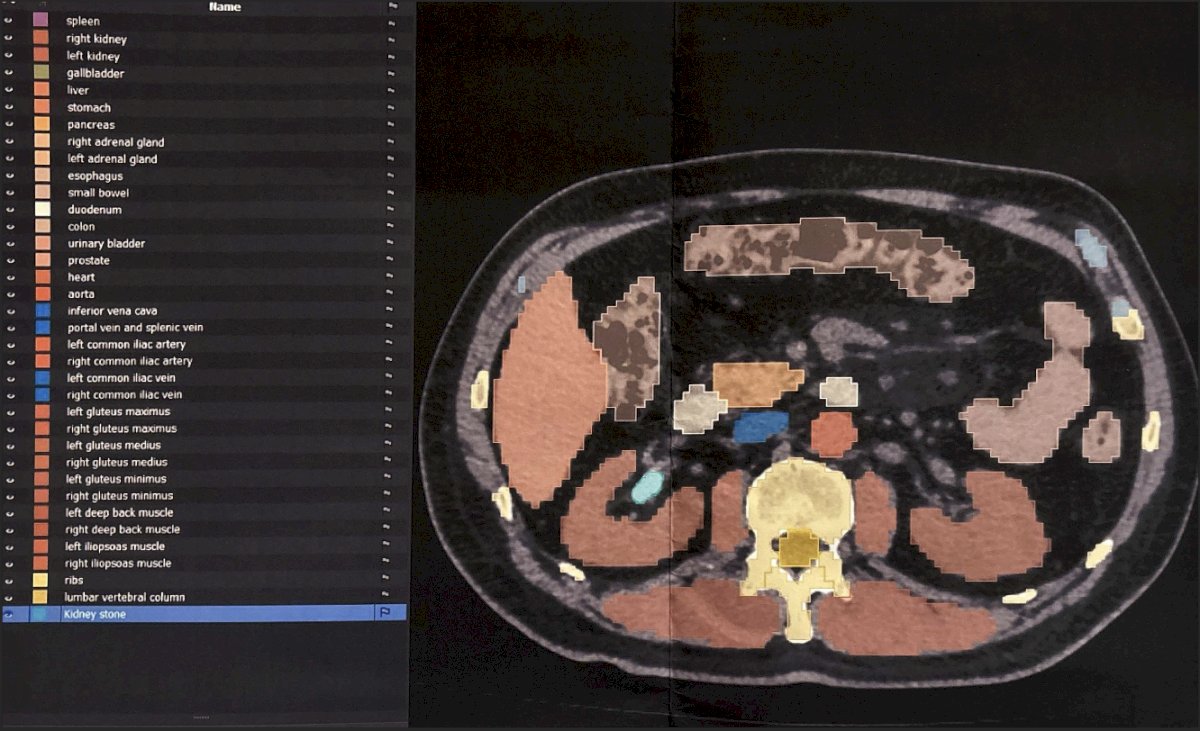
Figure 1. Annotated CT image showing surrounding abdominal structures around a kidney stone (light blue) in the right renal pelvis.
Dr. Zein states that his team was able to successfully develop an AI model that was able to automatically evaluate kidney stones and generate a needle access trajectory with quantitative needle measurements required for safe PCNL access. While further testing is needed to strengthen its accuracy and clinical validity, Dr. Zein and his team demonstrate that their AI model shows promise as a preoperative tool for identifying kidney stone composition as well as guiding surgeons on the optimal needle access trajectory to achieve a safe PCNL.
Before concluding the presentation, one of the moderators, Dr. Eugene Shkolyar, asked Dr. Zein how the surgeon would execute the specific needle angle that was planned by the AI model. In response, he stated that the AI model is only a preoperative plan while real-time intraoperative application is the next area of research. Lastly, another moderator, Dr. Daniel Lee, asked whether the AI model was validated for the main issues of accidental puncture into the pleural space and colon during a PCNL procedure. Dr. Zein replied succinctly that significant reviews by humans were performed for these instances and future incorporation of 3D CT scans would further facilitate safe needle access.
Presented by: Marwan Zein, M.D., PGY-5, American University of Beirut Medical Center, Beirut, Lebanon @MZein96 on X during the 2026 American Urological Association (AUA) Annual Meeting, May 15 – May 18, 2026, Washington, D.C.
Written by: Victor Pham, University of California Irvine, @victorpham01 on X during the American Urological Association (AUA) 2026 Annual Meeting, Washington, DC, Fri, May 15 – Mon, May 18, 2026.