

(UroToday.com) Dr. Giulia Ippolito from the University of Michigan presented findings from the UroEDIC Study, highlighting factors associated with elevated post-void residual (PVR) urine volumes in men and women living with long-standing type 1 diabetes (T1D).
She began by reviewing the study’s foundation: a nearly 30-year follow-up of patients with T1D originally enrolled in the Diabetes Control and Complications Trial (DCCT). After the original trial was stopped in 1993 due to the clear benefits of tight insulin control in preventing end-organ damage, participants were transitioned to intensive management and prospectively followed as part of the EDIC cohort. Now in its 29th year, the cohort offers a uniquely detailed longitudinal look at diabetes-related complications, including urologic dysfunction.
This study focused on a cross-sectional analysis of PVR urine volumes at year 29 between men and women. Patients completed validated lower urinary tract symptoms (LUTS) questionnaires, and data were collected on glycemic control, kidney function, and both peripheral and autonomic neuropathy.
“What we found here is that the median PVR, as expected, was higher among men versus women and increased with age,” Dr. Ippolito explained. “Surprisingly for me as a urologist, there really weren’t a lot of people with PVRs greater than 300. In fact, very few had PVRs over 150” (Figure 1).
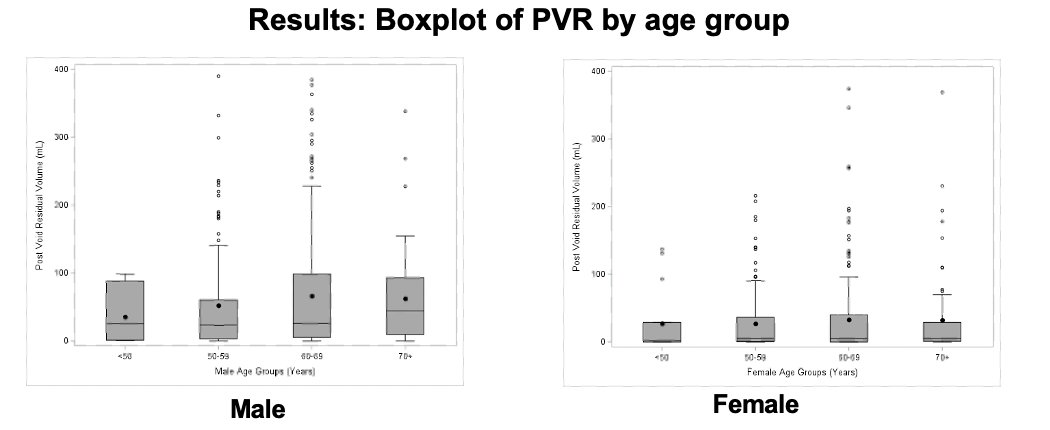
Figure 1.
Specifically, 16% of men and 5% of women had PVRs greater than 150 mL. “That kind of goes against what we tend to expect as urologists,” she added, noting that patients with long-standing type 1 diabetes are often assumed to have a higher prevalence of elevated PVR than the general population.
The data revealed a clear sex difference in median PVRs (higher in men), and as expected, PVR increased with age. However, multivariable models revealed a consistent and significant association between neuropathy and elevated PVR in both men and women (Table 1). This included both clinical peripheral neuropathy and autonomic dysfunction, which affect detrusor contractility and voiding coordination.
Table 1. Multilevel logistic regression model for odds of PVR > 150 mL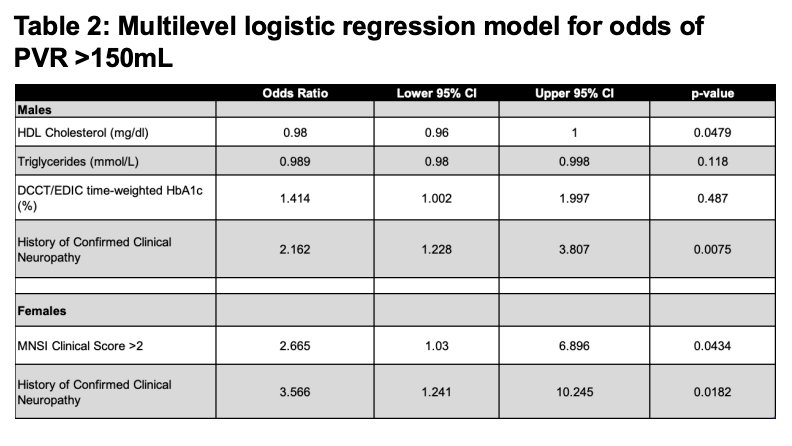
“We’re seeing the same signal across studies: neuropathy tracks with urologic dysfunction,” she noted. “And that’s something we need to feed back to primary care. These patients, once they get to us in urology, it’s probably too late.”
She concluded by emphasizing the importance of sharing these findings with primary care providers and highlighted the need to screen for PVR earlier, particularly in patients with clinical neuropathy.
During the Q&A, an audience member asked whether glycemic control, measured by HbA1c, played any role in predicting elevated PVR. Dr. Ippolito explained that HbA1c did not emerge as a significant factor in either the bivariate or multivariate models. While prior work from the group had found a small association between HbA1c and overactive bladder symptoms, the absolute difference (HbA1c of 8.0 vs. 7.6) was likely not clinically meaningful and may have reflected statistical significance due to the large sample size.
She also noted that this cohort is exceptionally well-managed, with few participants falling into poorly controlled glycemic ranges, possibly limiting the ability to detect a strong relationship.
Reflecting on the broader findings, Dr. Ippolito remarked, “For me, the takeaway is I’m going to start thinking more about autonomic neuropathy — I don’t think about it enough.”
She pointed out that signals from the session’s prior presentations, such as lower diastolic blood pressure, may reflect altered parasympathetic and sympathetic tone, which could underlie the presence of irritative lower urinary tract symptoms in this population. This raised the possibility that the symptoms may be driven less by obstructive pathology and more by autonomic dysfunction.
From the moderator table, Dr. Alan Wein added perspective on the cohort itself:
“This cohort was really followed very well, so it’s not entirely typical of the general population,” he noted. “It took a lot of work. I mean, the whole group should be congratulated for doing this — my goodness.”
Further discussion sparked conversation about a potential causal pathway, as previous studies found HbA1c to be the strongest signal for urologic complications in earlier years of follow-up. It was suggested that poor glycemic control earlier in life may lead to long-term dysfunction, even if current HbA1c levels no longer correlate with symptom severity.
Dr. Ippolito also noted that her team is reviewing urinary tract infection (UTI) data and is particularly interested in exploring whether elevated PVR is associated with increased UTI risk, an analysis that will be addressed in the forthcoming manuscript.
Moderated by: Alan Wein (Desai-Sethi Institute of Urology, University of Miami Miller School of Medicine), Gary Lemack (University of Texas Southwestern Medical Center), Priya Padmanabhan (William Beaumont University Hospital)
Presented by: Giulia Ippolito, MD, MS, Assistant Professor of Urology at the University of Michigan, specializing in Urogynecology and Reconstructive Pelvic Surgery (URPS).
Written by: Tiffany Huang, MS3, University of California, Irvine School of Medicine, @tiffvnyhuang on X during the American Urological Association's 2025 Annual Meeting, between April 26 – 29, 2025 in Las Vegas, NV.