

(UroToday.com) The 2025 AUA annual meeting featured an advanced prostate cancer session and a presentation by Dr. Renil Titus discussing a comparison of cardiovascular events in patients with advanced prostate cancer treated with LHRH agonists versus LHRH antagonists in the United States.
The standard of care for metastatic castrate-sensitive prostate cancer (mCSPC) is ADT using LHRH agonists (leuprolide, goserelin or triptorelin) or LHRH antagonists (degarelix or relugolix). Cardiovascular disease is the most common cause of non-cancer mortality in prostate cancer patients, and post hoc analyses have suggested that the risk of major adverse cardiovascular events (MACE – defined as myocardial infarction, stroke and deaths from any cause) among patients receiving LHRH antagonists may be lower. Using real world, de-identified data from multiple institutions in the United States (TriNetX database), Dr. Titus and colleagues examined the association between MACE and receipt of LHRH agonists versus LHRH antagonists.
This was a retrospective cohort study that included adult mCSPC patients who received either an LHRH agonist or LHRH antagonist. The primary outcome was MACE, and secondary outcomes were rates of ST-elevation myocardial infarction, rates of ischemic or hemorrhagic strokes, and death from any cause. Based on the HERO randomized clinical trial,1 the investigators balanced for potential confounders by using propensity score matching with a 1:1 ratio between LHRH agonist and LHRH antagonist groups, a caliper of 0.25 SDs, and a standardized mean difference of 0.1 by nearest-neighbor greedy matching:
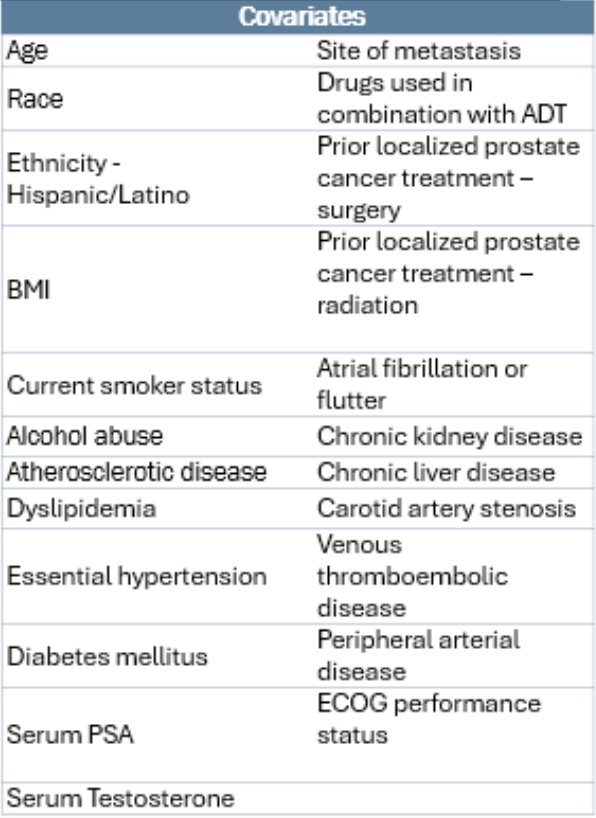
Risk ratios (RR) and 95% confidence intervals were reported for the outcomes.
This study identified 21,185 patients, 19,480 in the LHRH agonist and 1,705 in the LHRH antagonist groups. After propensity score matching, 1,699 patients receiving LHRH agonists were compared with 1,699 patients receiving LHRH antagonists. Patients receiving LHRH agonists were at a higher risk of MACE than those receiving LHRH antagonists (RR 1.29, 95% CI 1.17-1.43). Additionally, patients receiving LHRH agonists were at a higher risk of STEMI (RR 1.53, 95% CI 1.11-2.1), stroke (RR 1.50, 95% CI 1.05-2.16), and death from any cause (RR 1.20, 95% CI 1.09-1.32) compared to patients receiving LHRH antagonists:

Even among patients with low cardiovascular risk, patients receiving LHRH agonists were at a higher risk of MACE (RR 1.54, 95% CI 1.07-2.21), and death from any cause (RR 1.55, 95% CI 1.08-2.23) compared to patients receiving LHRH antagonists.
Dr. Titus concluded his presentation discussing a comparison of cardiovascular events in patients with advanced prostate cancer treated with LHRH agonists versus antagonists in the United States with the following take home points:
- Treatment with an LHRH agonist is associated with an increased risk of composite and separate MACE outcomes compared to treatment with an LHRH antagonist
- This evidence may help guide appropriate patient selection for either medication based on cardiovascular risk, history of compliance, and safety/efficacy of ADT
Presented by: Renil Titus, MD, Houston Methodist Hospital, Houston, TX
Written by: Zachary Klaassen, MD, MSc – Urologic Oncologist, Associate Professor of Urology, Georgia Cancer Center, Wellstar MCG Health, @zklaassen_md on Twitter during the American Urological Association's 2025 Annual Meeting, between April 26 – 29, 2025 in Las Vegas, NV.
References: