

(UroToday.com) The American Urologic Association (AUA) 2025 Annual Meeting, held in Las Vegas, NV, was host to an advanced prostate cancer moderated poster session. Dr. Lucas Amorim presented the results of a meta-analysis of prospective trials evaluating testosterone recovery profiles after cessation of androgen deprivation therapy (ADT) in prostate cancer patients.
Failure of testosterone recovery following ADT cessation is associated with adverse quality-of-life and cardiovascular/metabolic outcomes. Further evaluation of testosterone recovery outcomes following cessation of hormone therapy, stratified by drug class/intensification received, is critical for furthering our understanding of longitudinal health outcomes following discontinuation of hormone therapy and patient counseling for guiding personalized decision-making.
To this end, Dr. Amorim and colleagues performed a systematic review and meta-analysis of prospective trials evaluating testosterone recovery after cessation of ADT. A systematic search of PubMed, Embase, and Cochrane Central was performed to identify all prospective studies that evaluated testosterone recovery profiles following ADT discontinuation. Pooled analyses for binary data (testosterone recovery versus no recovery) were performed. Subgroup analyses by ADT drug class were performed, and a meta-regression analysis exploring the relationship between ADT duration and testosterone recovery was performed.
The study investigators identified 24 prospective trials with 2,850 patients. The median patient age ranged between 59 and 77 years. Overall, testosterone recovery, defined at 240 ng/dL, was observed in 75.8% of patients (95% CI: 67.1–83.6%).
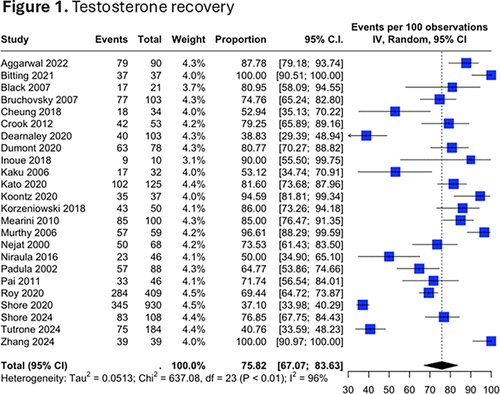
In a subgroup analysis of patients treated with GnRH agonists, T recovery was observed in only 41.8% of patients (95% CI: 13.9–76.1%), significantly lower compared to the overall cohort. Additionally, the meta-regression analysis demonstrated no significant correlations between the duration of ADT use and testosterone recovery.
The study investigators concluded that most patients recover ‘normal’ testosterone levels following ADT cessation. This proportion is lower in patients receiving GnRH agonists and not correlated with the duration of ADT use.
Presented by: Lucas Amorim, MD, Post-doctoral Fellow, Department of Urology, Indiana University, Indianapolis, IN
Written by: Rashid K. Sayyid, MD, MSc – Robotic Urologic Oncology Fellow at The University of Southern California, @rksayyid on Twitter during the 2025 American Urological Association (AUA) annual meeting held in Las Vegas, NV, Saturday, April 26 - Tuesday, April 29, 2025