

(UroToday.com) The American Urologic Association (AUA) 2025 Annual Meeting, held in Las Vegas, NV, was host to an advanced prostate cancer moderated poster session. Dr. Antony Pellegrino presented a study evaluating the prognostic implication of a negative PSMA PET at the time of biochemical recurrence in radical prostatectomy-treated patients.
There is significant debate regarding the benefit of pelvic radiotherapy in the post-radical prostatectomy biochemically recurrent setting for patients with negative staging scans (PSMA PET or conventional imaging). This study aimed to compare metastasis-free survival (MFS) outcomes in men receiving salvage radiotherapy (sRT) after a negative PSMA PET scan (miN0M0) versus those treated without molecular imaging guidance, i.e., negative conventional imaging (miNxMx).
This multicenter retrospective cohort study included 601 patients who underwent PSMA PET for biochemical recurrence following radical prostatectomy between 2016 and 2022. Patients with negative PSMA PET scans (miN0M0), no prior adjuvant therapy, and who subsequently received salvage radiotherapy (sRT) were selected. The comparator group included 527 ‘controls’ who underwent salvage radiotherapy for biochemical recurrence and who had negative conventional imaging findings. The study investigators performed a propensity score matched analysis, incorporating year of sRT, age, PSA, PSA doubling time, Gleason Score, T stage, and N stage. Interval imaging following sRT was used to define the development of metastatic disease. Metastasis-free survival was evaluated using cumulative incidence function curves and multivariable Cox regression modeling.
The median age (65 versus 64 years) and PSA (0.35 versus 0.28 ng/mL) were comparable between the two groups. However, the PSMA PET-negative group had a higher incidence of ISUP Grade Group 4–5 disease (38% versus 19%, p<0.001). After propensity matching, all baseline characteristics were balanced (all p > 0.05).
At a median follow-up of 24 months, 53 patients developed metastases. The 24-month cumulative incidences of metastases were:
- 22% in the conventional imaging group
- 10% in the PSMA PET-negative group
- Adjusted HR: 0.58, p=0.04
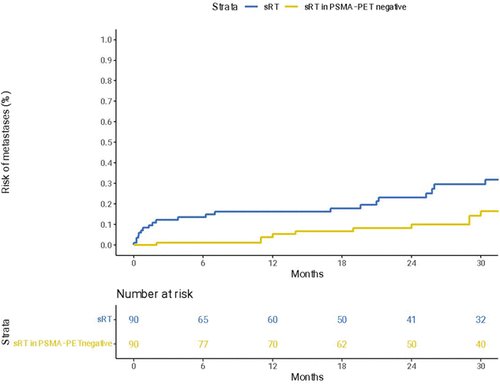
Dr. Pellegrino argued that this study supports the utility of PSMA PET for refining patient selection for sRT. Patients with negative staging PSMA PET scans in the biochemically recurrent setting who undergo sRT have significantly lower rates of metastatic progression compared to those with negative conventional imaging staging scans.
Presented by: Antony Pellegrino, MD, IRCCS Ospedale San Raffaele, Milan, Italy
Written by: Rashid K. Sayyid, MD, MSc – Robotic Urologic Oncology Fellow at The University of Southern California, @rksayyid on Twitter during the 2025 American Urological Association (AUA) annual meeting held in Las Vegas, NV, Saturday, April 26 - Tuesday, April 29, 2025
Related content: PSMA-PET Improves Metastasis-Free Survival in Salvage Radiotherapy for Prostate Cancer - Antony Pellegrino