

(UroToday.com) The American Urologic Association (AUA) 2025 Annual Meeting held in Las Vegas, NV was host to an advanced prostate cancer moderated poster session. Dr. Quoc-Dien Trinh presented an ad hoc analysis of the phase III ARANOTE trial evaluating the efficacy and safety of darolutamide + ADT in black patients with metastatic hormone-sensitive prostate cancer (mHSPC).
The incidence and mortality rates of prostate cancer are higher in Black patients compared with other racial groups,1 yet a recent multi-institutional analysis suggests Black patients with mHSPC have favorable outcomes with ADT-based regimens.2
In the phase III ARANOTE trial (NCT04736199) of patients with mHSPC, darolutamide combined with ADT significantly reduced the risk of radiological progression or death by 46% (HR: 0.54; 95% CI: 0.41–0.71; p<0.0001), compared to placebo + ADT.3 The incidence of treatment-emergent adverse events (TEAEs) was low and similar between groups, with fewer patients discontinuing darolutamide (6.1%) versus placebo (9.0%) due to TEAEs.3
Herein, Dr. Trinh reported the efficacy and safety of darolutamide + ADT versus placebo + ADT in Black patients from the ARANOTE trial.
Patients starting on ADT therapy were randomized 2:1 to receive darolutamide 600 mg twice daily or placebo. The primary endpoint was radiological progression-free survival (rPFS). Secondary endpoints included:
- Time to metastatic castration-resistant prostate cancer (mCRPC
- Time to prostate-specific antigen (PSA) progression
- Proportion of patients reaching PSA <0.2 ng/mL at any time
- Time to initiation of subsequent anticancer therapy
- Safety
Medians and 95% confidence intervals (CIs) were computed using Kaplan-Meier estimates with hazard ratios (HR [95% CI]) based on an unstratified Cox regression model. Patient demographics, baseline characteristics, and TEAEs were reported descriptively for the
Black patient subgroup and overall population. Of the overall ARANOTE study population (N=669), 65 patients (10%; darolutamide, n=41; placebo, n=24) were Black, and were located in Brazil (n=58), South Africa (n=6) and
Australia (n=1). The baseline characteristics were similar across treatment arms and generally consistent with the overall ARANOTE population, with the exception that Black patients had higher median baseline PSA levels (99.6 vs 21.3 ng/mL) and a greater proportion had high-volume mHSPC (78.5% vs 70.6%).

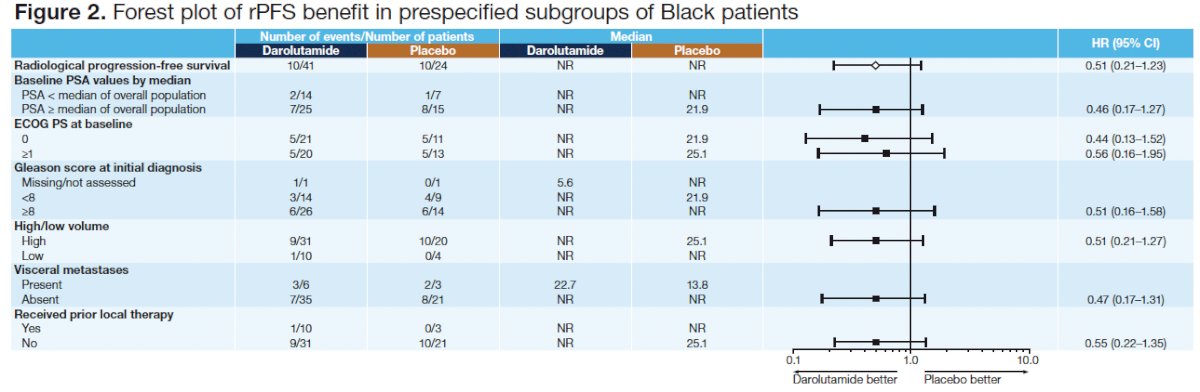
At a median follow-up of 25 months, darolutamide reduced the risk of radiological progression or death by 49% in Black patients (median: not reached in either treatment arm; HR: 0.51, 95% CI: 0.21-1.23):

The rPFS benefit of darolutamide was generally consistent across prespecified subgroups of Black patients:
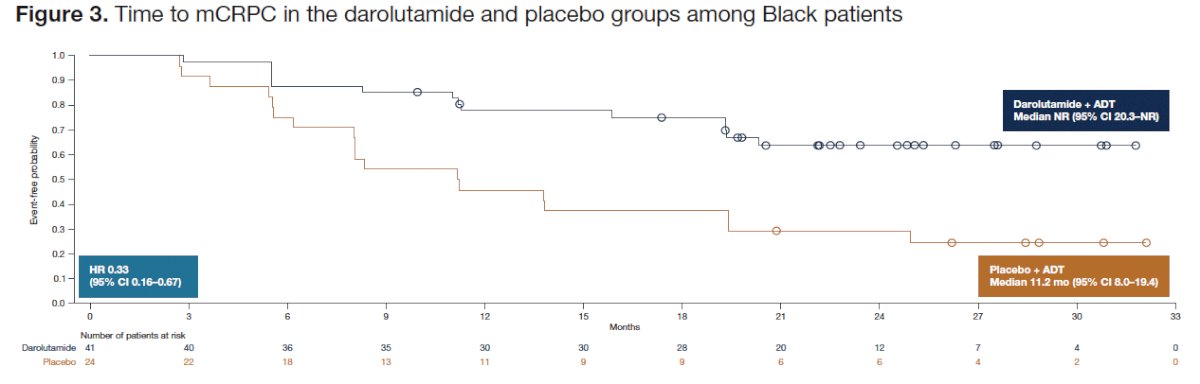
Darolutamide delayed time to mCRPC compared with placebo in Black patients:
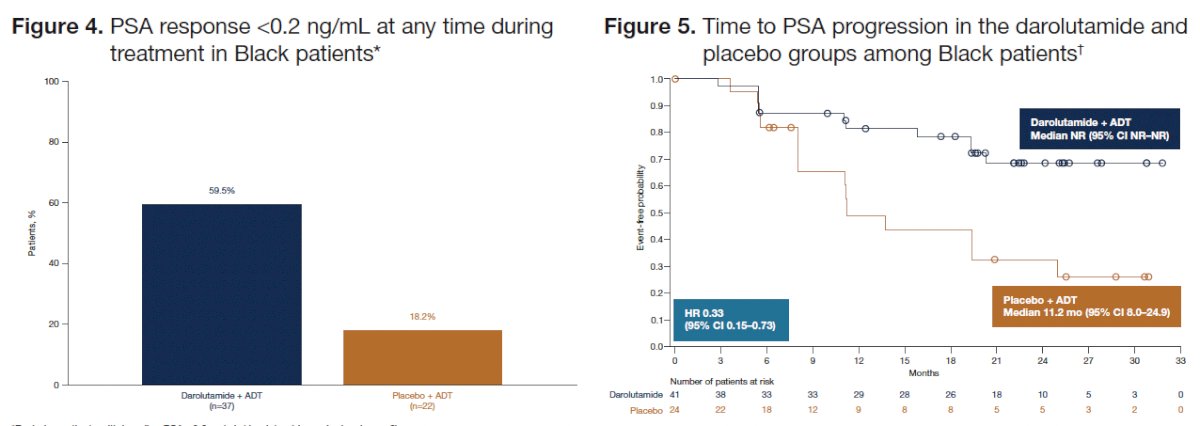
Black patients receiving darolutamide had a higher rate of PSA response <0.2 ng/mL at any time and a delayed time to PSA progression, compared with those receiving placebo.
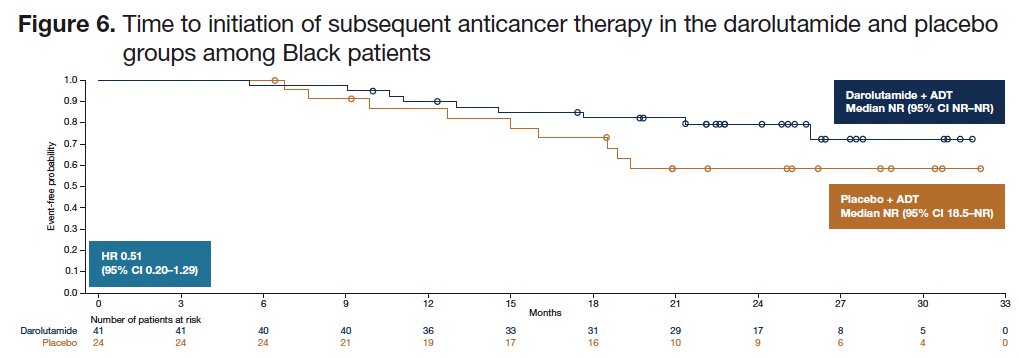
Darolutamide delayed time to initiation of subsequent anticancer therapy compared with placebo in Black patients:
The median duration of treatment in Black patients was 22.6 months in the darolutamide group and 19.5 months in the placebo group (overall population: darolutamide group 24.2 months; placebo group 17.3 months). Incidences of TEAEs were similar between treatment groups in Black patients, consistent with that observed in the overall ARANOTE population.
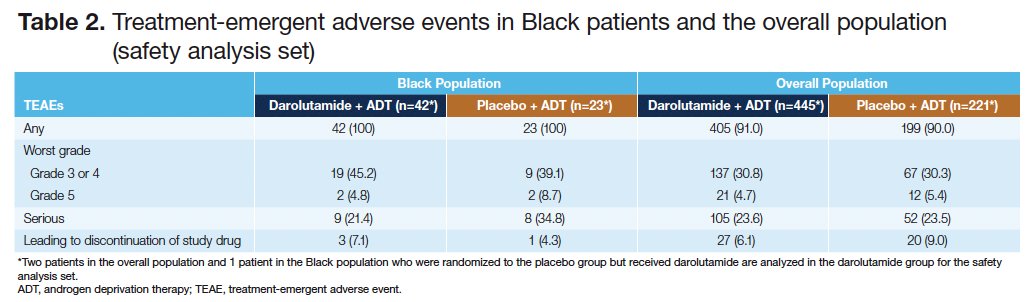
TEAEs commonly associated with androgen receptor pathway inhibitors were generally similar between treatment groups in Black patients.

Dr. Trinh concluded as follows:
- In the subgroup of Black patients from the ARANOTE study, darolutamide was associated with an improvement in rPFS and delayed time to mCRPC, time to PSA progression, and time to initiation of subsequent anticancer therapy, compared with placebo, and similar to what was observed in the overall population.
- The rPFS benefit was consistent across all prespecified subgroups of Black patients, although efficacy data were limited by the small sample size and numbers of events.
- PSA response rates and time to PSA progression are notable in the Black population given the higher PSA levels at baseline, compared with the overall ARANOTE population.
- Darolutamide exhibited a favorable safety profile in Black patients compared with placebo, that was generally consistent with the overall ARANOTE population between treatment groups
Presented by: Quoc-Dien Trinh, MD, MBA, Professor, Chair, Department of Urology, University of Pittsburgh, Pittsburgh, PA
Written by: Rashid K. Sayyid, MD, MSc – Robotic Urologic Oncology Fellow at The University of Southern California, @rksayyid on Twitter during the 2025 American Urological Association (AUA) annual meeting held in Las Vegas, NV, Saturday, April 26 - Tuesday, April 29, 2025
Related content: Subgroup Analysis Confirms Darolutamide Efficacy in Black Prostate Cancer Patients - Quoc-Dien Trinh
References:
- Siegel RL, Kratzer TB, Giaquinto AN, et al. Cancer statistics, 2025. CA Cancer J Clin. 2025; 75(1): 10-45.
- Freeman MN, Jang A, Zhu J, et al. Multi-institutional Analysis of the Clinical and Genomic Characteristics of Black Patients with Metastatic Hormone-Sensitive Prostate Cancer. Oncologist. 2022; 27(3): 220-7.
- Saad F, Vjaters E, Shore N, et al. Darolutamide in Combination With Androgen-Deprivation Therapy in Patients With Metastatic Hormone-Sensitive Prostate Cancer From the Phase III ARANOTE Trial. J Clin Oncol. 2024; 42(36): 4271-81.