

(UroToday.com) The American Urologic Association (AUA) 2025 Annual Meeting held in Las Vegas, NV was host to an advanced prostate cancer moderated poster session. Dr. David Morris presented results from the TRITON3 study of rucaparib versus docetaxel or a second-generation androgen receptor pathway inhibitor (ARPI) in metastatic castrate-resistant prostate cancer (mCRPC) patients with BRCA mutations.
Liver metastases are a known prognostic factor of poor outcomes in mCRPC and are correlated with a median overall survival of 10–14 months. Although around 25% of patients with mCRPC have liver metastases, mCRPC with liver metastases has not been widely studied.1
In the open-label, randomized, phase III TRITON3 (NCT02975934) study, chemotherapy-naïve mCRPC patients with BRCA1 or BRCA2 (BRCA1/2) or ATM gene alterations received rucaparib, a poly (ADP-ribose) polymerase (PARP) inhibitor, or physician's choice of docetaxel or an androgen receptor pathway inhibitor (ARPI). Primary results from the TRITON3 study demonstrated that rucaparib significantly improved rPFS, the primary efficacy endpoint, versus physician’s choice in the BRCA and intent-to-treat populations,2 and the final OS was similar between arms.3 Herein, Dr. Morris reported the results from an exploratory analysis of the BRCA population, where presence or absence of liver metastases was one of the stratification factors.
Men ≥18 years of age with histologically or cytologically confirmed chemotherapy-naïve
mCRPC and a BRCA1/2 or ATM alteration who progressed after prior treatment with one second-generation ARPI were eligible for enrollment. Patients were randomized 2:1 to rucaparib (n = 270) or physician’s choice (n = 135). Of the patients in the physician’s choice arm, 75 received docetaxel and 60 received ARPI.
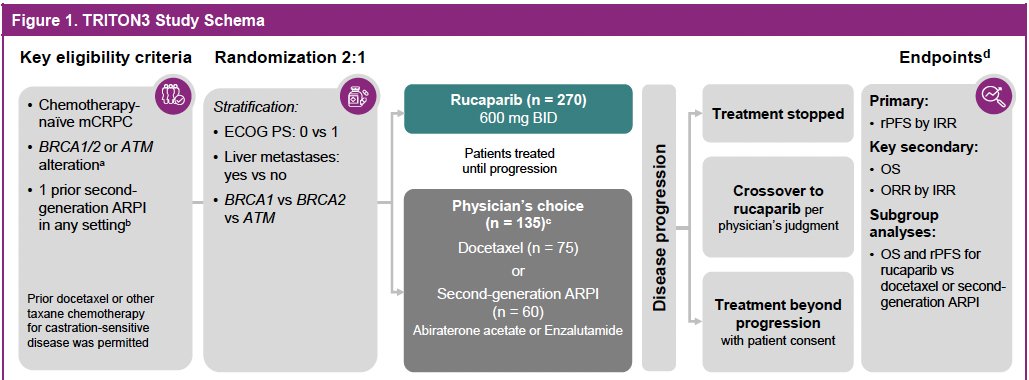
rPFS was the primary endpoint, and OS and ORR for patients with measurable disease were key secondary endpoints; descriptive P values were presented in these analyses. The data cutoff dates were August 25, 2022, for rPFS and ORR, and March 1, 2024, for OS. Crossover from physician’s choice to rucaparib was allowed after radiographic progression was confirmed by independent radiology review.
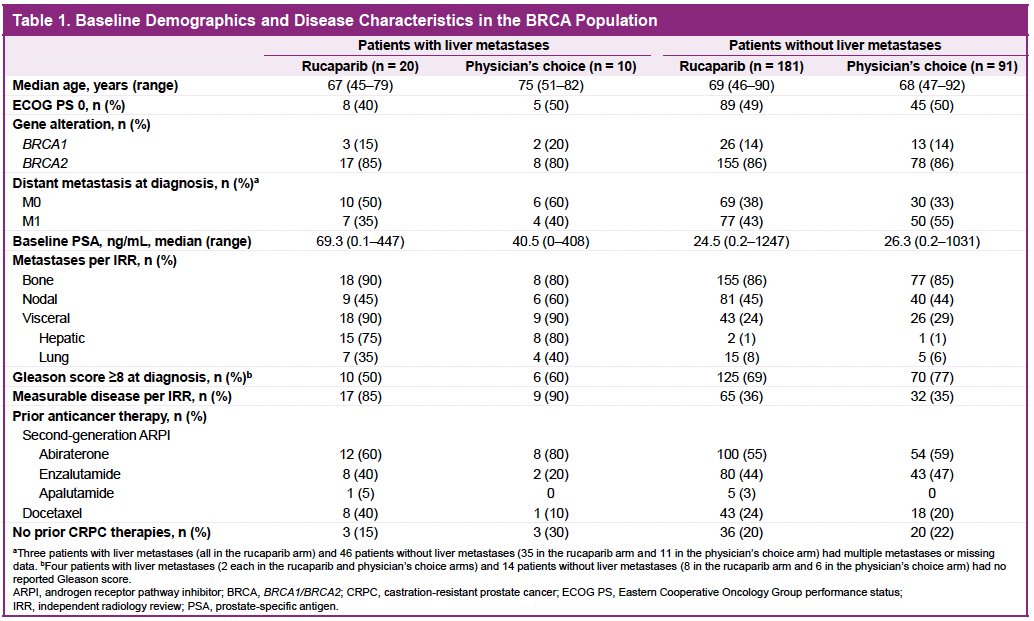
Of 302 patients in the BRCA population, 30 had liver metastases (20 rucaparib; 10 physician’s choice). The baseline demographics and characteristics were generally similar between arms for patients with and without liver metastases (Table 1).
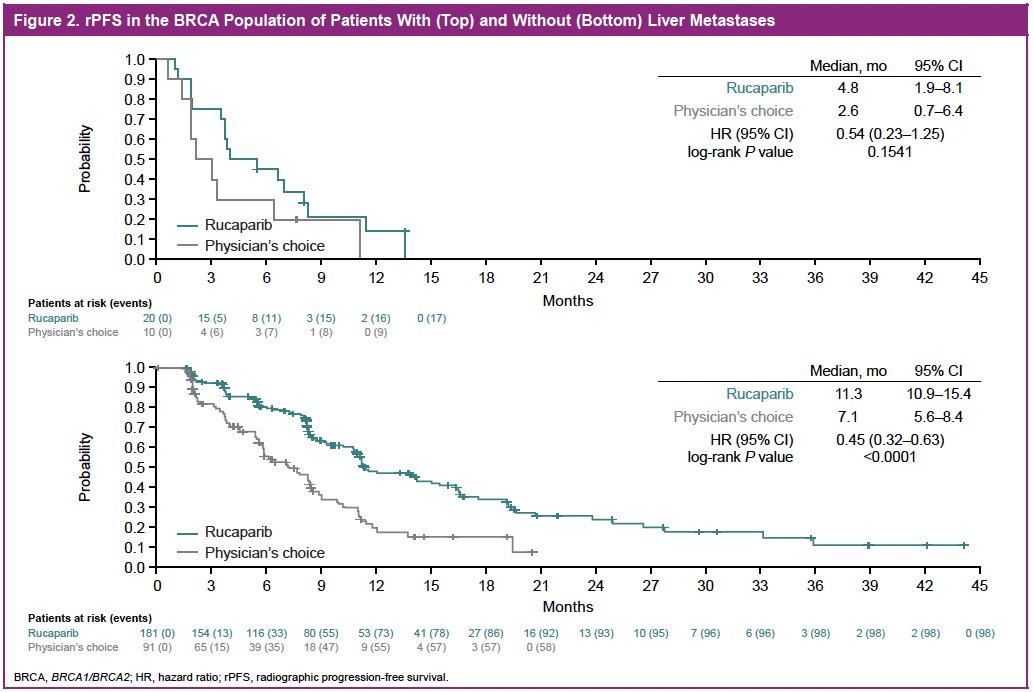
Median rPFS favored rucaparib over physician’s choice for patients with liver metastases (4.8 vs 2.6 months; hazard ratio [HR], 0.54 [95% CI, 0.23–1.25]) and without liver metastases (11.3 vs 7.1 months; HR, 0.45 [95% CI, 0.32–0.63]).
Median OS was similar between arms and was twice as long for those without liver metastases in comparison with those with liver metastases in both arms.

The ORR of rucaparib versus physician’s choice for patients with liver metastases was 41% versus 22%, respectively; the ORR for patients without liver metastases was 46% versus 16%, respectively.
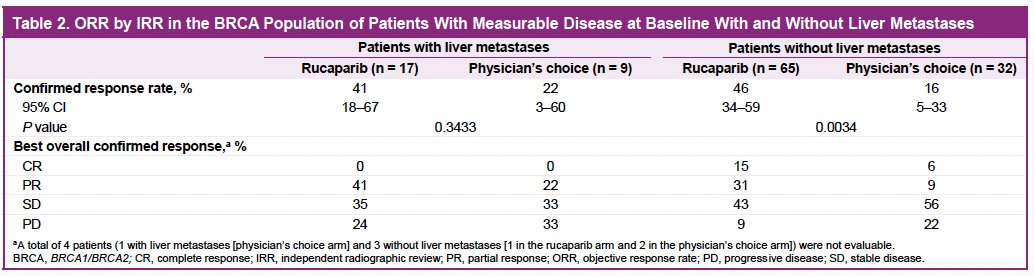
For patients with liver metastases, 41% (7/17) in the rucaparib arm compared with 22% (2/9) in the physician’s choice arm had a partial response (PR); no patients had a complete response. For patients without liver metastases, 46% (30/65) in the rucaparib arm compared with 16% (5/32) in the physician’s choice arm had a CR or PR. Of those in the physician’s choice arm, 50% (5/10) of patients with liver metastases and 53% (48/91) without crossed over to receive rucaparib.
Dr. Morris concluded as follows:
- In TRITON3, rucaparib provided a numerically longer radiographic progression-free survival, similar overall survival, and higher objective response rate in comparison with physician’s choice for patients with BRCA-mutated mCRPC with or without liver metastases, supporting rucaparib as a treatment option.
- These results should be interpreted with caution owing to the small number of patients with liver metastases
Presented by: David Morris, MD, Urology Associates PC, Nashville, TN
Written by: Rashid K. Sayyid, MD, MSc – Robotic Urologic Oncology Fellow at The University of Southern California, @rksayyid on Twitter during the 2025 American Urological Association (AUA) annual meeting held in Las Vegas, NV, Saturday, April 26 - Tuesday, April 29, 2025
Related content: TRITON3 Subgroup Analysis: Rucaparib Benefits BRCA+ Patients with Liver Mets - David Morris
References:
- Shiner A, Sperandio RC, Naimi M, Emmenegger U. Prostate cancer liver metastasis: an ominous metastatic site in need of distinct management strategies. J Clin Med. 2024; 13(3): 734.
- Fizazi K, Piulats JM, Reaume MN, Ostler P, et al. Rucaparib or physician's choice in metastatic prostate cancer. N Engl J Med. 2023; 388(8): 719–32.
- Bryce AH, McDermott RS, Piulats JM, et al. Rucaparib vs docetaxel (DTX) or second-generation androgen pathway inhibitor (ARPI) therapy for metastatic castration-resistant prostate cancer (mCRPC): TRITON3 final overall survival (OS) and safety. J Clin Oncol. 2025; 43(5_suppl): 155.