

(UroToday.com) The American Urological Association's 2025 Annual Meeting, in Las Vegas, Nevada, was host to the Moderated Poster 13: Prostate Cancer: Staging Session. Dr. Ana Moser presented the moderated poster 13-12: Who Still Needs a Lymph Node Dissection with a Negative PSMA-PET? Results from the Michigan Urological Surgery Improvement Collaborative.
Dr. Moser opened her presentation by noting the growing use of PSMA-PET imaging to stage men with prostate cancer, particularly for detecting regional lymph node involvement and distant metastases. The investigators aimed to evaluate the concordance between clinical N stage (cN), based on preoperative PSMA-PET imaging, and pathological N stage (pN), using real-world data from the Michigan Urological Surgery Improvement Collaborative (MUSIC), a statewide registry that includes data from 46 urology practices across Michigan.
The investigators reviewed the MUSIC registry to identify men who underwent PSMA-PET imaging prior to radical prostatectomy (RP) with pelvic lymph node dissection (PLND). They compared PSMA-PET findings for pelvic lymph node involvement (cN) with final pathology (pN) to evaluate the test’s positive predictive value (PPV) and negative predictive value (NPV). Additionally, they analyzed pathology grade group (GG), PSA, and pathologic T stage between cN0/pN1 and cN0/pN0 patients using Fisher’s exact and Wilcoxon rank-sum tests.
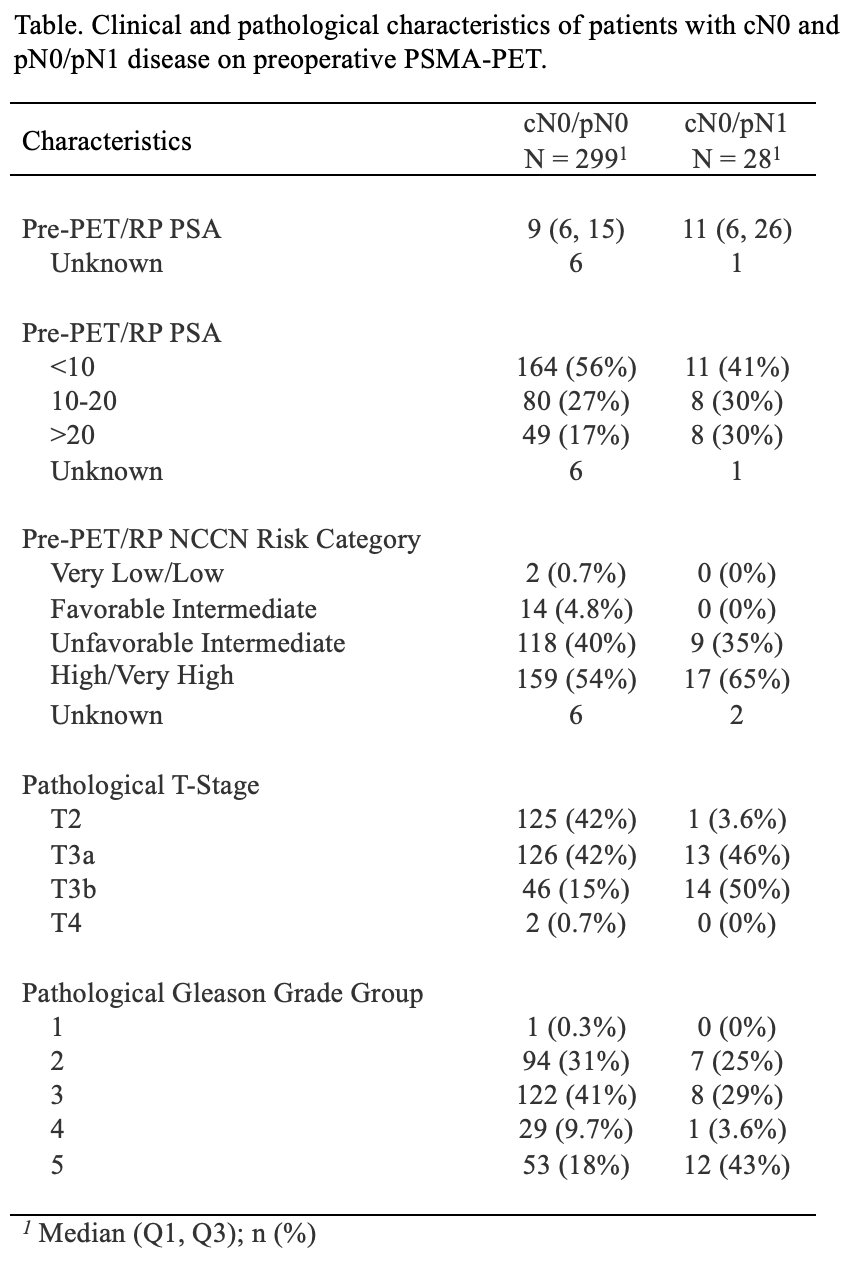
A total of 359 men who underwent PSMA-PET prior to radical prostatectomy with pelvic lymph node dissection were included in the analysis. Of these, 327 were cN0, 21 were cN1, and 11 were cNx. Among the 327 cN0 patients, 299 were confirmed as pN0 and 28 as pN1. Median PSA levels were similar between the cN0/pN1 and cN0/pN0 groups. Baseline clinical and pathological characteristics are outlined in the table below.
Of the 21 patients with cN1 disease on PSMA-PET, 15 were ultimately pN0 and 6 were pN1, corresponding to a negative predictive value (NPV) of 91% and a positive predictive value (PPV) of 29%. Notably, 28 patients classified as cN0 on PSMA-PET were found to have nodal involvement (pN1) on final pathology following pelvic lymph node dissection, underscoring the limitations of PSMA-PET in detecting occult nodal metastases.
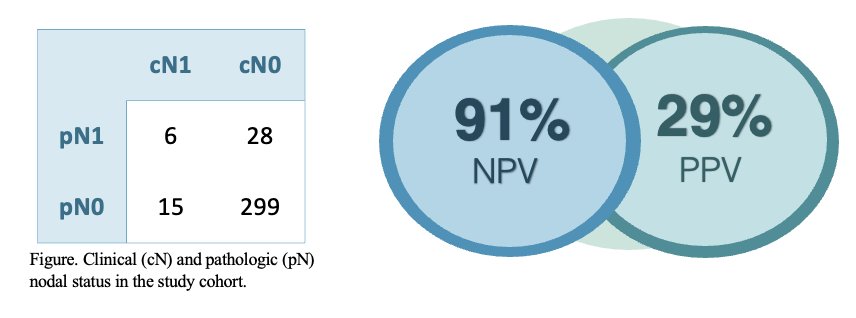
Dr. Moser pointed out that the NPV of PSMA-PET observed in the MUSIC cohort aligned with prior studies, hovering around 80%. However, the PPV was substantially lower than expected 29% compared to ~75% in published literature. This discrepancy raises concerns regarding potential limitations in either the quality of pelvic lymph node dissection or the real-world performance of PSMA-PET imaging.
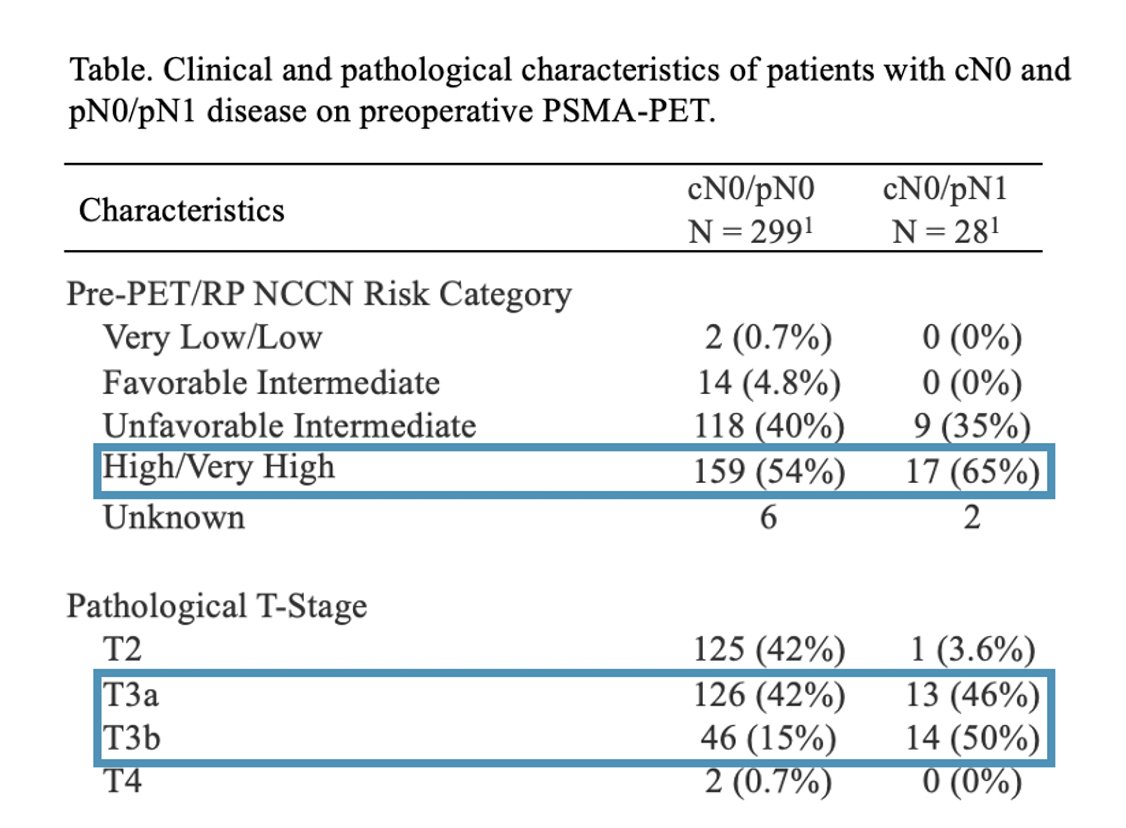
Notably, a higher proportion of cN0/pN1 patients were classified as NCCN high-risk preoperatively (65% vs. 54%). Additionally, 96% of cN0/pN1 patients had pT3a/b disease, compared to 57% of those with cN0/pN0 status as shown in the table below.
Dr. Moser concluded her presentation with the following key takeaways:
- Patients with cN0/pN1 disease were, as expected, at higher risk compared to those with cN0/pN0 disease.
- These findings may help refine patient selection for pelvic lymph node dissection among those staged as cN0 on PSMA-PET.
- The lower positive predictive value observed in the MUSIC cohort raises important questions about the quality of PLND and/or PSMA-PET imaging in real-world practice.
- These insights may guide future quality improvement initiatives to ensure that patients at high risk for pelvic lymph node metastases receive appropriate and high-quality PLND.
Presented by: Ana Moser, MD, Department of Urology, Wayne State University School of Medicine, Detroit, MI, United States.
Written by: Julian Chavarriaga, MD – Urologic Oncologist at Cancer Treatment and Research Center (CTIC) via Society of Urologic Oncology (SUO) Fellow at The University of Toronto. @chavarriagaj on Twitter during the 2025 American Urological Association (AUA) annual meeting held in Las Vegas, NV, Saturday, April 26 - Tuesday, April 29, 2025