

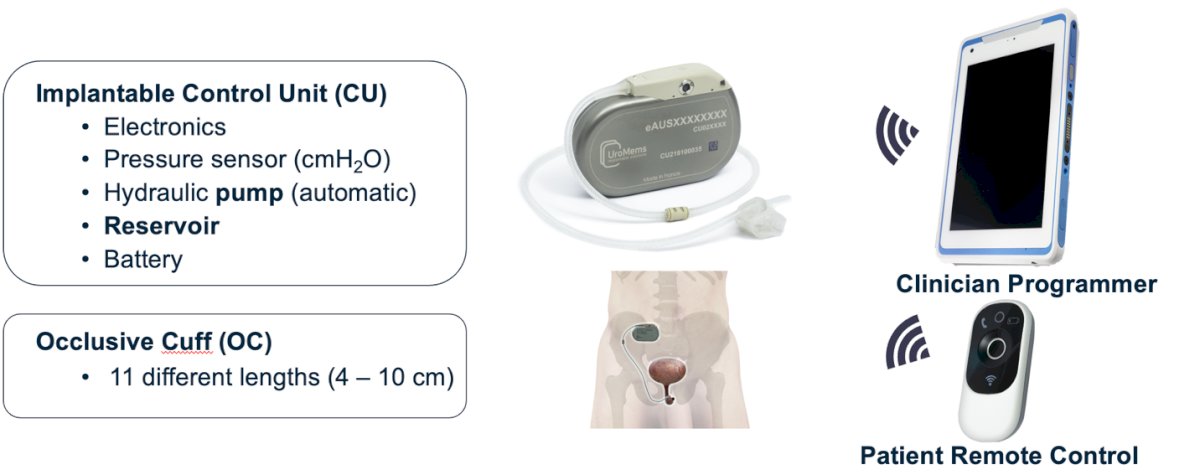
(UroToday.com) Dr. Chartier-Kastler (sponsored by UroMems) presented their findings on the UroActiveTM implantable electronic artificial urinary sphincter (AUS), aimed at treating male stress urinary incontinence. The UroActiveTM device is comprised of two main components: an implantable control unit (CU) containing a pressure sensor, hydraulic pump, reservoir and battery, and an occlusive urethral cuff (OC) which is fitted to the patient from 11 possible sizes, ranging from 4.0 cm to 10.0 cm. The control unit is placed in the right lower abdomen, above the rectus aponeurosis, while the occlusive cuff is placed around the bulbar urethra. A clinician is then able to program device parameters using a wireless external device in an outpatient setting. The patient is given a remote control to adjust cuff pressure on-demand within the set parameters, allowing them to open and close the cuff during voiding, and decrease the closed cuff pressure while lying down. UroActiveTM is not currently approved by the FDA or CE marked. The UroActiveTM device is outlined in the figure below.
The prospective SOPHIA study investigated the first-in-man safety and efficacy in 6 patients with stress urinary incontinence who received the UroActiveTM device. Results from the primary outcomes demonstrated all 6 patients with a successfully implanted device and no explantations or revisions at one year post activation. One patient had a hematoma in the immediate post-operative period. The safety mechanism on the device was triggered three times for a “time to long” function setting, and there was one non-device related serious adverse event. These results demonstrate that the UroActiveTM device is safe, with no safety concerns or unexpected adverse events at 1-year post-activation.
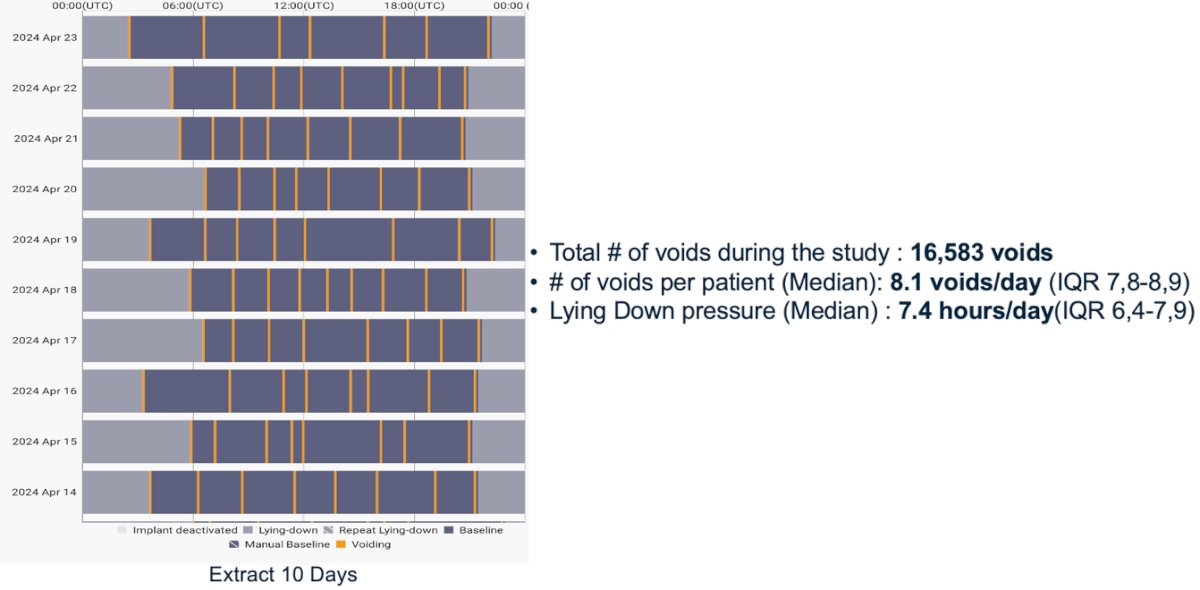
For main secondary outcomes at one-year post-activation, all patients had >50% reduction in 24-hour pad weight test (24H-PWT) with a median of 87% (IQR 77-97). Patients also had a mean of 8.1 micturitions/day (IQR 7,8-8,9) and used the low-pressure cuff setting while lying down, with median duration of 7.4 hours/day (IQR 6,4-7,9). Quality of life (QoL) at 1-year post-activation was also improved for the ICIQ-UI SF and IQOL forms, however, there was no difference in the EQ-5D-3L form. UroActiveTM is efficacious with a significant reduction in 24H-PWT and improvement in quality of life as seen in the tables below.


During a moderated discussion, panelists and audience members had several questions and comments related to the presentation. On the topic of the low-pressure cuff setting, further detail was provided on how patients can use a button on the remote control to switch the cuff from standard to low pressure on-demand. Dr. Chartier-Kastler additionally describes how using a low-pressure setting while sleeping reduces the chronic pressure burden on the urethra and has the potential to decrease the risk of urethral erosion in the long-term. The table below illustrates how patients switch between the different pressure settings (open, closed, & low pressure while lying down) over the course of 24 hours.
While panelists and audience members debated whether urethral erosion is a relevant risk to consider, and if variable pressure settings have utility, another audience member commented on how a wirelessly controlled AUS is of benefit to elderly patients who do not have the dexterity to operate a manual AUS implant. Thus, a caregiver or third party can operate the cuff wirelessly and remove the burden and risk of malfunction in the elderly population. There seemed to be a consensus that this was an appropriate application for variable pressure AUS settings.
Regarding differences in pre-operative and immediate post-operative urinary frequency, Dr. Chartier-Kastler discussed patients recovering some bladder function with decreased urinary frequency after surgery. When asked about future software developments, Dr. Chartier-Kastler confirmed plans to develop software that improves the function and capabilities of the UroActiveTM. He also reports that the devices will remain in the subjects with close follow-up, despite the UroActiveTM not being FDA approved or CE marked. The battery also has a lifespan of 7 to 10 years.
The SOPHIA study demonstrates the safety and efficacy of the UroActiveTM electronic artificial urethral sphincter at 1-year post-activation. Compared to analog AUS implants, the UroActiveTM is remote controlled and can be programmed by a clinician in the outpatient setting. It also has the benefit of a low-pressure setting to reduce the risk of urethral erosion and can be easily operated by a third party if the patient is unable to do so. This work represents an exciting advancement in the treatment of male stress urinary incontinence and sets the stage for development of new features and improved functionality in artificial urethral sphincter technology. UroMems is currently planning a prospective, multicenter, international, single-arm pivotal study to expand on this work. A first-in-women study is also ongoing.
Presented by: Emmanuel Chartier-Kastler, MD, PhD, Professor of Urology, Sorbonne Université, Paris, France
Written by: Tyler Lunow-Luke, Medical Student Year 3, University of California Irvine, during the 2025 American Urological Association (AUA) annual meeting held in Las Vegas, NV, Saturday, April 26 - Tuesday, April 29, 2025
References:
- Beaugerie A, Perrouin-Verbe MA, Denormandie A, Cotte J, Poinard F, Plassais C, et al. PD02-01 NEW ARTIFICIAL URINARY SPHINCTER : RESULTS OF THE FIRST IN MAN STUDY AT ONE YEAR POST-ACTIVATION (SOPHIA STUDY). Journal of Urology [Internet]. 2025 May 1 [cited 2025 Apr 26];213(5S):e41. Available from: https://doi.org/10.1097/01.JU.0001109716.61721.8d.01