

(UroToday.com) Dr. Dean Elterman from the University of Toronto delivered a podium presentation on the long-term efficacy of Rezūm therapy in patients with benign prostatic hyperplasia (BPH). Specifically, Dr. Elterman and colleagues sought to evaluate the durability of symptom relief and overall improvement in lower urinary tract symptoms (LUTS) with follow-up data extending to three years.
Dr. Elterman’s presentation could not have been better timed. Earlier in the same session, several speakers had pointed out the lack of long-term data on Rezūm, making his contribution particularly valuable. Rezūm, a minimally invasive therapy, uses water vapor injections to ablate prostate tissue, aiming to improve urinary symptoms while preserving sexual function.
Using data from a prospective international registry established at two high-volume centers, Dr. Elterman and colleagues evaluated outcomes from 712 patients treated with Rezūm between 2019 and 2021, focusing on lower urinary tract symptom (LUTS) improvement and preservation of sexual function. Baseline assessments included medical history, prostate volume measurement, uroflowmetry (Qmax, PVR), and validated questionnaires (IPSS, IPSS-QoL, BPHII, IIEF-15, MSHQ-EjD).
At baseline, the mean prostate volume was 74.1 cc (SD 34.4), notably larger than the prostate sizes typically included in prior clinical trials, such as Rezūm II, where the average volume was approximately 45 cc. Dr. Elterman emphasized that, in real-world practice, many patients present with prostates exceeding 80 cc, making this study cohort more representative of everyday clinical experience. The mean age at treatment was 67.2 years, mean number of vapor injections per procedure was 9.6 (SD 4.3), with an average scope-in time of 6.5 minutes (SD 23.9).
Importantly, no statistically significant changes were observed in validated sexual function questionnaires, including the International Index of Erectile Function (IIEF-15) and the Male Sexual Health Questionnaire-Ejaculatory Dysfunction (MSHQ-EjD) domains for function and bother.
Post-void residual (PVR) volume decreased from a baseline mean of 134.9 mL to 49.5 mL at 12 months, continuing to decline over the three-year follow-up period. As expected, Qmax, or maximum urinary flow rate, increased from 8.6 mL/s at baseline to 14.5 mL/s at 12 months, and remained improved thereafter (Figure 1).
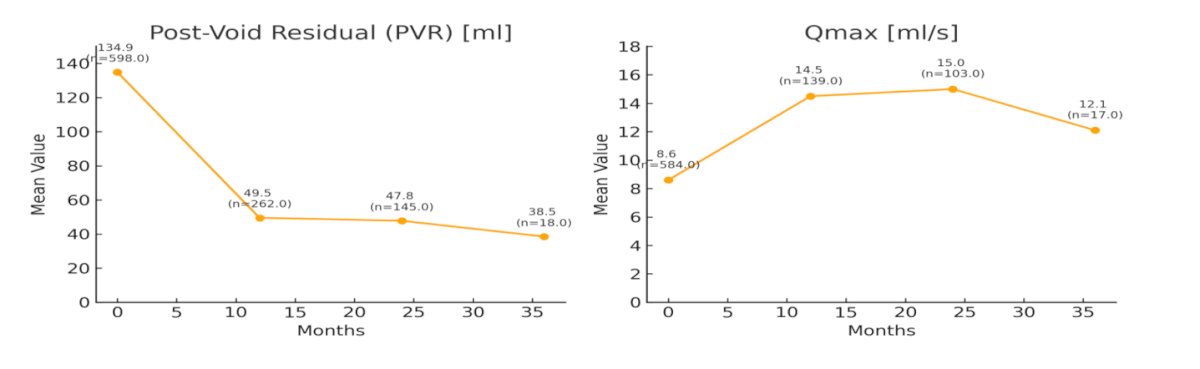
Figure 1.
IPSS scores decreased from a baseline mean of 22 to 9.6 at one year, remaining stable through three years. Quality of life (IPSS-QoL) scores and the BPH Impact Index (BPHII) also demonstrated sustained improvement over the study period (Figure 2).
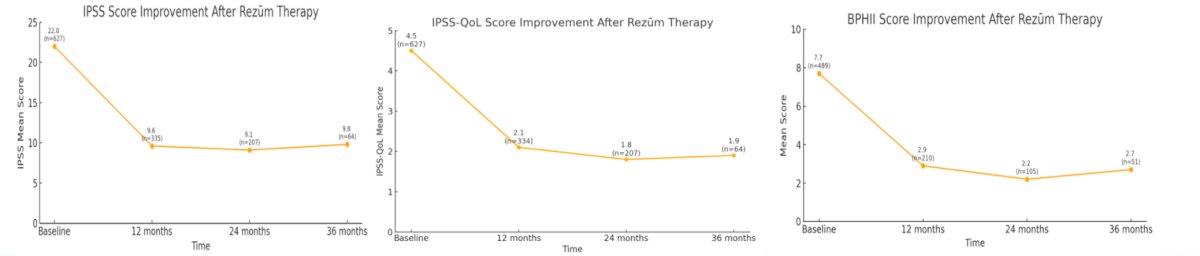
Figure 2.
In conclusion, Dr. Elterman emphasized that these results support the durability and safety of Rezūm therapy, particularly highlighting its minimal impact on erectile and ejaculatory function, as demonstrated through real-world data over three years of follow-up.
During the lively Q&A session that followed Dr. Dean Elterman’s presentation, audience members wasted no time diving into the real-world challenges of Rezūm therapy.
One attendee raised a familiar patient complaint: that patients often feel “MI-SER-A-BLE” for the first four to six weeks after treatment. They pressed Dr. Elterman on catheter duration and how Rezūm’s recovery compares to other minimally invasive BPH procedures.
Dr. Elterman acknowledged the tough early recovery, but stressed that with long-term data in hand, urologists can now better frame the short-term discomfort—dysuria and catheter use—as a worthwhile trade-off for durable symptom relief. Catheter duration, he explained, varies by prostate size: about 7 days for prostates under 80 cc, and 10–14 days for larger glands. Overall, he admitted, Rezūm patients generally need a catheter slightly longer than patients undergoing other procedures.
Another audience member asked whether patients who went back on medications after Rezūm were excluded from the study. They were not. “All-comers, nobody was censored,” Dr. Elterman said, adding that analyzing rates of medical reintervention would be a valuable secondary project.
Questions continued around outcomes for patients who initially presented in urinary retention. Dr. Elterman emphasized that these patients were included in the study and pointed out that catheter-free rates range from 70–100% by one month after Rezūm. However, he cautioned that patients in retention typically need catheter support a bit longer to allow the retention to resolve.
Finally, an audience member flagged the drop-off in uroflowmetry data—only 17 patients had flow rates measured at three years out of the original 712. Had the team considered remote flow monitoring? Dr. Elterman acknowledged the challenge of long-term follow-up, particularly during the COVID-19 pandemic, when much of their data collection had to shift remotely. He pointed to the growing potential of sound-based phone apps for uroflowmetry, noting that better remote technologies could transform how future BPH studies are conducted.
In closing, Dr. Elterman highlighted the sustained benefits of Rezūm therapy and its potential to offer patients significant symptom relief while maintaining sexual function over the long term.
Presented by: Dean S. Elterman, MD, MSc, FRCSC, University of Toronto
Written by: Tiffany Huang, MS3, University of California Irvine School of Medicine, @tiffvnyhuang on X during the 2025 American Urological Association (AUA) annual meeting held in Las Vegas, NV, Saturday, April 26 - Tuesday, April 29, 2025