

(UroToday.com) The 2025 AUA annual meeting featured a kidney cancer session and a presentation by Dr. Kazutaka Nakamura discussing a comparison of clinical outcomes between cabozantinib + nivolumab and lenvatinib + pembrolizumab in advanced renal cell carcinoma (RCC). Combination therapy with immune checkpoint inhibitors and tyrosine kinase inhibitors is used for advanced RCC. However, there is no direct comparative clinical trial, and evidence on the relative efficacy of these regimens remains lacking. Therefore, to provide better information for clinical decision-making regarding treatment selection, Dr. Nakamura and colleagues conducted a comparative analysis based on their experience with cabozantinib + nivolumab and lenvatinib + pembrolizumab in treating advanced RCC.
This retrospective analysis included 102 patients with advanced RCC treated with either cabozantinib + nivolumab or lenvatinib + pembrolizumab as first-line therapy at Tokyo Women's Medical University institution and affiliated facilities between April 2018 and May 2024 (analysis was conducted on 92 patients). Progression free survival, overall survival, objective response rate, and disease control rate were compared between treatment groups. Adverse events were assessed in both groups in all patients using the CTCAE version 5.0, and patients who underwent nephrectomy and had evaluable lesions (and thus became non-evaluable) were classified by their preoperative tumor response, unless progression occurred.
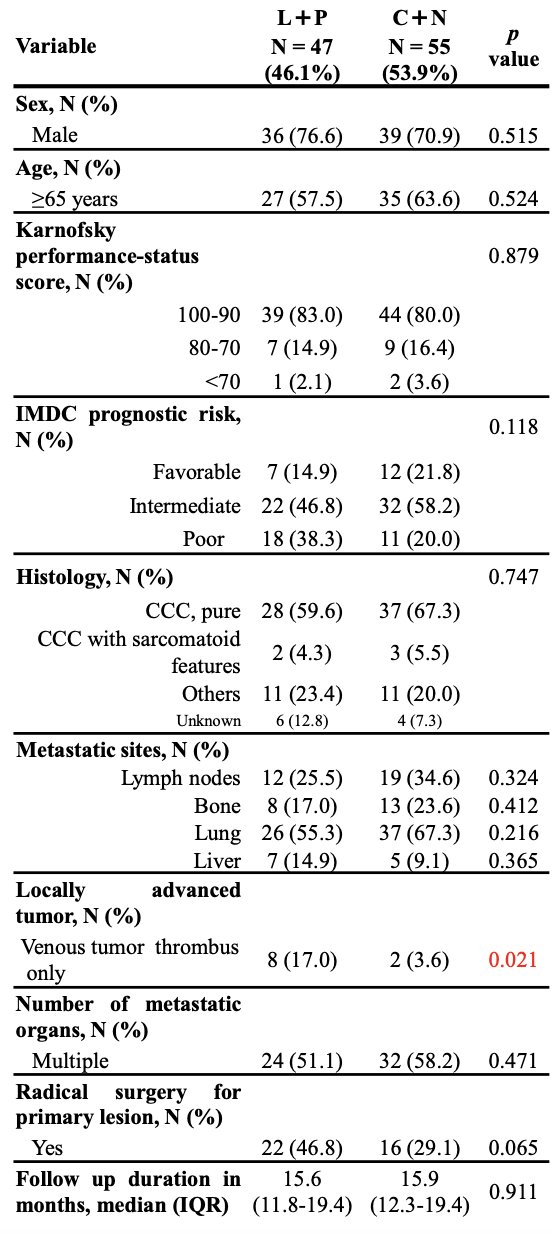
Over a median follow-up period of 13.5 months, 31 patients (31%) experienced disease progression, and 12 patients (12%) died due to cancer or other causes. Among the study population, 55 patients (54%) received cabozantinib + nivolumab, and 47 patients (46%) received lenvatinib + pembrolizumab. The lenvatinib + pembrolizumab group had more IMDC poor-risk patients and locally advanced tumors:
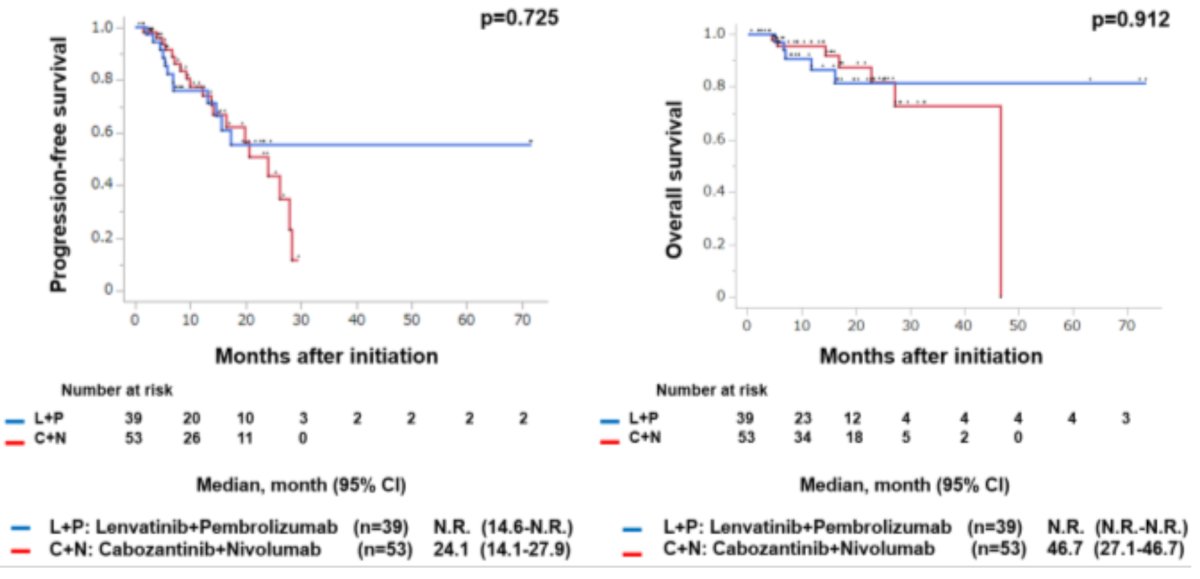
No significant differences were observed between groups for progression free survival and overall survival (median progression free survival: 24.1 months versus not reached, p = 0.725; overall survival: 46.7 months versus not reached, p = 0.912 for cabozantinib + nivolumab versus lenvatinib + pembrolizumab, respectively):
The objective response rate was significantly higher in the cabozantinib + nivolumab group (77% versus 43%, p = 0.004), while no significant difference was observed in the disease control rate (100% versus 96%, p = 0.076):
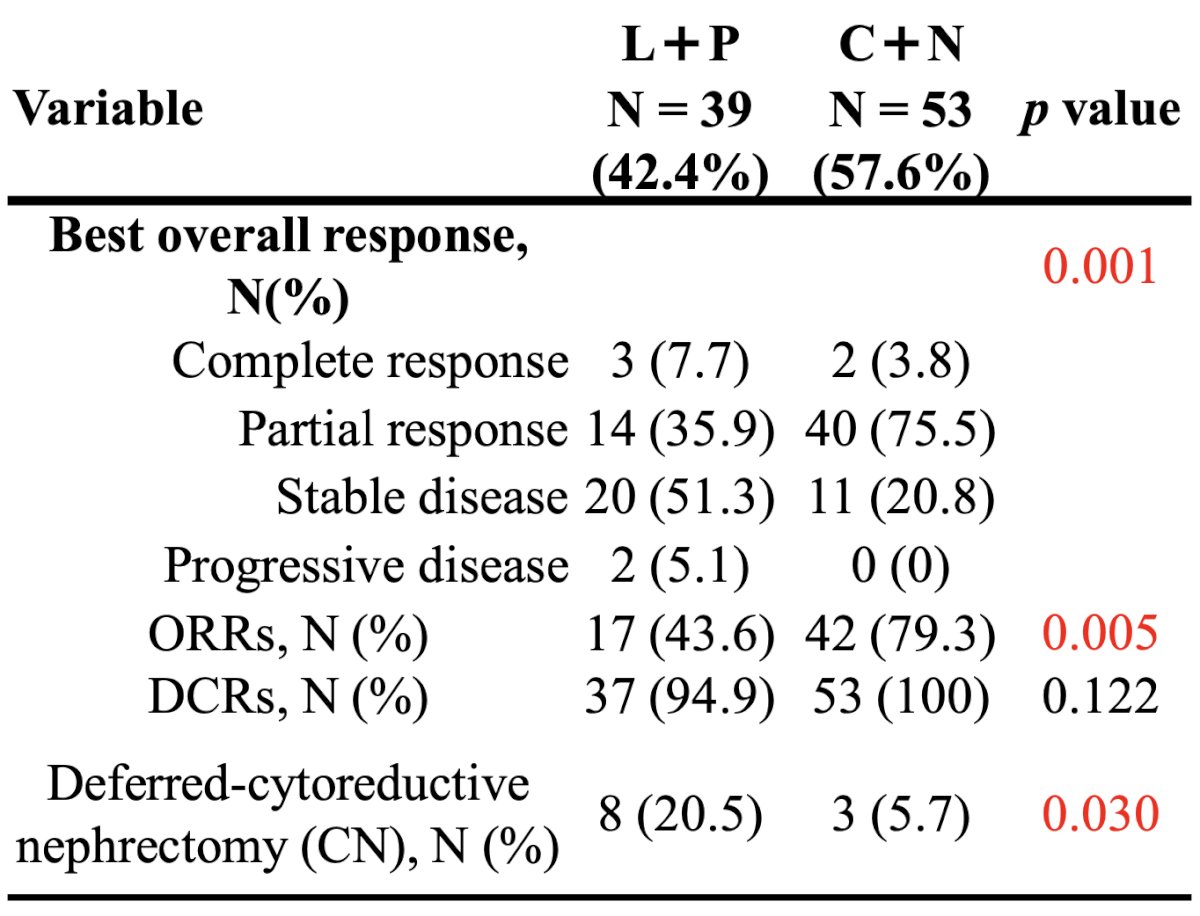
Incidences of adverse events due to tyrosine kinase inhibitors (78% versus 89%, p = 0.125) and immune-related adverse events due to immune checkpoint inhibitors (64% versus 49%, p = 0.135) were comparable between groups. Deferred cytoreductive nephrectomy was more frequent in the lenvatinib + pembrolizumab group (5.7% versus 20.5%, p = 0.03). In the multivariate analysis of progression free survival, deferred cytoreductive nephrectomy (HR 0.15, p = 0.018) and the favorable and intermediate IMDC risk groups (HR 0.20, p = 0.004) were identified as independent predictors, while no significant difference was observed between treatment regimens (HR 1.01, p = 0.974). A Swimmer plot for deferred cytoreductive nephrectomy showed 5/8 lenvatinib + pembrolizumab patients (63%) with stable disease:

Dr. Nakamura concluded his presentation discussing a comparison of clinical outcomes between cabozantinib + nivolumab and lenvatinib + pembrolizumab in advanced RCC with the following take home points:
- While objective response rate was significantly higher in the cabozantinib + nivolumab group, this difference may have been influenced by deferred cytoreductive nephrectomy
- No significant differences in progression free survival or overall survival were observed between the cabozantinib + nivolumab and lenvatinib + pembrolizumab regimens
- Further studies are warranted to better understand the relative efficacy of these regimens in advanced RCC
Written by: Zachary Klaassen, MD, MSc – Urologic Oncologist, Associate Professor of Urology, Georgia Cancer Center, Wellstar MCG Health, @zklaassen_md on Twitter during the 2025 American Urological Association (AUA) annual meeting held in Las Vegas, NV, Saturday, April 26 - Tuesday, April 29, 2025