

(UroToday.com) The American Urological Association (AUA) 2025 Annual Meeting, held in Las Vegas, NV, was host to an advanced kidney cancer moderated poster session. Dr. Chiara Re presented the results of an analysis of the impact of the timing of recurrence on survival outcomes and its potential implications for the postoperative management of a ‘KEYNOTE-564’-like population.
The KEYNOTE-564 trial demonstrated improved overall survival in patients with intermediate and high-risk clear cell renal cell carcinoma (ccRCC) treated with adjuvant pembrolizumab following either a radical or partial nephrectomy.1 Dr. Re argued that the timing of recurrence among risk categories varies and represents a key aspect for identifying the optimal follow-up strategy.
This study included 422 patients who underwent surgery for RCC between 2000 and 2023, and who would have met the eligibility criteria for the KEYNOTE-564 trial. Patients were stratified into recurrence groups as follows:
- Early: ≤6 months
- Mid: 6–18 months
- Late: >18 months
The primary outcomes were cancer-specific mortality (CSM) and overall survival (OS). Survival analyses using Kaplan-Meier curves and multivariable Cox regression modeling were used to evaluate the association between recurrence of timing and overall survival, adjusted for tumor and patient characteristics. Cancer-specific mortality was assessed using cumulative incidence curves and multivariable Fine-Gray competing risks analyses, with other causes of death as the competing event.
Of the 422 patients, 198 (47%) experienced a recurrence following surgery. There was an almost even split between early (34%), mid (33%), and late recurrences (32%). Time to recurrence was associated with worse overall survival and cancer-specific mortality outcomes:
- Overall mortality (per 3-month increase): HR=0.91, 95% CI 0.86–0.95, p<0.001
- Cancer-specific mortality: HR=0.96, 95% CI 0.93–0.99, p=0.02
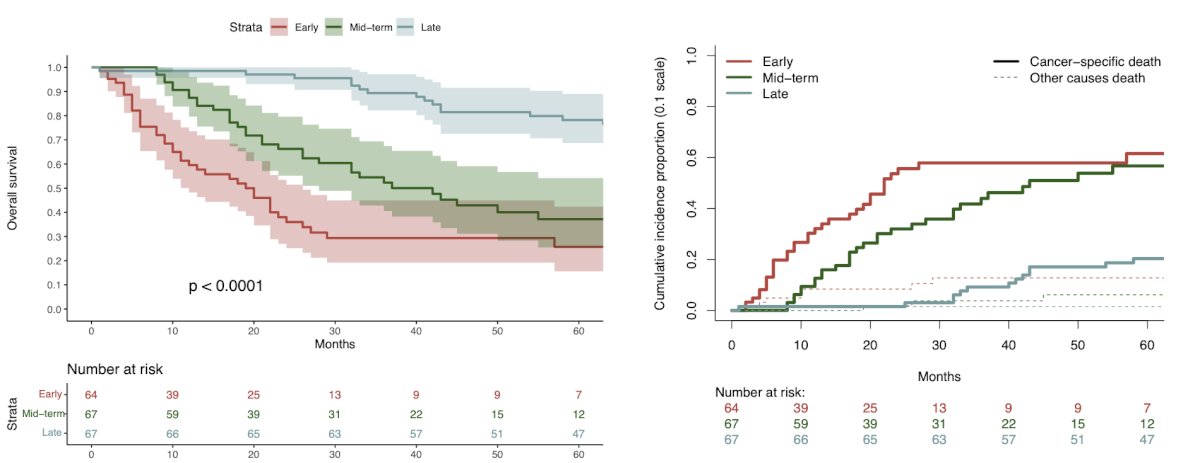
Dr. Re concluded as follows:
- Timing of recurrence, as a predictor of cancer-specific mortality and overall survival, is of paramount importance in clinical decision-making, especially for patients at intermediate and high-risk of recurrences
- Patients at risk of late recurrence may initially be considered for more conservative strategies
Presented by: Chiara Re, MD, Unit of Urology, Division of Experimental Oncology, Urological Research Institute, IRCCS San Raffaele Scientific Institute, Vita-Salute San Raffaele University, Milan, Italy
Written by: Rashid K. Sayyid, MD, MSc – Robotic Urologic Oncology Fellow at The University of Southern California, @rksayyid on Twitter during the 2025 American Urological Association (AUA) annual meeting held in Las Vegas, NV, Saturday, April 26 - Tuesday, April 29, 2025
References: