

(UroToday.com) At the Engineering and Urology Society (EUS) session, Nicolas Soputro presented a pioneering poster detailing the first reported case of transcontinental telesurgery using High-Intensity Focused Ultrasound (HIFU) for the treatment of localized prostate cancer. This case marks an important milestone in the globalization of focal cancer therapies, highlighting the potential to extend expert surgical care beyond geographic barriers.
In this study, a 72-year-old patient with ISUP Grade Group 2 prostate cancer and a solitary PI-RADS 4 lesion in the left mid-apical prostate underwent focal HIFU therapy. The remote procedure was performed across a distance of 7,091 miles (11,412 km) between Cleveland Clinic Abu Dhabi and Cleveland Clinic Ohio, leveraging an existing SD-WAN infrastructure with a measured round-trip latency of 115 milliseconds. Notably, the operation was conducted without any interruptions, according to Nicolas.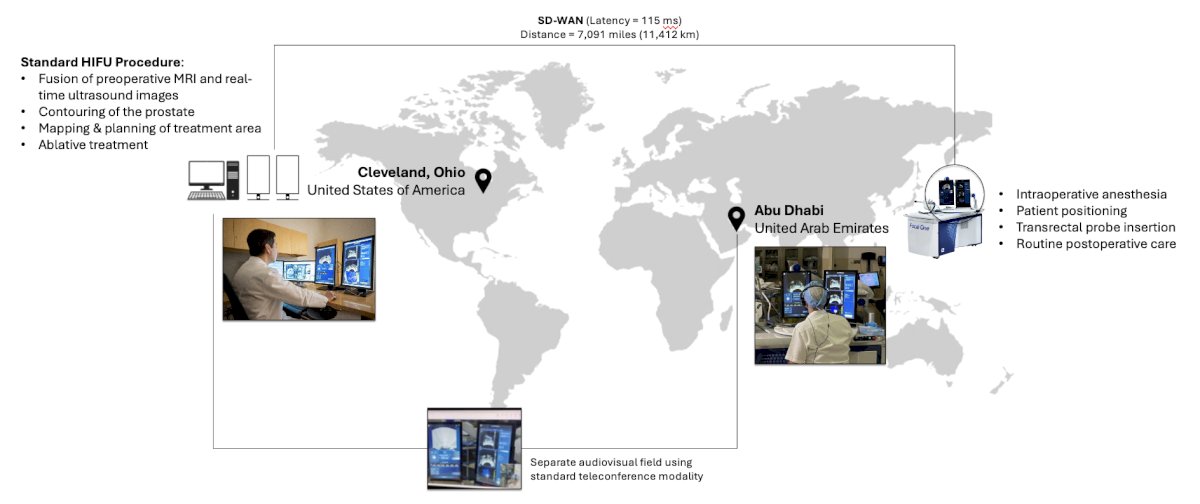
He then went on to describe the Focal One® HIFU device, which is equipped with a purpose-built virtual desktop that enables the remote surgeon to perform the treatment. Preoperative MRI images were fused with real-time ultrasound to plan and contour the ablation zone.
For the procedure, Standard HIFU protocols were followed, with a separate audiovisual field established using a standard teleconferencing platform. In terms of intraoperative data, the total operative time was 100 minutes, with 50 minutes dedicated to the ablation itself. Additionally, the total ablation volume reached 26.4 cm³. The patient was discharged the same day after a 4-hour hospital stay, experienced minimal postoperative pain (requiring no opioids), and had a Foley catheter removed after 5 days. No intraoperative or perioperative complications were reported.
Nicolas noted several advantages of HIFU telesurgery compared to other telesurgical modalities: greater portability and lower equipment costs, a favorable safety profile, and the ease of removing the transrectal ultrasound probe if needed. Also, there is no need for local expertise as the local team is strictly responsible for anesthesia and probe placement. Challenges include the continued need for local surgical support and troubleshooting capabilities during the procedure.
This successful case illustrates the feasibility and safety of HIFU-based telesurgery for managing clinically significant localized prostate cancer, setting the stage for future expansion of global remote surgical capabilities. When asked how the patient consented to such an advanced and experimental surgical technique, Nicolas answered by saying the surgeon, Dr. Ruben Olivares, had a longstanding relationship with them that helped to facilitate their consent to the procedure
Presented by: Nicolas A. Soputro, Department of Urology, Cleveland Clinic Main Campus, Cleveland, OH, USA.
Co-Authors: Waleed Hassan, Christopher J. Weight, Georges-Pascal Haber, Jihad Kaouk, Ruben Olivares.
Written by: Yezan Hadidi, BS, Department of Urology, University of California, Irvine. @yezanhadidi on X during the American Urological Association's 2025 Annual Meeting, between April 26 – 29, 2025 in Las Vegas, NV.