

(UroToday.com) While kidney stone removal is a standard clinical procedure, surgeons can encounter stones that lie in recessed areas that are challenging to reach. Particularly, stones which are present in the lower pole (accounting for 25-35% of all kidney stones)1 can be difficult due to anatomical constraints and the limited maneuverability of existing ureteroscopes and ureteroscopic tools. Mr. Connor and his team hypothesized that an independently steerable stone retrieval basket would provide improved access to difficult-to-reach kidney regions, enabling quicker stone removals compared to standard techniques.
Mr. Connor and his team at Vanderbilt designed, manufactured, and evaluated a stone retrieval device with an independently steerable tip based on recently invented concentric push-pull technology2. To demonstrate access, they performed an experiment where a user navigated the device through a porcine kidney to demonstrate reachability of all calyces and found that complete access was possible. To demonstrate usability and the potential to improve procedure times, a cohort of users (N=11, experience level ranging from novice to expert) used the device to remove as many stones as possible from the lower pole of a synthetic kidney simulator, both with and without our device. The stone capture rate for each trial was recorded.
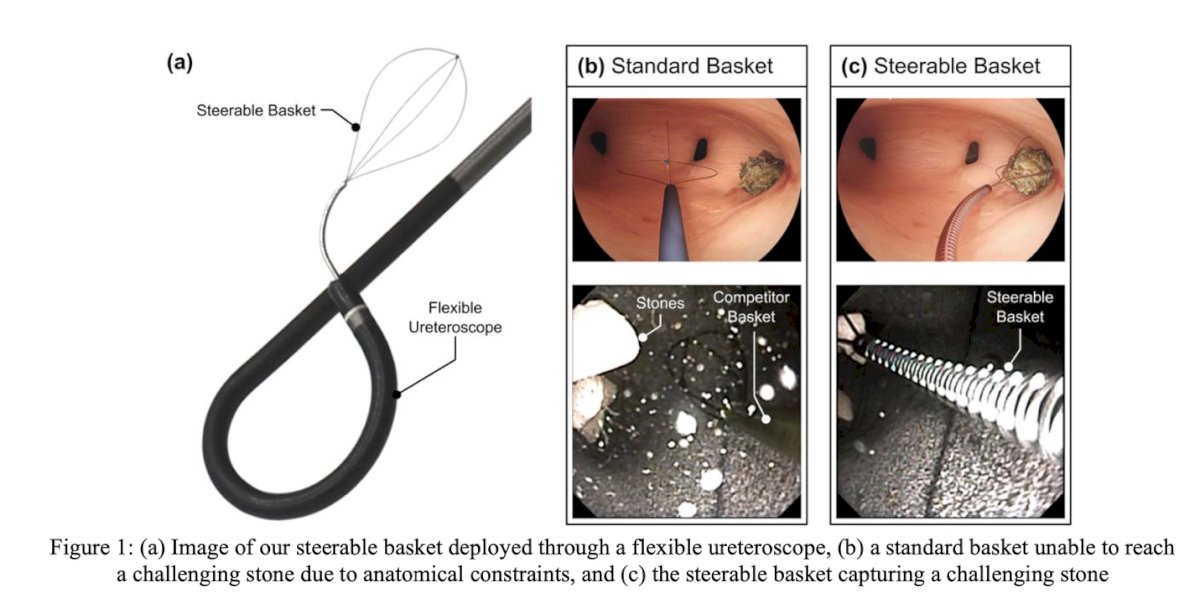
The team found that a user was able to deploy our basket into all calyces of the kidney without adverse effects (as confirmed by a post-operative inspection), even those in the lower pole. Users in the stone removal trials were able to remove lower pole stones significantly more rapidly using our device compared to standard techniques (2.7 ± 1.8 stones/min with our basket compared to 0.9 ± 0.10 stones/min with a standard basket).
The key takeaways from this study were that the device allows for:
- Increased reachability within the kidney to remove challenging stones
- Enables faster retrieval of more typical stones
Mr. Connor and his team at Vanderbilt, in conjunction with EndoTheia Inc, demonstrated that a steerable basket retrieval device can improve the process of stone retrieval.
Presented by: Peter Connor, Vanderbilt University, Nashville, TN, USA
Co-Authors: Joshua Gafford, Scott Webster, S. Duke Herrell, Nick Kavoussi, Kim Maciolek, Amy Reed, Kent Chevli, Jake Childs, Tyler Efird, and Robert J. Webster III
Written by: Eman Chaudhri, MD, Department of Urology, University of California, Irvine, @EmanChaudhri on Twitter during the American Urological Association's 2025 Annual Meeting, between April 26 – 29, 2025 in Las Vegas, NV.
References:- Ur Rehman O, Imran M, Rafaqat M, et al. Outcomes in Lower Pole Kidney Stone Management Using Mini-Percutaneous Nephrolithotomy Compared With Retrograde Intra Renal Surgery: A Randomized Controlled Trial. Cureus. 2023;15(2):e35343. Published 2023 Feb 23. doi:10.7759/cureus.35343
- Childs JA, Rucker C. A Kinetostatic Model for Concentric Push-Pull Robots. IEEE Trans. Robot. 2024;40:554-572. doi:10.1109/tro.2023.3327811