

(UroToday.com) The American Urological Association's 2025 Annual Meeting, between April 26 – 29, 2025, in Las Vegas, Nevada, was host to the IP24: Bladder Cancer: Invasive II Session. Dr. Kazutaka Nakamura delivered the presentation: Treatment Outcomes of Enfortumab Vedotin in Ineligible Patients from the EV-301 Trial.
Dr. Nakamura began his presentation by highlighting the EV-301 trial, a confirmatory, Phase 3, open-label, randomized controlled trial (NCT03474107) that enrolled patients with locally advanced or metastatic urothelial carcinoma who had previously received platinum-containing chemotherapy and experienced disease progression during or after treatment with a PD-1/PD-L1 inhibitor. Patients were randomized 1:1 to receive either enfortumab vedotin (EV) or the investigator’s choice of standard chemotherapy. The EV-301 trial demonstrated the efficacy of EV as a third-line treatment.
However, in real-world practice, patients who reach third-line treatment for advanced urothelial carcinoma often present with poor performance status at the time of treatment initiation, frequently making them ineligible for participation in clinical trials. To address this gap, Dr. Nakamura and colleagues evaluated treatment outcomes of EV in both EV-301–eligible and –ineligible patients and presented these real-world findings in their presentation.
The EV-301 excluded patients with an Eastern Cooperative Oncology Group (ECOG) performance status ≥2, baseline hemoglobin (Hb) levels <9 g/dL, or creatinine clearance <30 mL/min.
This study included 58 patients with locally advanced or metastatic urothelial carcinoma who received enfortumab vedotin as third-line or later therapy at Tokyo Women’s Medical University Hospital and its affiliated institutions between November 2021 and September 2024. Dr. Nakamura noted that patients were stratified based on eligibility criteria from the EV-301 trial, and key clinical outcomes including progression-free survival (PFS), overall survival (OS), objective response rate (ORR), disease control rate (DCR), and adverse events. These clinical outcomes were compared between the eligible and ineligible population groups.
During which 35 patients (60%) experienced disease progression, and 30 patients (52%) died from cancer or other causes.
A total of 58 patients were included in this analysis. Of these, 33 met the eligibility criteria of the EV-301 trial, while 25 were classified as ineligible. The median follow-up period was 8.4 months overall, with 9.3 months in the eligible cohort and 7.9 months in the ineligible cohort. Notably, there were significant differences in BMI between the two groups, with the eligible population having a higher median BMI (22.6) and a greater proportion of patients with visceral metastases (90.9% vs. 52%).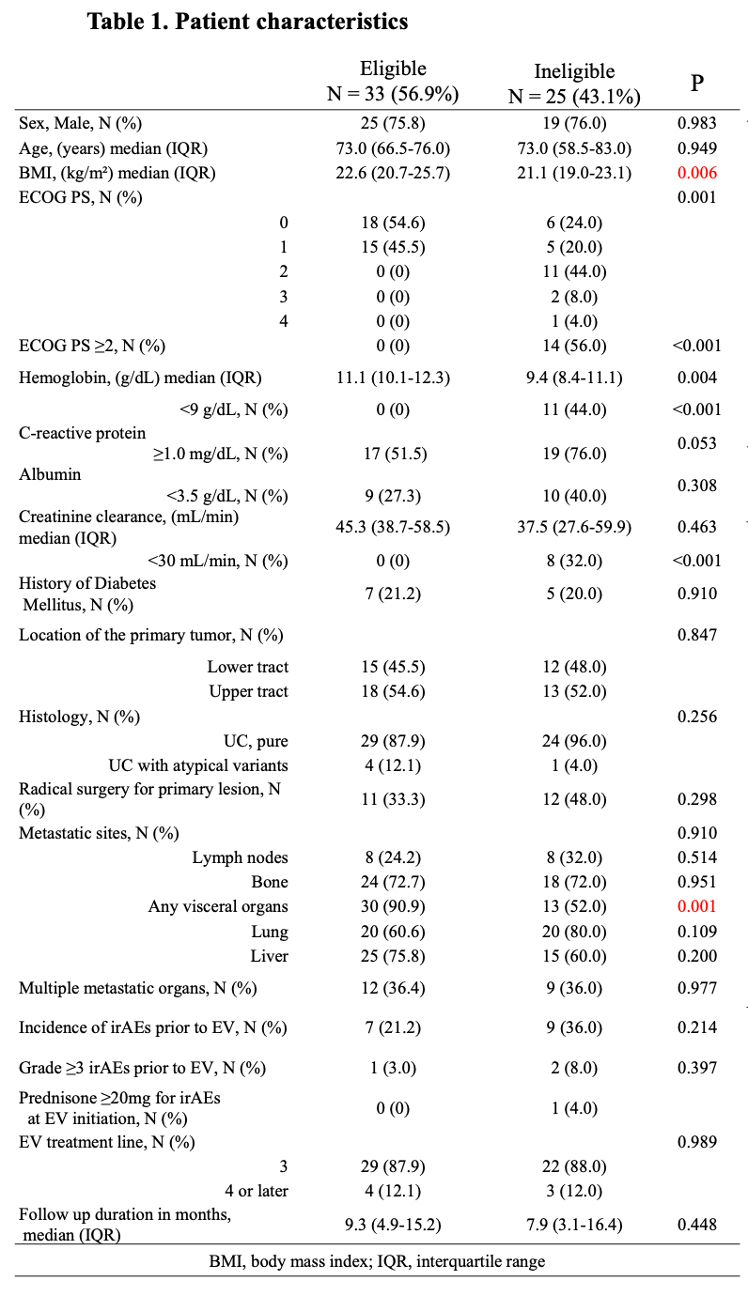
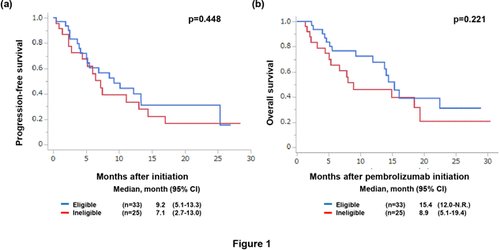
The investigators observed no significant difference in progression-free survival (PFS) between the eligible and ineligible groups (9.2 months vs. 7.1 months; P = 0.448), nor in overall survival (OS) (15.4 months vs. 8.9 months; P = 0.221).
Notably, the objective response rate (ORR) was significantly higher in the eligible group (54.5% vs. 28%, p=0.043). However, no significant difference was observed in the DCR between groups (78.8% vs. 80%; P = 0.910). Furthermore, in the subgroup analysis, 21 patients met one ineligibility criterion, whereas four met two or more criteria as listed in the table below.
Adverse events were more frequently observed in the eligible group compared to the ineligible group (90% vs. 64%; P = 0.012); however, there was no significant difference in the incidence of grade 3 or higher adverse events (9% vs. 8%; P = 0.883).
Dr. Nakamura concluded the presentation with the following key takeaways:
- This multicentric retrospective study suggests that patients deemed ineligible for the EV-301 trial, often considered to have a poor prognosis, may still achieve survival outcomes with EV that are comparable to those of trial-eligible patients.
- There were no significant differences in PFS, OS, or the incidence of grade 3 or higher adverse events between eligible and ineligible patients.
- EV treatment provides comparable efficacy and safety even in ineligible patients.
Presented by: Kazutaka Nakamura, MD, Department of Urology, Jyoban Hospital of Tokiwa Foundation, Iwaki, Japan.
Written by: Julian Chavarriaga, MD – Urologic Oncologist at Cancer Treatment and Research Center (CTIC) via Society of Urologic Oncology (SUO) Fellow at The University of Toronto. @chavarriagaj on Twitter during the American Urological Association's 2025 Annual Meeting, between April 26 – 29, 2025 in Las Vegas, NV.
Related content: Real-World EV-301 Data: Enfortumab Vedotin in Trial-Ineligible Patients - Kazutaka Nakamura
References
- Rosenberg JE, Powles T, Sonpavde GP, Loriot Y, Duran I, Lee JL, Matsubara N, Vulsteke C, Castellano D, Mamtani R, Wu C, Matsangou M, Campbell M, Petrylak DP. EV-301 long-term outcomes: 24-month findings from the phase III trial of enfortumab vedotin versus chemotherapy in patients with previously treated advanced urothelial carcinoma. Ann Oncol. 2023 Nov;34(11):1047-1054. doi: 10.1016/j.annonc.2023.08.016. Epub 2023 Sep 9. PMID: 37678672.